
Force on Charges
Here’s something strange: put a charged particle in a magnetic field and nothing happens. The particle just sits there. No force, no motion, no nothing.
Start that particle moving, though, and a force suddenly appears — and it acts in a bizarre direction. Not along the field. Not along the motion. Sideways to both.
This counterintuitive behavior is the essence of magnetic forces on charges. Once you’ve got the right-hand rule down and you’ve seen a few worked examples, it stops feeling weird and starts feeling consistent. Let’s build it up step by step.
The Key Insight: Motion Required
Compare electric and magnetic forces:
| Type | Does a stationary charge feel a force? |
|------|---------------------------------------|
| Electric force | Yes - just place it in an electric field |
| Magnetic force | No - the charge must be moving |
Why the difference? At a deep level, electric and magnetic fields are two aspects of the same phenomenon (electromagnetism), but for the MCAT, just remember: magnetic forces only act on moving charges.
The Magnetic Force Formula
This formula should remind you of the torque on a dipole (τ = pE sin θ). The sin θ factor keeps appearing because it captures “how much of the motion/orientation is perpendicular to the field.”
The Weirdest Part: The Force Is Sideways
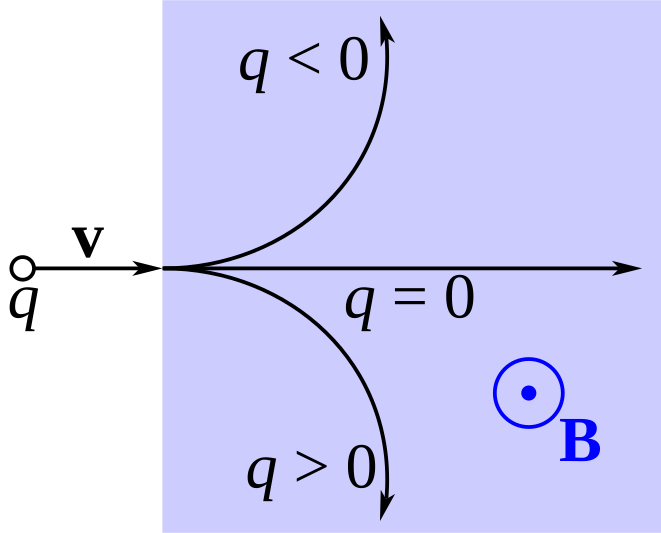
Here’s what trips up most students: the magnetic force doesn’t push the charge in the direction of the field, and it doesn’t push along the direction of motion. It pushes perpendicular to both.
Finding the Direction: The Right-Hand Rule
So the force is perpendicular to both velocity and field. But which perpendicular direction? There are two options (up or down, left or right, etc.). The right-hand rule tells you which.
Step-by-Step Instructions
- Hold up your right hand (this is important - not your left!)
- Point your fingers in the direction the charge is moving (velocity v)
- Curl your fingers toward the direction of the magnetic field (B)
- Your thumb now points in the direction of the force (F) - but ONLY for positive charges
For negative charges (like electrons): Do the right-hand rule, then flip the direction. The force on a negative charge is opposite to what the right-hand rule gives.
Practice Example
A proton moves to the right in a magnetic field pointing into the page.
- Point fingers right (velocity direction)
- Curl fingers into the page (field direction)
- Thumb points… up!
The force on the proton is upward.
A proton moving to the right enters a magnetic field pointing out of the page. Which way does the magnetic force initially push it?
Launch the proton in the simulation below and compare the red force arrow with your prediction. Then switch to an electron, or flip the field into the page, and watch the curve reverse direction. Adjust speed and field strength and note what each one does to the size of the circle.
Circular Motion in a Magnetic Field
Here’s a beautiful consequence of the sideways force: if a charged particle enters a magnetic field moving perpendicular to the field, it moves in a circle.
Why? Think about it:
- The force is always perpendicular to the velocity (sideways)
- A force perpendicular to motion doesn’t speed up or slow down the object - it just turns it
- The force keeps turning the particle, always perpendicular
- What shape has constant turning? A circle!
This is exactly like circular motion from centripetal force. The magnetic force provides the centripetal force that keeps the particle moving in a circle.
Finding the Radius
Since the magnetic force IS the centripetal force, we can set them equal:
Magnetic force = Centripetal force
Solve for :
What does this formula tell us?
- Heavier particles (larger ) → bigger circles
- Faster particles (larger ) → bigger circles
- More charge (larger ) → tighter circles
- Stronger field (larger ) → tighter circles
This is how mass spectrometers work: particles with different masses curve differently, allowing them to be separated and identified.
The “No Work” Rule
This is a crucial conceptual point that the MCAT loves to test.
Remember from work and energy that work is only done when a force has a component along the direction of motion:
For magnetic forces, the force is always perpendicular to the velocity. That means , and . So:
Velocity Selector: Combining Electric and Magnetic Forces
What if you want only particles traveling at a specific speed to pass through? Use a velocity selector.
Here’s the setup: create both an electric field AND a magnetic field in the same region, oriented perpendicular to each other. A charged particle enters and feels two forces:
- Electric force: (pushes in one direction, let’s say up)
- Magnetic force: (pushes in the opposite direction, down)
For particles at exactly the right speed, these forces cancel:
Solving for :
Particles traveling at this speed feel no net force and go straight through. Particles traveling faster or slower get deflected.
The force is directed upward. Using the right-hand rule: point your fingers to the right (velocity), curl them into the page (toward B). Your thumb points upward. Since the proton is a positive charge, the right-hand rule gives the correct direction directly.
Because the magnetic force is always perpendicular to the velocity, it does zero work (). With no work done, there is no change in kinetic energy, and therefore no change in speed. The force only changes the direction of the velocity vector, not its magnitude. This is why charged particles follow circular (not spiral) paths in uniform magnetic fields.