
EM Induction
In 1831, Michael Faraday discovered something that quite literally changed the world: a changing magnetic field can create an electric current — without any battery or power source. Move a magnet through a coil of wire and a current flows. Stop moving the magnet and the current stops. Move it the other way and the current reverses.
This is electromagnetic induction, and it’s the principle behind every electrical generator, every transformer in every power line, every induction cooktop, every wireless phone charger, and every MRI machine. Your wall outlets exist because Faraday figured this out.
If you’ve studied electric fields and magnetic fields, you know that these fields can exert forces on charges. Induction goes a step further: a changing magnetic field can actually create an electric field, which then pushes charges around a circuit.
Magnetic Flux
Before we can talk about induction, we need the concept of magnetic flux - the total amount of magnetic field passing through a surface.
Magnetic flux () through a surface is:
where = magnetic field (T), = area of the loop (m²), and = angle between and the normal (perpendicular) to the surface. The unit of flux is the weber (Wb), where 1 Wb = 1 T·m².
Flux is maximum when the field is perpendicular to the surface (, ) and zero when the field is parallel to the surface (, ).
Faraday’s Law (Conceptual)
Faraday’s law states that a changing magnetic flux through a loop induces an EMF (voltage) in the loop. The faster the flux changes, the larger the induced EMF.
Three ways to change flux (and induce an EMF):
- Change - move a magnet closer to or farther from the loop, or turn an electromagnet on/off.
- Change - expand or contract the loop (like pulling a wire through a field).
- Change - rotate the loop in the field (this is how generators work).
Lenz’s Law
Lenz’s law tells you the direction of the induced current: the induced current flows in a direction that opposes the change in flux that caused it.
Applying Lenz’s Law Step by Step
- Determine the direction of the external magnetic field through the loop.
- Determine whether the flux is increasing or decreasing.
- The induced current will create a magnetic field that opposes the change:
- If flux is increasing, the induced field opposes the external field (points opposite).
- If flux is decreasing, the induced field supports the external field (points same direction).
- Use the right-hand rule to find the current direction that produces the needed induced field.
Example
A bar magnet with its north pole pointing down is dropped toward a horizontal loop of wire. The downward magnetic flux through the loop is increasing. By Lenz’s law, the induced current must create an upward magnetic field to oppose the increase. Using the right-hand rule, this means the current flows counterclockwise when viewed from above.
Applications
Generators
A generator is the reverse of a motor. A motor takes current and produces rotation. A generator takes rotation and produces current. Spinning a wire loop in a magnetic field continuously changes the flux (by changing θ), inducing an alternating EMF. That’s the basis of AC power generation at every power plant.
Transformers
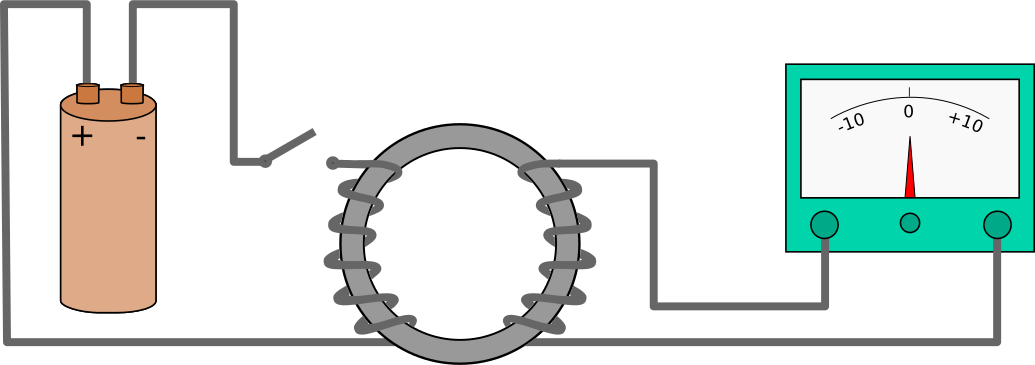
A transformer uses electromagnetic induction to change the voltage of AC power. Two coils (primary and secondary) are wound around a shared iron core. Alternating current in the primary coil creates a changing magnetic field, which induces an EMF in the secondary coil.
The voltage ratio depends on the number of turns:
A step-up transformer () increases voltage. A step-down transformer () decreases voltage. Energy is conserved (ideally): if voltage goes up, current goes down proportionally.
Eddy Currents
When a conducting material (not just a wire loop) is exposed to a changing magnetic field, induced currents swirl through the bulk of the material. These are called eddy currents. They oppose the change in flux (Lenz’s law) and dissipate energy as heat. Eddy currents are why:
- A metal pendulum swinging between the poles of a magnet slows down rapidly.
- Induction cooktops heat metal pots without a flame.
- Electromagnetic brakes work without friction pads.