
Magnetic Fields
Stick a compass on a table and the needle swings to point north. Hold a strong magnet nearby and the needle snaps toward the magnet instead. The compass is responding to magnetic fields — invisible vector fields that exert forces on moving charges and magnetic materials.
Magnetic fields differ from electric fields in one fundamental way: while electric fields can be produced by stationary charges, magnetic fields are fundamentally tied to motion — moving charges, electric currents, or the intrinsic “spin” of electrons. No motion, no magnetism. (The MRI machine in a hospital generates its enormous magnetic field by running massive electric currents through superconducting coils.)
Magnetic Field Lines
Magnetic field lines describe the direction and strength of the magnetic field, following rules similar to electric field lines:
- Outside a bar magnet, field lines emerge from the north pole and curve around to enter the south pole.
- Inside the magnet, lines run from south to north (they form continuous closed loops - they never start or stop).
- Field lines never cross.
- The density of field lines represents field strength. Lines are densest near the poles.
Sources of Magnetic Fields
Bar Magnets
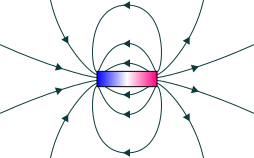
A bar magnet produces the classic dipole field pattern. Every magnet has both a north and south pole. Break a magnet in half and you get two smaller magnets, each with its own north and south pole. There’s no such thing as an isolated magnetic pole (magnetic monopole).
Current-Carrying Wires
A straight wire carrying current produces circular magnetic field lines that loop around the wire. The direction follows the right-hand rule.
The field strength around a straight wire decreases with distance from the wire (proportional to , not ). You won’t need this formula for the MCAT, but you should know qualitatively that the field is strongest close to the wire.
Current Loops and Solenoids
Bend a current-carrying wire into a loop and the magnetic field looks like that of a tiny bar magnet. Stack many loops together into a coil (solenoid) and you get a strong, nearly uniform field inside. This is how electromagnets work - and it’s the basis of MRI machines, electric motors, and speakers.
Paramagnetism vs. Diamagnetism
The AAMC specifically lists these two forms of magnetism. Both describe how materials respond to an external magnetic field.
Paramagnetism: Materials with unpaired electrons (like iron, aluminum, and oxygen). The unpaired electrons act like tiny magnets that weakly align with an external field, causing the material to be slightly attracted. When the external field is removed, the alignment is lost. Think of paramagnetic atoms as compass needles that align with the field but have no memory.
Diamagnetism: Materials with all electrons paired (like copper, gold, water, and most organic molecules). An external field induces a tiny opposing magnetic moment in each atom, causing the material to be very weakly repelled. Diamagnetism is present in all materials but is extremely weak and usually masked by paramagnetism or ferromagnetism when those are present.
| Property | Paramagnetic | Diamagnetic |
|---|---|---|
| Electrons | Unpaired electrons present | All electrons paired |
| Response to external field | Weakly attracted | Very weakly repelled |
| Without external field | No net magnetism | No net magnetism |
| Examples | , , Al | , Cu, Au, most organic molecules |
Earth’s Magnetic Field
The Earth itself acts like a giant bar magnet. The geographic north pole is near the magnetic south pole (which is why the north-seeking end of a compass points toward geographic north - it’s attracted to the magnetic south pole). The Earth’s field protects us from charged particles in the solar wind by deflecting them toward the poles, producing auroras.