We know that increasing the temperature speeds up nearly all reactions. But by how much? The Arrhenius equation gives us the precise mathematical relationship between the rate constant k, the temperature T, and the activation energy Ea.
The Equation
Understanding the Variables
The frequency factor (A) represents how often molecules collide with the correct orientation. It depends on the physical characteristics of the molecules (size, shape) and the concentration. A larger A means more frequent, correctly oriented collisions.
The exponential term (e^(-Ea/RT)) represents the fraction of molecules that have enough energy to overcome the activation energy barrier. This fraction is always between 0 and 1.
How Temperature Affects k
The key to understanding the Arrhenius equation on the MCAT is the exponent -Ea/RT:
Increasing T makes the denominator RT larger, making Ea/RT smaller, making -Ea/RT less negative (closer to zero). Since e⁰ = 1, the exponential term gets larger, so k increases.
Increasing Ea makes Ea/RT larger, making -Ea/RT more negative. Since e^(-large number) is tiny, k decreases.
As T approaches infinity, -Ea/RT approaches zero, and k approaches A (the maximum possible rate constant).
The Arrhenius Plot
Taking the natural log of both sides of the Arrhenius equation gives a linear form:
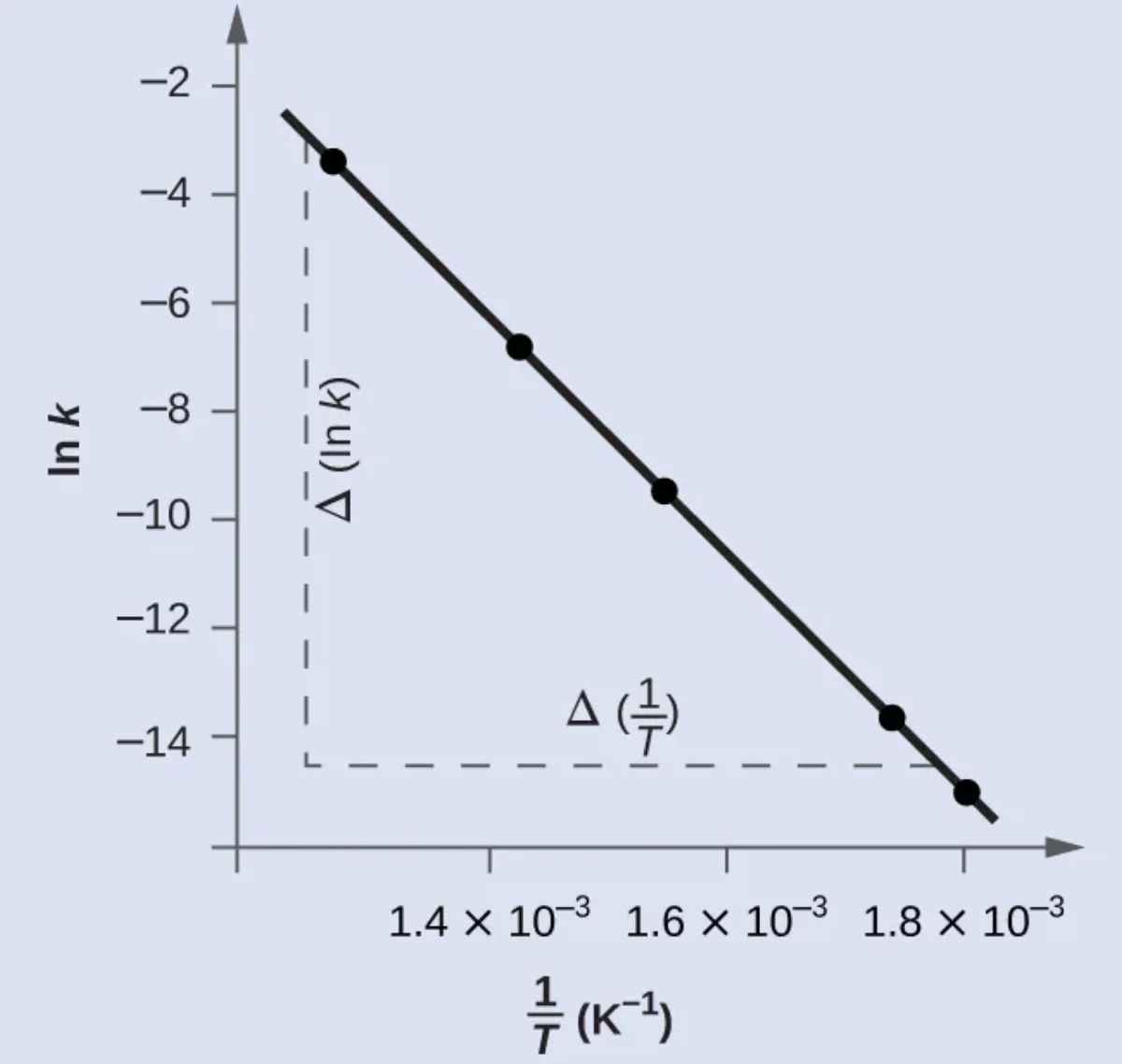
Plotting ln(k) vs. 1/T gives a straight line. The slope is -Ea/R, so you can determine the activation energy from the slope:
Ea = -slope x R
A steeper (more negative) slope means a higher activation energy. The reaction is more sensitive to temperature changes.
An Arrhenius plot: ln(k) vs. 1/T gives a straight line with slope = -Ea/R. The dashed lines show how to calculate the slope from Δ(ln k) / Δ(1/T). Credit: OpenStax Chemistry 2e, CC BY 4.0
The Two-Point Form
If you know the rate constant at two different temperatures, you can find Ea without plotting:
On an Arrhenius plot (ln k vs. 1/T), what does the slope represent?
Click to reveal answer
Slope = -Ea / R. The slope is always negative (k increases with temperature, and 1/T decreases with temperature). A steeper slope indicates a larger activation energy. Ea can be calculated as Ea = -slope x R.
Two reactions have the same frequency factor A, but Reaction 1 has Ea = 50 kJ/mol and Reaction 2 has Ea = 100 kJ/mol. Which reaction is faster at 300 K?
Click to reveal answer
Reaction 1 is faster. A lower activation energy means the exponential term e^(-Ea/RT) is larger, giving a larger rate constant k. Since both reactions have the same A, the one with lower Ea has the larger k and therefore proceeds faster.