
Capillary Exchange
Every cell in your body needs oxygen and nutrients delivered and waste products removed. This exchange does not happen in arteries or veins - it happens exclusively at the capillary level. Understanding how fluid and solutes move across capillary walls is essential for the MCAT and for understanding conditions like edema (swelling).
The Tug-of-War at the Capillary Wall
Fluid movement across capillary walls is governed by two opposing forces:
The Four Starling Forces
There are actually four pressures at play, though two dominate:
| Force | Direction | Typical Value | Description |
|---|---|---|---|
| Capillary hydrostatic pressure (Pc) | Pushes fluid OUT | ~35 mmHg (arteriole end) → ~15 mmHg (venule end) | Blood pressure pushing fluid through the capillary wall |
| Interstitial hydrostatic pressure (Pi) | Pushes fluid IN (opposes filtration) | ~0 mmHg (often negligible) | Pressure of fluid already in the tissue space |
| Capillary oncotic pressure (πc) | Pulls fluid IN | ~25 mmHg (relatively constant) | Osmotic pull of plasma proteins (mainly albumin) |
| Interstitial oncotic pressure (πi) | Pulls fluid OUT | ~1 mmHg (usually small) | Osmotic pull of proteins in the interstitial fluid |
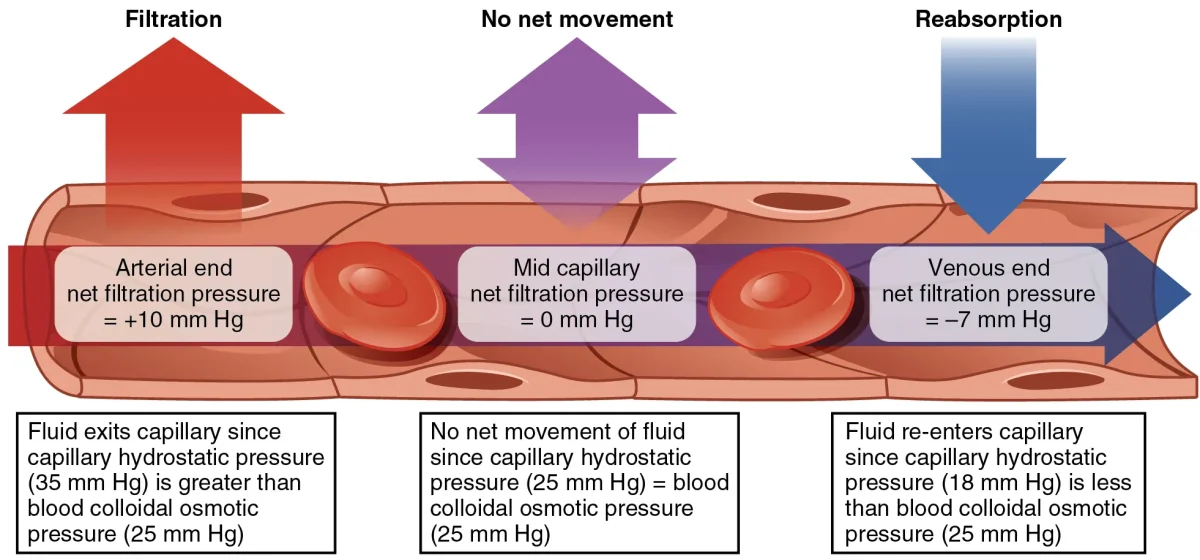
What Happens at Each End
At the arteriole end:
- Capillary hydrostatic pressure (~35 mmHg) > oncotic pressure (~25 mmHg)
- Net filtration - fluid moves OUT of the capillary into the interstitial space
- This delivers oxygen, glucose, and other nutrients to cells
At the venule end:
- Capillary hydrostatic pressure (~15 mmHg) < oncotic pressure (~25 mmHg)
- Net reabsorption - fluid moves back INTO the capillary
- This picks up CO2, urea, and other waste products
About 85% of the filtered fluid is reabsorbed at the venule end. The remaining 15% (~3 liters per day) is picked up by the lymphatic system and returned to the venous circulation.
Edema: When the Balance Breaks
Edema (tissue swelling) occurs when more fluid leaves capillaries than returns. There are four main causes, each linked to a Starling force:
| Cause | Starling Force Affected | Example |
|---|---|---|
| Increased capillary hydrostatic pressure | More fluid pushed out | Heart failure (blood backs up, raising venous/capillary pressure) |
| Decreased plasma oncotic pressure | Less fluid pulled back in | Liver failure or nephrotic syndrome (low albumin production or loss) |
| Increased capillary permeability | Proteins leak out, pulling fluid with them | Inflammation, burns, allergic reactions |
| Blocked lymphatic drainage | Filtered fluid cannot return | Lymphedema after lymph node removal, parasitic infection (elephantiasis) |
Bulk Flow vs. Diffusion
Do not confuse bulk flow (Starling forces) with diffusion:
- Bulk flow moves large volumes of fluid across capillary walls. It is driven by pressure gradients (hydrostatic and oncotic). This is what Starling forces describe.
- Diffusion moves individual molecules (O2, CO2, glucose) down their concentration gradients. It is the primary mechanism for gas and nutrient exchange. O2 diffuses from blood (high PO2) to tissues (low PO2). CO2 diffuses the opposite direction.
Both processes happen simultaneously at the capillary level, but they are driven by different forces.