
Collision Theory
Why do reactions happen at all? At the molecular level, the answer is simple: molecules must collide. But not just any collision will do. Collision theory lays out the rules for what makes a collision productive.
The Two Requirements for an Effective Collision
For a collision between reactant molecules to produce products, two conditions must be met simultaneously:
1. Sufficient energy. The colliding molecules must have a combined kinetic energy equal to or greater than the activation energy (). If they collide too gently, they simply bounce off each other unchanged.
2. Correct orientation. The reactive parts of the molecules must be facing each other during the collision. A molecule of A might need to collide with the oxygen end of molecule B, not the nitrogen end.
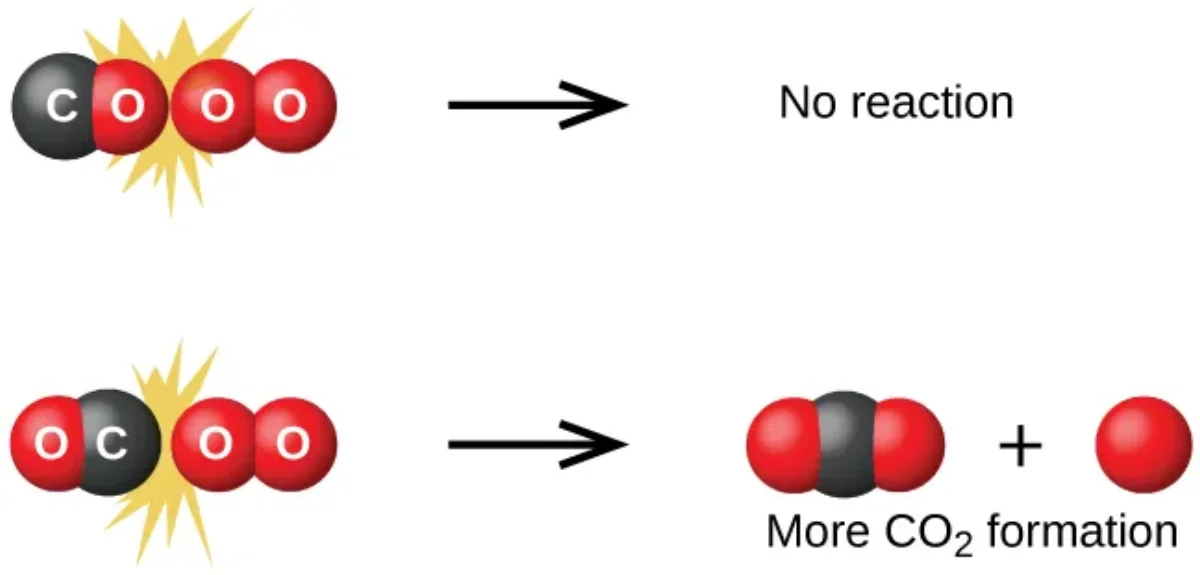
Collisions that meet both requirements are called effective collisions (or productive collisions). Only effective collisions lead to product formation.
The Rate Equation from Collision Theory
Factors That Increase the Collision Rate
Collision theory directly explains why each of these factors increases reaction rate:
Concentration: More molecules in a given volume means more collisions per second (Z increases). This is why increasing concentration usually increases rate - except for zero-order reactions, where the bottleneck is elsewhere.
Temperature: Temperature has a double effect. First, molecules move faster, so they collide more frequently (Z increases slightly). Second, and much more importantly, a higher fraction of molecules have enough energy to exceed (f increases dramatically). The temperature effect is dominated by the energy factor.
Surface area (for heterogeneous reactions): Grinding a solid into a fine powder exposes more surface for collisions. This is why powdered sugar dissolves faster than sugar cubes.
Medium and viscosity: The physical environment of the reaction affects how freely molecules can move and collide. In a low-viscosity medium like water, molecules diffuse quickly and collide often. In a high-viscosity medium like glycerol or a thick gel, molecular movement is restricted, collisions are less frequent, and the reaction slows down. This is one reason biological reactions rely on enzymes - in the crowded, viscous environment of the cytoplasm, uncatalyzed collisions would be too infrequent to sustain life.
The Maxwell-Boltzmann Distribution
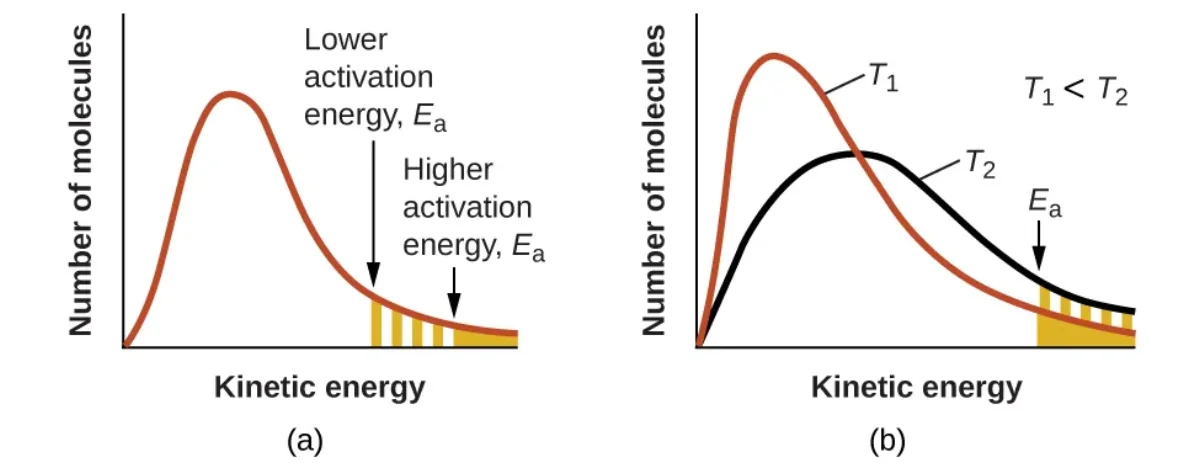
At any given temperature, not all molecules move at the same speed. The Maxwell-Boltzmann distribution describes the range of kinetic energies in a sample of gas molecules.
At a given temperature, some molecules move slowly, most move at moderate speed, and a few move very fast. The area under the curve to the right of represents the fraction of molecules with enough energy to react.
When temperature increases:
- The peak of the distribution shifts to the right (higher average energy)
- The curve broadens and flattens
- The area to the right of increases significantly
- More molecules can clear the activation energy barrier
Collision Theory vs. Transition State Theory
Collision theory and transition state theory are two models that explain the same phenomenon from different perspectives:
| Feature | Collision Theory | Transition State Theory |
|---|---|---|
| Focus | Energy and orientation of collisions | Energy profile along the reaction path |
| Key concept | Effective collisions | Activated complex (transition state) |
| Approach | ”All-or-nothing” - either there is enough energy or there is not | Continuous energy profile from reactants to products |
| Best for | Explaining why rate depends on concentration and temperature | Explaining reaction coordinate diagrams and catalysis |
Both theories require the activation energy to be overcome. They are complementary, not contradictory.