A child on a swing. A mass bouncing on a spring. A plucked guitar string. The atoms in a molecule vibrating against their bonds. All of these are examples of simple harmonic motion (SHM) — one of the most fundamental types of periodic motion in physics.
The MCAT tests SHM with relentless focus on two questions: what determines the period, and what does the energy do? Get these two pieces and you can answer almost any SHM question — and avoid the classic traps the exam loves to set.
What Makes Motion “Simple Harmonic”?
Simple harmonic motion happens whenever a restoring force is proportional to displacement and directed back toward the equilibrium position. Pull a mass to the right of equilibrium on a spring, and the spring pulls left. Push it to the left, the spring pushes right. The farther you displace it, the harder the spring pulls back.
🎯 Predict First
A mass on a spring is pulled twice as far from equilibrium before being released. What happens to the period of its oscillation?
Use the simulation below to watch a spring and a pendulum oscillate side-by-side. Adjust mass, spring constant, length, and gravity to see how each variable changes the period — and pay close attention to which variables surprisingly don’t matter.
Amplitude
Spring
Pendulum
Hooke’s Law
The spring is the canonical SHM system. Hooke’s law gives the restoring force:
A spring with large k (stiff) takes a lot of force to stretch and snaps back hard. A spring with small k (soft) stretches easily and returns gently. (Full Hooke’s law treatment in §2.5.)
Period of a Mass-Spring System
Period of a Simple Pendulum
The Critical MCAT Trap: What Does NOT Affect the Period?
This is the single most-tested SHM concept.
Energy in SHM
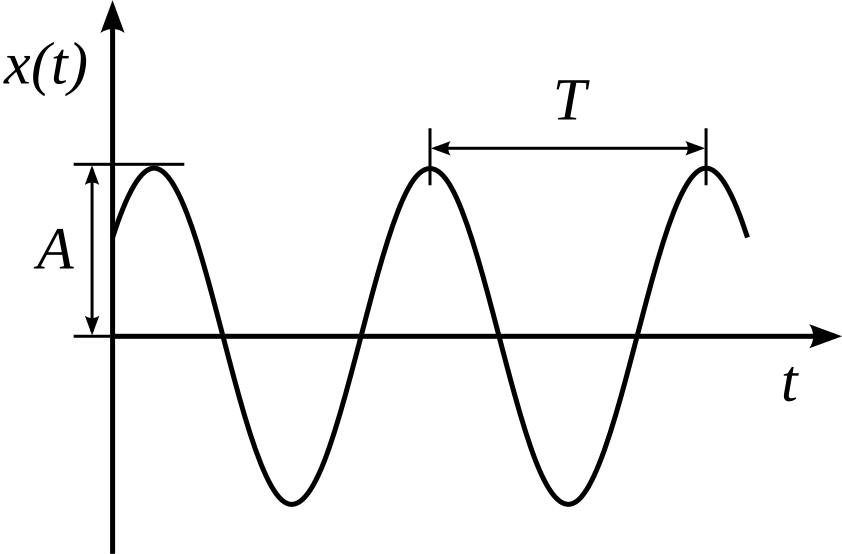
SHM plotted over time. Displacement is sinusoidal. Velocity is maximum at equilibrium (zero displacement) and zero at the extremes. Acceleration always points opposite to displacement — the hallmark of a restoring force. Credit: Wikimedia Commons, CC BY-SA
In an ideal (frictionless) SHM system, total mechanical energy is conserved. Energy oscillates between kinetic and potential forms:
At maximum displacement (amplitude): all PE (PEspring=21kx2 is maximum). KE = 0. Velocity = 0.
At equilibrium (x=0): all KE (21mv2 is maximum). PE = 0. Velocity is maximum.
In between: mix of KE and PE, with KE+PE = constant.
| Position | Displacement | Velocity | KE | PE |
|----------|-------------|----------|----|----|
| Maximum displacement (±A) | Maximum | 0 | 0 | Maximum |
| Equilibrium (x=0) | 0 | Maximum | Maximum | 0 |
A 2 kg mass hangs on a spring with k=200 N/m. What is the period? If the mass is replaced with 8 kg, what happens to the period?
Click to reveal answer
T≈0.63 s for 2 kg; T≈1.26 s for 8 kg.T=2πm/k. With 2 kg: T=2π0.01≈0.63 s. With 8 kg: T=2π0.04≈1.26 s. Quadrupling mass doubles the period (because T∝m).
A pendulum has period 2 s. If the bob’s mass is doubled, what’s the new period? If the length is quadrupled, what’s the new period?
Click to reveal answer
Mass doubled: still 2 s. Pendulum period doesn’t depend on mass. Length quadrupled: 4 s.T=2πL/g. Quadrupling L doubles T (4=2).
A mass on a spring oscillates with amplitude A. At what point is velocity greatest? At what point is the restoring force greatest?
Click to reveal answer
Velocity max at x=0 (equilibrium); restoring force max at x=±A (extremes). Velocity peaks at equilibrium where all energy is kinetic. Force peaks at maximum displacement (since F=−kx). When one is max, the other is zero — they’re 90° out of phase.