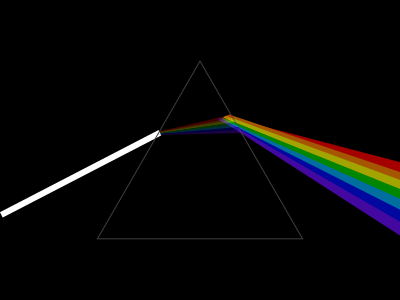
Shine a narrow beam of white light through a glass prism and a rainbow fans out the other side. Isaac Newton first did this experiment in the 1660s and proved something that surprised everyone: white light isn’t a single color — it’s a mixture of every visible wavelength traveling together.
The prism doesn’t add color to the light. It reveals what was already there by bending each wavelength by a slightly different amount. That phenomenon is dispersion, and it explains rainbows, prisms, the colors at the edges of cheap binoculars, and a class of lens problems called chromatic aberration.
Why Dispersion Happens
The index of refraction of a material isn’t a single fixed number — it depends slightly on the wavelength of light passing through. Shorter wavelengths (violet, blue) experience a higher index than longer wavelengths (red, orange).
Since higher n means light slows down more and bends more, violet bends the most and red bends the least when going through a prism.
Prisms
Dispersion through a prism. Each wavelength has a slightly different index in glass, so each color refracts by a slightly different angle. Violet bends the most; red bends the least. Credit: Wikimedia Commons, CC BY-SA
When white light enters a prism, each wavelength refracts by a slightly different angle. The small differences add up — especially because the light refracts twice (once entering the prism, once exiting). The exit beam is the visible spectrum spread out in order: red, orange, yellow, green, blue, violet.
Rainbows
Rainbows are dispersion in the wild. Sunlight enters a spherical raindrop, refracts at the front surface (slightly separating the colors), reflects off the back surface, and refracts again on the way out. The two refractions amplify the color separation. Each color exits the raindrop at a slightly different angle — red exits at ~42° from the anti-solar point, violet at ~40°. That’s why you see red on the outside of the rainbow arc and violet on the inside.
White light passes through a glass prism. Which color is refracted the most? Which the least?
Click to reveal answer
Violet most; red least. Violet has the shortest visible wavelength → highest n in glass → most bending. Red has the longest wavelength → lowest n → least bending.
In a rainbow, why is red on the outside (top) of the arc and violet on the inside (bottom)?
Click to reveal answer
Because dispersion in raindrops bends violet more than red. Sunlight enters each raindrop and is refracted/reflected/refracted before exiting at different angles per color. Red emerges at ~42° from the antisolar point; violet at ~40°. Geometrically that puts red on the outside (larger angle) and violet on the inside (smaller angle).