
The Electromagnetic Spectrum
Your microwave heats leftovers. A radio tower broadcasts to your car. A hospital X-ray images your broken wrist. Your phone uses gigahertz signals to talk to a cell tower. The sun warms your face with infrared.
These look like completely different technologies — but they’re all the same thing: electromagnetic (EM) waves traveling at the speed of light. The only difference between a radio wave and a gamma ray is the wavelength.
That single fact is the punch of this section. Once you internalize that the entire electromagnetic spectrum is just one phenomenon at different wavelengths, the rest of optics — and a lot of biology, chemistry, and medical imaging — clicks into place.
What Are Electromagnetic Waves?
An EM wave is a pair of oscillating fields — one electric, one magnetic — that travel together through space at right angles to each other and to the direction of motion. Neither field needs a medium to oscillate in. Unlike sound (which requires air or water or some material), light can cross the vacuum of space — which is how sunlight reaches Earth across 93 million miles of nothing.
Key properties of all EM waves:
- They are transverse waves (oscillation perpendicular to propagation).
- The electric and magnetic fields are perpendicular to each other.
- They travel at the speed of light in vacuum: m/s.
- They do not require a medium — they can travel through vacuum.
- They carry energy and can transfer it to matter (think solar panels, X-ray exposure, sunburns).
The Fundamental Equation
This one equation tells you everything about the trade-off between frequency and wavelength. Double the frequency, halve the wavelength. Know one, you know the other.
The Spectrum: From Low Energy to High Energy
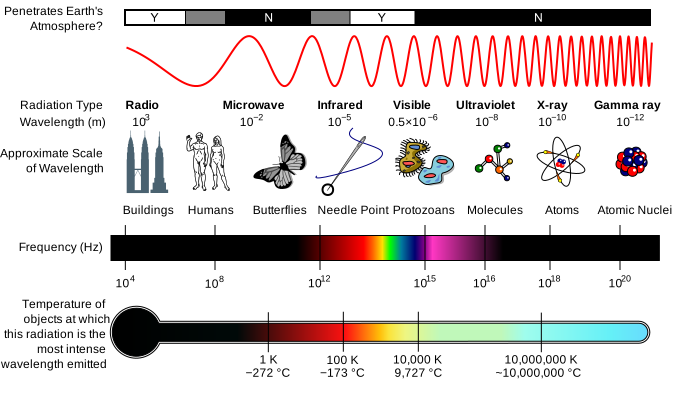
The EM spectrum arranged from longest wavelength to shortest:
| Region | Wavelength range | Frequency range | Common use |
|---|---|---|---|
| Radio | > 1 m | < Hz | AM/FM radio, TV, broadcast |
| Microwave | 1 mm – 1 m | – Hz | Microwave ovens, cell phones, WiFi |
| Infrared (IR) | 700 nm – 1 mm | up to Hz | Heat sensing, remote controls |
| Visible | 400 – 700 nm | – Hz | Human vision |
| Ultraviolet (UV) | 10 – 400 nm | up to Hz | Sunburn, sterilization |
| X-ray | 0.01 – 10 nm | up to Hz | Medical imaging |
| Gamma (γ) | < 0.01 nm | > Hz | Nuclear decay, cancer treatment |
The Energy Relationship
Higher frequency → higher energy per photon. This determines how EM radiation interacts with matter:
- Radio waves pass harmlessly through your body — too low-energy to break bonds.
- Microwaves make water molecules rotate, generating heat (that’s how a microwave oven works).
- Visible light excites electrons in retinal pigments → vision.
- UV light can break chemical bonds in DNA → mutations and sunburn.
- X-rays penetrate soft tissue but get absorbed by dense bone → medical imaging contrast.
- Gamma rays can destroy cells → used in radiation therapy for tumors.
The reason UV is dangerous and visible light isn’t comes down to one fact: UV photons carry enough energy to break covalent bonds in DNA. Visible photons don’t. That’s why a sunburn happens from UV exposure even though visible light from the sun is way more intense — it’s about the energy per photon, not total energy delivered.
Speed of Light in Different Media
In vacuum, all EM waves travel at exactly m/s. In a material medium (glass, water, air), light slows down. The amount it slows depends on the material’s index of refraction, covered in §8.4. For now:
- Light is fastest in vacuum.
- Light slows down in matter.
- Frequency stays the same when light enters a new medium; wavelength changes (since changes and doesn’t).