
Thin Lenses
Hold a magnifying glass over a piece of paper in sunlight. Tilt it until the sunlight converges to a tiny, brilliant point. That point is the focal point of the lens — and it’s hot enough to ignite the paper.
The magnifying glass is a converging lens. The thin-lens equation that governs it is identical to the mirror equation from §8.7. Learn one, and you’ve learned both. The whole job of this section is teaching you to use that equation, the sign conventions, and the qualitative image rules.
Converging vs. Diverging Lenses
- Converging lenses (convex — thicker in the middle) bring parallel light rays together to a focal point on the far side. Positive focal length ().
- Diverging lenses (concave — thinner in the middle) spread parallel light rays apart, as if from a focal point on the near side. Negative focal length ().
The Thin Lens Equation
Sign Conventions for Lenses
| Quantity | Positive (+) | Negative (−) |
|----------|-------------|-------------|
| | Object on incoming-light side | Object on outgoing-light side (rare) |
| | Image on outgoing-light side (real) | Image on incoming-light side (virtual) |
| | Converging (convex) | Diverging (concave) |
| | Upright | Inverted |
Interactive Lens Simulator
An object sits far from a converging lens, forming a real, inverted image. You slide the object inward until it is closer to the lens than the focal point. What happens to the image?
Drag the object arrow to see how image position, size, and orientation change with object distance. Switch between converging and diverging lenses. Watch the three principal rays trace image formation in real time. Pay close attention to what happens as the object crosses the focal point.
Converging Lens Image Cases
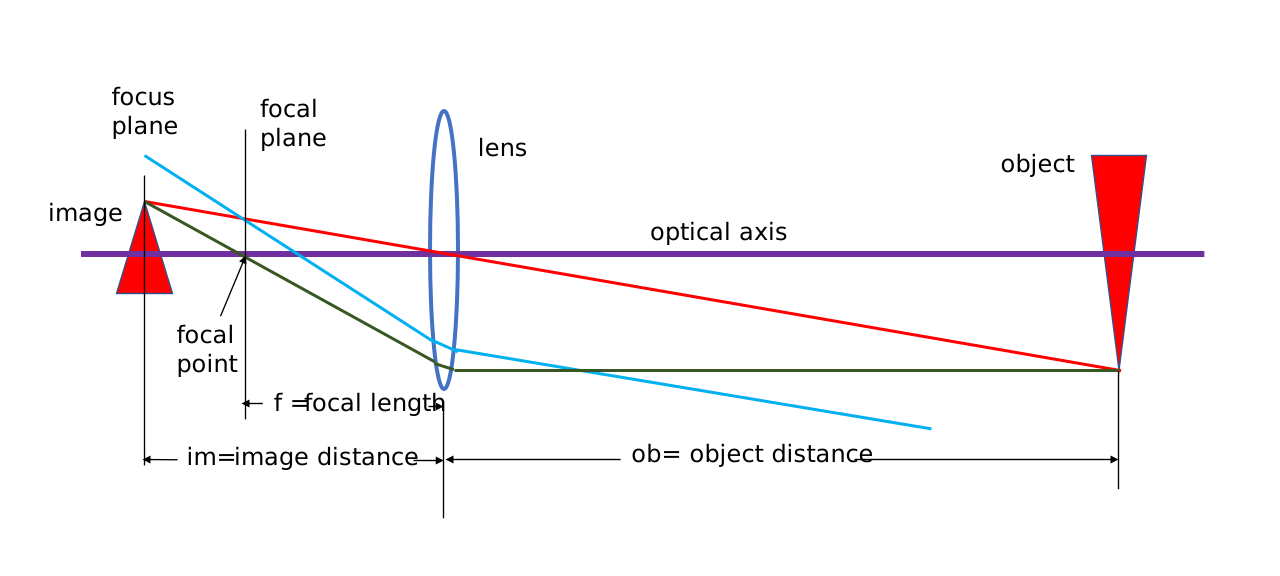
Like concave mirrors, converging lenses produce different images depending on where the object sits:
| Object position | Image location | Image type | Orientation | Size |
|----------------|---------------|------------|-------------|------|
| Beyond | Between and (far side) | Real | Inverted | Reduced |
| At | At (far side) | Real | Inverted | Same size |
| Between and | Beyond (far side) | Real | Inverted | Enlarged |
| At | At infinity | — | — | — |
| Inside | Same side as object | Virtual | Upright | Enlarged |
Diverging Lens Images
Like convex mirrors, diverging lenses always produce the same type of image regardless of object position:
- Virtual (same side as object, negative).
- Upright ( positive).
- Reduced ().
Diverging lenses by themselves never form real images.
Lens Power in Diopters
Optometrists don’t describe eyeglass lenses by focal length — they use diopters.
The advantage of diopters: lens powers add simply when lenses are placed in contact. Two lenses with powers and have combined power . This is much easier than trying to combine focal lengths directly (which involves the reciprocal mess).
cm; real, inverted, enlarged. cm. Positive → real image on far side. → inverted, 2× enlarged.
D. Convert to meters: m. D. Negative confirms it’s a diverging lens.
cm (diverging). Powers add: D. Then m = cm. The combination acts as a diverging lens (negative net power).