Look at yourself in the back of a metal spoon. Hold the spoon close on the concave (bowl) side: your face appears magnified and right-side-up. Move it farther away and your image suddenly flips upside down. Now flip the spoon to the convex (back) side: your face is small and upright at every distance.
These aren’t optical illusions — they’re the predictable behavior of curved mirrors. One equation governs them all. Once you know the mirror equation, the sign conventions, and the qualitative behavior of concave vs. convex, every mirror problem on the MCAT becomes mechanical.
Concave vs. Convex Mirrors
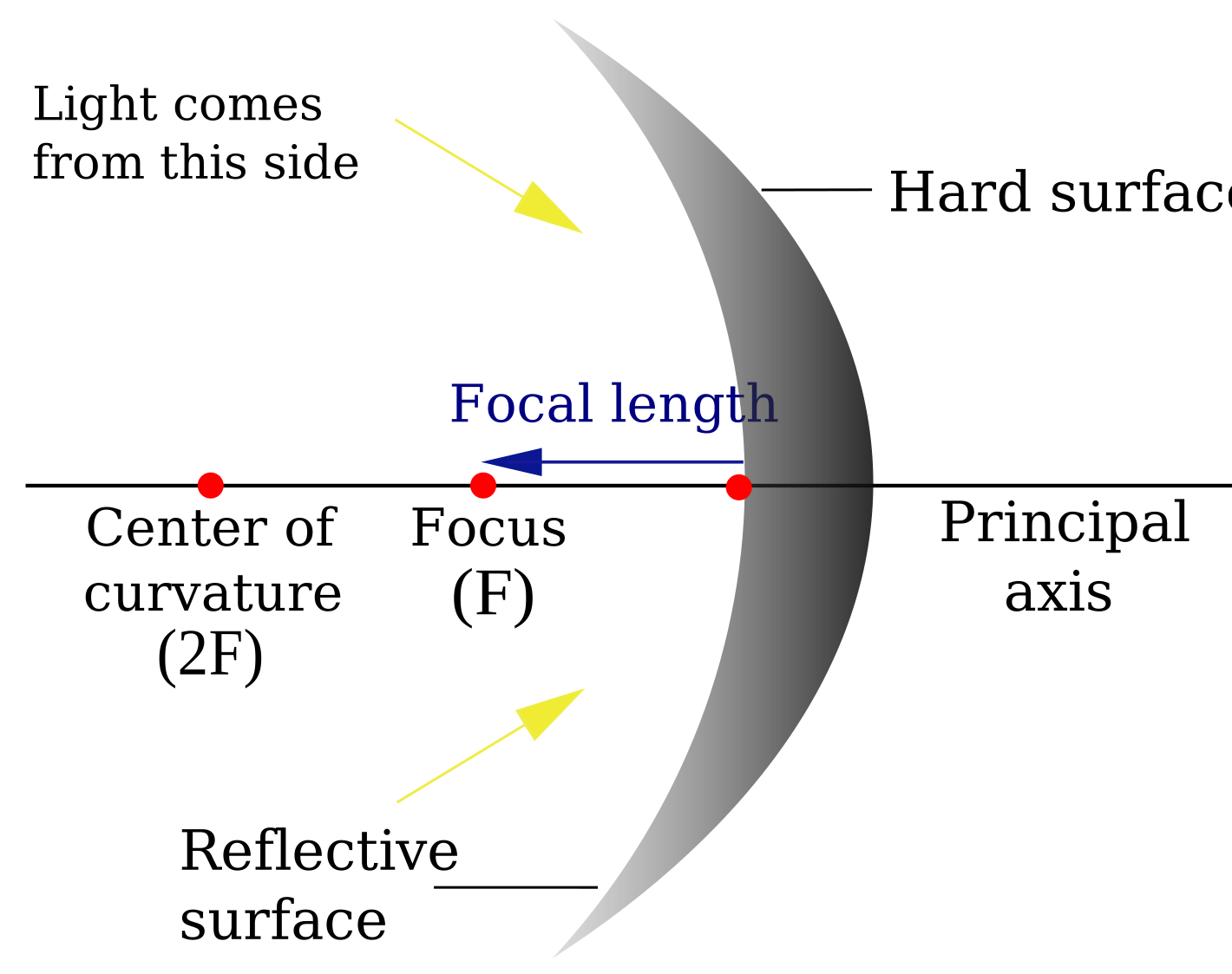
Concave mirrors curve inward (like the inside of a bowl). Parallel rays converge to a focal point in front of the mirror. They converge light → positive focal length (f>0).
Convex mirrors curve outward (like the back of a spoon). Parallel rays diverge as if from a focal point behind the mirror. They diverge light → negative focal length (f<0).
The Mirror Equation
Sign Conventions for Mirrors
Quantity
Positive (+)
Negative (−)
do
Object in front of mirror (real)
Object behind mirror (virtual — rare)
di
Image in front of mirror (real)
Image behind mirror (virtual)
f
Concave (converging)
Convex (diverging)
m
Upright
Inverted
Concave Mirror Image Cases
Ray diagram for a concave mirror. Parallel rays converge at the focal point (f). Image location, orientation, and size all depend on where the object sits relative to f and the center of curvature (C=2f). Credit: Wikimedia Commons, CC BY-SA
Object position
Image location
Image type
Orientation
Size
Beyond C (do>2f)
Between f and C
Real
Inverted
Reduced
At C (do=2f)
At C
Real
Inverted
Same size
Between C and f
Beyond C
Real
Inverted
Enlarged
At f (do=f)
At infinity
—
—
—
Inside f (do<f)
Behind mirror
Virtual
Upright
Enlarged
Convex Mirror Images
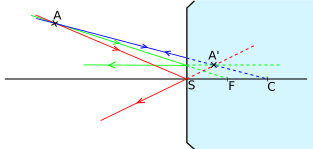
Ray diagram for a convex mirror. Reflected rays diverge, but tracing them backward reveals a virtual focal point behind the mirror. The image is always virtual, upright, and reduced. Credit: Wikimedia Commons, CC BY-SA
Convex mirrors are blissfully simple. No matter where you put the object, the image is always:
Virtual (behind the mirror, di negative).
Upright (m positive).
Reduced (∣m∣<1).
This is why convex mirrors are used as car side mirrors and store security mirrors — they always give an upright, reduced image with a wide field of view. The trade-off: objects look farther away than they really are. Hence the warning printed on every convex car mirror: “objects in mirror are closer than they appear.”
Ray Diagram Rules (Concave Mirror)
The mirror equation is faster, but ray diagrams build intuition. For a concave mirror, three reliable rays:
A ray parallel to the principal axis reflects through the focal point.
A ray through the focal point reflects parallel to the principal axis.
A ray through the center of curvature (C) reflects back on itself.
The intersection of any two of these rays is where the image forms. For convex mirrors, trace the reflected rays backward (behind the mirror) to find where they appear to intersect — that’s the virtual image location.
An object is placed 30 cm in front of a concave mirror with f=20 cm. Where is the image? Real or virtual? Upright or inverted?
Click to reveal answer
di=+60 cm; real and inverted.1/f=1/do+1/di⇒1/20=1/30+1/di⇒1/di=1/60⇒di=+60 cm. Positive di → real, in front of mirror. m=−60/30=−2 → inverted, 2× enlarged.
An object is placed 10 cm in front of a convex mirror with f=−20 cm. Where is the image? Describe it.
Click to reveal answer
di≈−6.7 cm; virtual, upright, reduced.1/(−20)=1/10+1/di⇒1/di=−1/20−1/10=−3/20⇒di≈−6.67 cm. Negative di → virtual (behind mirror). m=−(−6.67)/10≈+0.67 → upright, about 32 the original size.
Why does the warning "objects in mirror are closer than they appear" appear on convex car mirrors but not on flat mirrors?
Click to reveal answer
Because convex mirrors produce reduced images that look small (and therefore far away) even when the object is close. Flat mirrors produce 1:1 size images at the same apparent distance. Convex mirrors trade accurate size/distance for a wider field of view. The visual cue "smaller = farther" tricks your brain into thinking the trailing car is more distant than it really is.