
Refraction & Snell's Law
Stick a straw in a glass of water and look at it from the side. The straw appears to bend or break sharply at the water’s surface. Your eyes aren’t lying, and the straw isn’t actually broken — but the image of the underwater portion is in the wrong place.
Light traveling from the underwater part of the straw changes direction when it crosses from water into air. Your brain traces those bent rays backward in a straight line, so it perceives the underwater straw shifted from where it actually is. That bending of light at a boundary is refraction — and it’s the principle that makes lenses (and your eyes) able to form images.
Index of Refraction
Every transparent material slows light down by a characteristic amount. The index of refraction () tells you how much:
| Material | Index of refraction () |
|----------|------------------------|
| Vacuum | 1.00 (exact) |
| Air | 1.00 (effectively) |
| Water | 1.33 |
| Glass (typical) | 1.50 |
| Diamond | 2.42 |
What Causes Refraction?
When a light wave crosses from one medium into another, its speed changes but its frequency stays the same (frequency is locked in by the source — same rule from §7.1). Since , if speed decreases and frequency is fixed, wavelength must shrink too. The change in speed at the boundary causes the wavefront to pivot, bending the light ray.
Snell’s Law
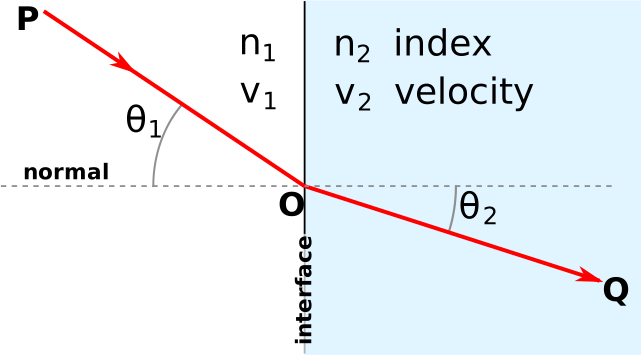
Snell’s law is the quantitative rule for refraction. Plug in three of the four quantities and solve for the fourth.
The Two Bending Rules
You can predict the direction of bending without doing any math:
- Entering a denser medium ( increases): light bends toward the normal. Angle gets smaller. (“Light slows down and turns in.”)
- Entering a less dense medium ( decreases): light bends away from the normal. Angle gets larger. (“Light speeds up and turns out.”)
Light passes from water (n = 1.33) into air (n = 1.00). As you keep increasing the angle of incidence, what eventually happens?
Test your prediction with the simulation below. Make larger than , then drag the incident angle upward and watch the refracted ray swing away from the normal while the faint reflected ray grows stronger. Push the incident ray past the dashed critical angle marker and see where the light goes.
Important Details
- Light hitting the boundary at (perpendicular) doesn’t bend. Snell’s law confirms: .
- Frequency stays constant when light enters a new medium. Speed and wavelength change together (both decrease in a denser medium); frequency is locked in by the source.
- The path is reversible. If light bends 30° going from air into glass, it bends 30° the other way going from glass back into air along the same line.
Worked Example
Light travels from air () into water () at an angle of incidence of 45°. Find the angle of refraction.
Light bends toward the normal entering water (denser medium) — angle drops from 45° to 32°, exactly as the rule predicts.
~48.6°, bending away from the normal. . Going to a less dense medium (lower ) → bends away from normal → larger angle.
400 nm. In a medium with index : nm. Frequency unchanged, but wavelength shrinks because the light slows down.
It passes straight through with no bending. Light hitting a boundary perpendicular to the surface () doesn’t refract — Snell’s law gives , so regardless of the indices. Refraction only happens at non-zero angles.