Drop two pebbles into a still pond at the same time. Where the expanding ripples overlap, you see something curious: some spots have extra-tall waves (the crests added together), while other spots are eerily flat (a crest met a trough and they canceled).
That’s interference. Light does the exact same thing — and the patterns it produces (bright and dark bands, the rainbow colors of soap bubbles, X-ray diffraction images of DNA) are some of the strongest evidence we have that light behaves as a wave. The MCAT tests interference in three flavors: double-slit, thin films, and diffraction gratings/single slits.
Constructive and Destructive Interference
Constructive interference: two waves arrive in phase (crest meets crest). Amplitudes add → bright spot. Path difference: 0, λ, 2λ, 3λ, … (whole number of wavelengths).
Destructive interference: two waves arrive out of phase (crest meets trough). Amplitudes cancel → dark spot. Path difference: λ/2, 3λ/2, 5λ/2, … (half a wavelength off — half, one-and-a-half, two-and-a-half wavelengths, and so on).
Young’s Double-Slit Experiment
Young's double-slit pattern. Coherent light diffracts through two narrow slits, the wavefronts overlap on a screen, and the result is alternating bright (constructive) and dark (destructive) fringes. Credit: Wikimedia Commons, CC BY-SA
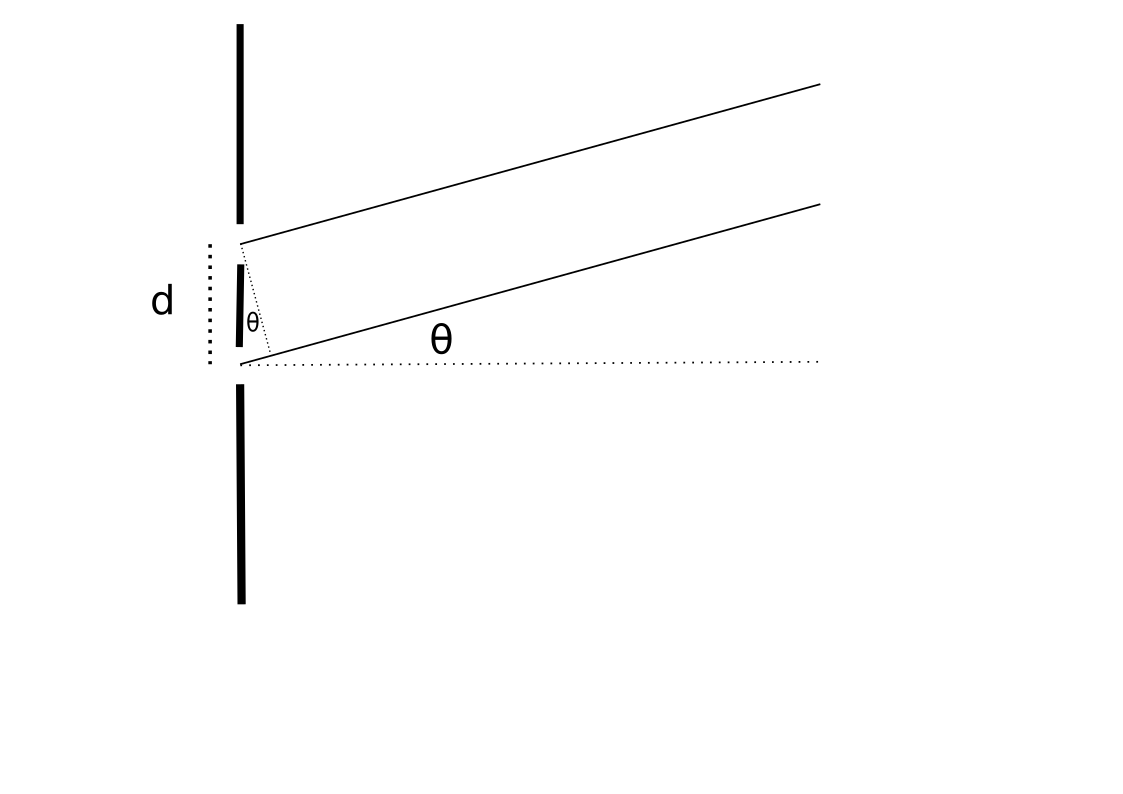
Thomas Young’s 1801 experiment is the classic demonstration of light’s wave nature. Coherent light passes through two narrow slits separated by distance d. The light from each slit spreads out (diffracts), and the two expanding wavefronts overlap on a distant screen — producing alternating bright and dark bands.
Three relationships to lock in:
Longer wavelength → wider spacing between fringes (red light produces wider bands than blue).
Smaller slit separation d → wider spacing between fringes.
Larger distance to screen → wider fringes (pattern fans out).
Thin Film Interference
When light hits a thin transparent film (soap bubble, oil slick on water, anti-reflective coating on glasses), some reflects off the top surface and some off the bottom. Those two reflected beams interfere with each other, producing the shimmering colors you see.
Two factors determine whether the interference is constructive or destructive:
Path difference. The beam reflecting off the bottom travels an extra distance of 2t (down and back up through a film of thickness t).
Phase shift on reflection. When light reflects off a surface with higher index, it picks up a 180° phase shift (= half a wavelength). Off a lower index surface, no phase shift.
The wavelength inside the film is shorter: λfilm=λvacuum/nfilm. Use this wavelength when calculating path differences.
Case 1 — One phase shift (most common: air → film → glass, where nfilm>nair):
Constructive: 2t=(m+21)λfilm.
Destructive: 2t=mλfilm.
Case 2 — Zero or two phase shifts:
Constructive: 2t=mλfilm.
Destructive: 2t=(m+21)λfilm.
Diffraction Grating
A diffraction grating is a surface with many equally spaced slits (hundreds or thousands per centimeter). It works on the same principle as the double slit — but with far more slits, the maxima become much sharper and brighter at the same positions.
The same equation: dsinθ=mλ for constructive maxima. Here d is the spacing between adjacent slits. Because the maxima are so sharp, diffraction gratings are the workhorse of spectrometers — instruments that precisely measure the wavelengths in a light source (used in chemistry, astronomy, forensics).
Single-Slit Diffraction
When light passes through a single narrow slit of width a, it diffracts and produces a pattern of bright and dark bands. The central bright band is by far the widest and brightest. The positions of the dark fringes (minima) are:
X-ray Diffraction
In a double-slit experiment, light of wavelength 500 nm passes through slits separated by 0.1 mm. At what angle does the first-order bright fringe (m=1) appear?
Click to reveal answer
~0.29°.dsinθ=mλ⇒sinθ=(1)(500×10−9)/(0.1×10−3)=0.005⇒θ≈0.29°. The angle is tiny because slit separation (d) is much larger than wavelength.
A thin film of oil (n=1.40) sits on water (n=1.33), illuminated from above. The air-oil reflection causes a phase shift; the oil-water reflection does not. What condition gives constructive interference in the reflected light?
Click to reveal answer
2t=(m+21)λfilm, where λfilm=λ/noil. One phase shift only (air-oil interface, low → high n). The two reflected beams start half a wavelength out of phase, so constructive needs the path difference to compensate: 2t must be half-and-something wavelengths (½, 1½, 2½, …) inside the film.
Why are the bright fringes of a diffraction grating so much sharper than those of a double-slit experiment?
Click to reveal answer
More slits → more waves contributing to constructive interference at the maxima, and sharper destructive interference everywhere else. With two slits, you get broad bright fringes. With hundreds of slits, the constructive condition is met at very narrow specific angles, and any deviation from those angles causes most of the contributing waves to interfere destructively. The result: thin, intense, well-resolved spectral lines — perfect for spectroscopy.