
The Eye & Optical Instruments
Your eye is the most sophisticated optical instrument you’ll ever use. It has a converging lens system that automatically adjusts its focal length, a self-regulating aperture, and a detector (the retina) packed with over 100 million light-sensitive cells.
Understanding how the eye focuses light — and what goes wrong in myopia, hyperopia, and astigmatism — is high-yield MCAT material that ties together everything from the previous sections (refraction, lens equation, diopters) into a single biological system.
Anatomy of the Eye as an Optical System
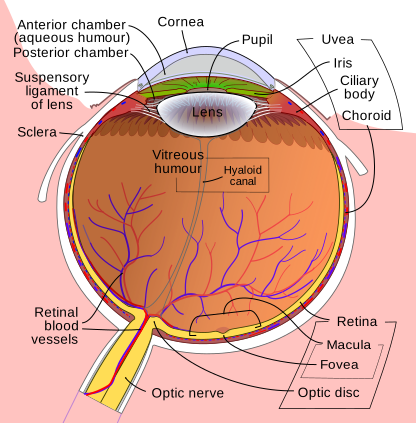
Light entering the eye is refracted by two main structures:
- Cornea — the transparent front surface. It provides about two-thirds of the eye’s total refractive power, because of the huge change in index of refraction between air () and the cornea ().
- Lens — the adjustable internal lens. It provides the remaining one-third of refractive power and can change shape to fine-tune focus.
After passing through both structures, light converges to form a real, inverted image on the retina at the back of the eye. Your brain flips the inverted image to “right-side up” automatically — you’ve never seen the world upside down because your visual cortex compensates.
Accommodation
Accommodation is the process by which the lens changes shape to focus on objects at different distances:
- Distant objects: ciliary muscles relax → lens flattens → focal length increases. Less bending needed (incoming rays nearly parallel).
- Near objects: ciliary muscles contract → lens becomes rounder → focal length decreases. More bending needed to converge the diverging rays from a close object.
The near point is the closest distance the eye can focus clearly (~25 cm in a young adult). The far point is the farthest (infinity for a normal eye).
Myopia (Nearsightedness)
A myopic eye sees nearby objects clearly but distant objects look blurry.
Cause: The eyeball is too long front-to-back, or the cornea/lens is too strong. Either way, light from distant objects converges to a focal point in front of the retina, then diverges again before reaching the retina.
Correction: A diverging (concave) lens with negative power. The lens spreads incoming rays slightly before they reach the eye, pushing the focal point back onto the retina.
Hyperopia (Farsightedness)
A hyperopic eye sees distant objects clearly but near objects look blurry.
Cause: Eyeball is too short, or the cornea/lens is too weak. Light from near objects would converge behind the retina if the system extended that far.
Correction: A converging (convex) lens with positive power. The lens adds extra convergence, bringing the focal point forward onto the retina.
| Condition | Eye shape | Problem | Corrective lens | Sign |
|---|---|---|---|---|
| Myopia | Too long | Distant blur | Diverging (concave) | Negative (−) |
| Hyperopia | Too short | Near blur | Converging (convex) | Positive (+) |
Microscopes and Telescopes
Astigmatism
Astigmatism happens when the cornea (or lens) isn’t perfectly spherical — it curves more in one direction than the other (think the back of a spoon vs. a perfect ball). Light then focuses at different distances depending on the orientation, producing blurred or distorted images. Corrected with cylindrical lenses that compensate for the uneven curvature in just the right axis.