Before we dig into specific kinds of waves (sound, light, water, vibrating strings), you need a vocabulary that works for any wave. The good news: only five numbers describe almost any wave you’ll meet, and one tiny equation links three of them. Master those and you can characterize a sound wave, an ocean swell, and a radio signal with the same toolbox.
The Five Core Properties
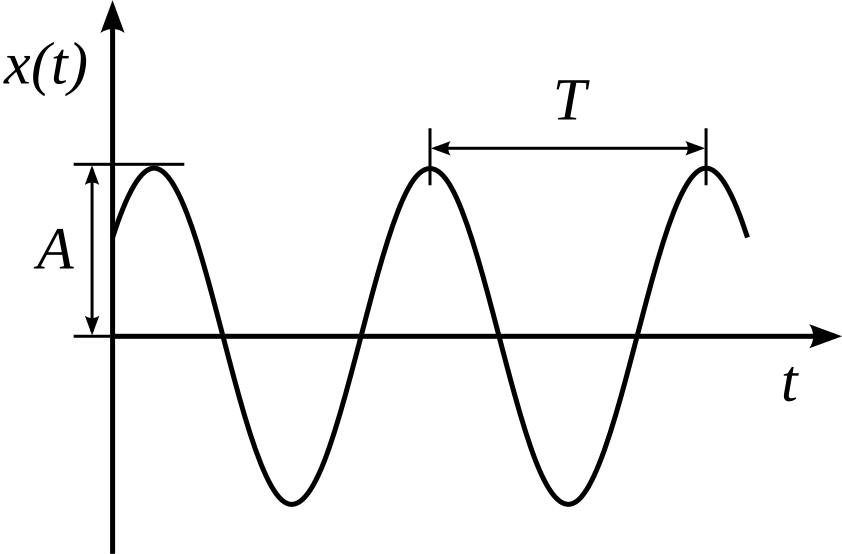
Wavelength (λ) — the distance between two consecutive identical points on a wave: crest-to-crest, trough-to-trough, or any matching point. Measured in meters.
Frequency (f) — how many complete cycles pass a fixed point per second. Measured in hertz (Hz), where 1 Hz = 1 cycle per second. Frequency is set by the source. A 440 Hz tuning fork (concert A) produces 440 Hz waves whether you strike it in air, water, or helium.
Period (T) — the time for one complete cycle. Inverse of frequency.
Amplitude (A) — the maximum displacement from equilibrium. For a water wave, amplitude is the height from flat water to the top of the crest. Amplitude determines the energy carried by the wave — and energy goes with amplitude squared (E∝A2). Doubling the amplitude quadruples the energy carried, not just doubles it.
Phase — where a wave is in its cycle at a given moment. Two waves are “in phase” if their crests and troughs line up. They’re “180° out of phase” (or “half a wavelength apart”) if the crest of one aligns with the trough of the other. Phase determines whether waves combine constructively (bigger wave) or destructively (cancellation).
The Wave Speed Equation
The single most important equation in wave physics ties speed, frequency, and wavelength together.
Here’s the critical insight the MCAT tests over and over:
Speed is determined by the medium. Sound travels at ~340 m/s in air, ~1500 m/s in water, ~5000 m/s in steel — regardless of frequency.
Frequency is determined by the source. A 440 Hz tuning fork makes 440 Hz waves no matter what medium they travel through.
Wavelength adjusts. Since v=fλ, if speed changes (new medium) and frequency stays fixed (same source), wavelength must change to compensate. A sound wave entering water speeds up, so its wavelength increases while frequency stays at 440 Hz.
Putting It All Together
Property
Symbol
Unit
Determined by
Wavelength
λ
m
Adjusts (v/f)
Frequency
f
Hz
Source
Period
T
s
Source (1/f)
Amplitude
A
m
Energy input
Speed
v
m/s
Medium
A sound wave with frequency 680 Hz travels through air at 340 m/s. What is its wavelength? If the same wave enters water (sound speed 1360 m/s), what happens to its frequency and wavelength?
Click to reveal answer
In air: λ=v/f=340/680=0.5 m. In water: frequency stays at 680 Hz (set by the source). New wavelength: λ=1360/680=2.0 m. Wavelength quadrupled because speed quadrupled while frequency stayed constant.
Wave A has amplitude 3 cm. Wave B has amplitude 6 cm but the same frequency and wavelength. How do their energies compare?
Click to reveal answer
Wave B carries 4× the energy.E∝A2. Doubling amplitude quadruples energy. (This is why doubling the volume on a stereo doesn't just feel "twice as loud" — the energy delivery is way more than double.)
A radio station broadcasts at 100 MHz. Radio waves travel at the speed of light (3×10⁸ m/s). What is the wavelength?
Click to reveal answer
3 m.λ=v/f=(3×108)/(100×106)=3 m. (FM radio antennas are typically about 41 to 1 wavelength long for good reception — which is why car FM antennas are about 75 cm to 3 m.)
All waves carry energy through a medium (or through space, in the case of light) — but they do it in one of two fundamentally different ways. The classification comes down to a single question:
Which direction do the particles move, relative to the direction the wave travels?
If they move perpendicular to the wave’s direction → transverse wave (like water waves, light, a vibrating guitar string).
If they move parallel to the wave’s direction → longitudinal wave (like sound, a Slinky compression, earthquake P-waves).
Once you can spot the difference, identifying any wave on the MCAT becomes automatic.
Transverse Waves
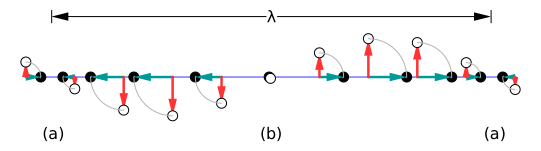
Transverse vs. longitudinal waves. Transverse: particles oscillate perpendicular to wave travel. Longitudinal: particles oscillate parallel to wave travel, creating compressions and rarefactions. Credit: Wikimedia Commons, CC BY-SA
In a transverse wave, particles oscillate perpendicular to the direction of wave propagation. Picture shaking a rope up and down — the wave travels horizontally along the rope, but each point on the rope moves vertically.
Examples of transverse waves:
Vibrating guitar string or shaken rope.
Water surface waves (particles actually move in circles, but the displacement is perpendicular to wave direction).
All electromagnetic (EM) waves: light, radio, X-rays, microwaves.
Important note: transverse waves can only travel through solids (which resist shear) or along surfaces. They can’t move through the interior of fluids — liquids and gases have no shear resistance, so there’s nothing to spring back perpendicularly. The big exception: EM waves, which need no medium at all and travel through pure vacuum.
Longitudinal Waves
In a longitudinal wave, particles oscillate parallel to the direction of wave propagation. Picture pushing and pulling one end of a Slinky — the coils bunch together (compression) and spread apart (rarefaction) as the wave travels along the Slinky’s length.
In a longitudinal wave, regions of high density are called compressions and regions of low density are called rarefactions. One wavelength spans from one compression to the next (or one rarefaction to the next).
Examples of longitudinal waves:
Sound waves in any medium (air, water, solids). Sound is always longitudinal.
Compression waves in a Slinky.
Earthquake P-waves (“primary” — they arrive first because they’re faster).
Quick Comparison
Feature
Transverse
Longitudinal
Particle motion
Perpendicular to propagation
Parallel to propagation
Key visual
Crests and troughs
Compressions and rarefactions
Travels through
Solids, surfaces, vacuum (EM only)
Solids, liquids, gases
Main example
Light, rope wave
Sound, Slinky compression
Can a Wave Be Both?
Surface water waves actually do a bit of both — particles near the surface move in circular or elliptical paths, combining vertical (transverse) and horizontal (longitudinal) motion. For the MCAT, you can usually treat water waves as transverse when analyzing the surface profile.
Some materials (solids) can carry both types of waves at once. In an earthquake, the P-waves (primary, longitudinal) arrive first because they travel faster, followed by S-waves (secondary, transverse). S-waves can’t pass through the liquid outer core of the Earth — this is how seismologists discovered that Earth’s outer core is liquid. The S-wave shadow zone on the far side of the Earth proved it.
Why can't sound travel through a vacuum, while light can?
Click to reveal answer
Sound needs a medium; light doesn't. Sound is a longitudinal mechanical wave that requires particles to compress and expand. A vacuum has no particles → nothing to transmit compressions and rarefactions. Light is an electromagnetic wave — oscillating electric and magnetic fields that propagate without any medium.
A wave travels through a Slinky. The coils move back and forth along the same axis as the wave direction. Is this wave transverse or longitudinal?
Click to reveal answer
Longitudinal. Particle displacement (coils moving along the Slinky axis) is *parallel* to wave propagation. If the coils moved side-to-side, it would be transverse.
An earthquake's P-waves arrive at a seismograph 30 seconds before its S-waves. Which type of wave is faster, and which type cannot travel through liquids?
Click to reveal answer
P-waves are faster (longitudinal); S-waves can't travel through liquids (transverse). P-waves are longitudinal compressions; S-waves are transverse shears. Liquids and gases can't sustain shear, so S-waves stop at the boundary of a liquid layer — which is exactly how scientists deduced that Earth has a liquid outer core.
When two people talk in a room at the same time, you hear both voices simultaneously. The sound waves don’t bounce off each other or get mangled — they just pass through each other, briefly overlap, and continue on their way as if the other wave wasn’t there.
That’s the superposition principle, and it’s one of the most powerful ideas in wave physics. It explains noise-canceling headphones, the colors of soap bubbles, the dark/bright bands in CD reflections, and why some seats at a concert hall sound great while others (just feet away) sound dead.
The Superposition Principle
When two or more waves occupy the same space at the same time, the total displacement at any point is the algebraic sum of the individual displacements. After passing through each other, the waves continue as if they had never met — each with its original amplitude, frequency, and direction.
Constructive Interference
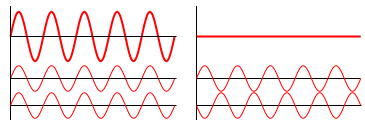
Constructive interference (waves in phase, amplitudes add) vs. destructive interference (waves 180° out of phase, amplitudes cancel). Whether interference is constructive or destructive depends on the path length difference between the two sources. Credit: Wikimedia Commons, CC BY-SA
When two waves arrive at the same point in phase (crest meets crest, trough meets trough), their amplitudes add. The combined wave has a larger amplitude than either individually. If both waves have amplitude A, the combined amplitude is 2A.
Constructive interference happens when the path length difference between two coherent sources is a whole number of wavelengths:
Destructive Interference
When two waves arrive out of phase (crest meets trough), their amplitudes subtract. If both waves have equal amplitude, the result is zero — complete cancellation.
Destructive interference happens when the path length difference is half a wavelength off — half, one-and-a-half, two-and-a-half wavelengths, and so on:
Interactive Wave Explorer
🎯 Predict First
Two identical sound waves arrive at the same point exactly 180 degrees out of phase. What is the result where they overlap?
Adjust the amplitude, frequency, and phase of two waves and watch them combine. Try the presets to see constructive interference (doubled amplitude), destructive interference (cancellation), and beats (pulsing loudness from slightly different frequencies).
In phase → amplitudes add (2A peak).
Partial Interference
Perfect constructive and destructive interference are special cases. Most of the time, waves overlap with some intermediate phase difference, producing partial reinforcement or partial cancellation. The resultant amplitude lies somewhere between zero and the full sum of the two amplitudes.
Path Length Difference Problems
The MCAT commonly presents two speakers (or two slits) emitting the same wave. A listener at some point P is at a different distance from each source. The question: does P experience constructive or destructive interference?
Step-by-step:
Find the distance from each source to point P (call them d1 and d2).
Compute the path length difference: ∣d1−d2∣.
If the difference equals nλ → constructive interference.
If the difference equals (n+21)λ → destructive interference.
Worked Example
Two speakers, separated by some distance, emit identical 1000 Hz tones in air (v=340 m/s). A listener is 5.0 m from speaker A and 5.34 m from speaker B. Does the listener hear loud or quiet sound?
Wavelength: λ=v/f=340/1000=0.34 m.
Path difference: ∣5.34−5.0∣=0.34 m = 1λ exactly.
One whole wavelength → constructive → loud.
Move the listener slightly so the path difference becomes 0.51 m = 1.5λ → destructive → quiet. This is exactly why concert halls have “dead spots” and “loud spots” — slight position changes can shift you between constructive and destructive interference.
Two speakers emit identical sound waves (λ=0.5 m). A listener is 3.0 m from speaker A and 3.75 m from speaker B. Constructive or destructive?
Click to reveal answer
Destructive. Path difference: ∣3.75−3.0∣=0.75 m. Divide by λ: 0.75/0.5=1.5 wavelengths. That’s (1+21)λ — one-and-a-half wavelengths off, so destructive interference.
Two identical waves overlap. Wave A has amplitude 4 cm; wave B has amplitude 4 cm. What is the resulting amplitude if they interfere (a) fully constructively, and (b) fully destructively?
Click to reveal answer
(a) 8 cm. (b) 0 cm. Constructive: amplitudes add → 4+4=8 cm. Destructive: amplitudes subtract → 4−4=0 (complete cancellation). These are the max and min possible resultants.
Two waves of different amplitudes (5 cm and 3 cm) interfere. What’s the maximum and minimum amplitude of the resulting wave?
Click to reveal answer
Max: 8 cm. Min: 2 cm. Constructive: 5+3=8 cm. Destructive: ∣5−3∣=2 cm (the bigger wave wins; cancellation is partial because the amplitudes don’t match).
Standing waves are one of the most heavily tested wave topics on the MCAT. They show up in passages about guitar strings, organ pipes, vocal cords, ear canals, and even atomic and molecular vibrations. The good news: once you understand the boundary conditions, every standing wave problem becomes a drawing exercise — sketch a picture, count wavelengths, plug into the formula.
🎯 Predict First
A pipe that is closed at one end resonates at a fundamental frequency of 100 Hz. Which of these frequencies can it also resonate at?
Use the simulation below to check your prediction. Switch between the string and the two pipe types, then step through the harmonics and watch how the boundaries force a node (N) or antinode (A) at each end. Pay special attention to the closed pipe: the harmonic slider skips every even value because no even harmonic can satisfy both boundaries at once.
Harmonic: 1stWavelength: λ = 2LFrequency: f = f1
How Standing Waves Form
When a wave travels down a string fixed at both ends and reflects back, the incoming and reflected waves interfere with each other. At certain special frequencies, the interference produces a wave pattern that appears to stand still — specific points on the string never move (called nodes), while other points oscillate with maximum amplitude (called antinodes).
Nodes and Antinodes
Nodes are points of zero displacement. The string (or air column) never moves there. Nodes come from perfect destructive interference between incoming and reflected waves.
Antinodes are points of maximum displacement. They sit exactly halfway between adjacent nodes. Antinodes come from constructive interference.
Strings and Open Pipes (Both Ends the Same)
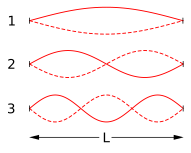
Standing wave harmonics on a string fixed at both ends. Fundamental (n=1): one antinode in the middle. Each successive harmonic adds another half-wavelength. Credit: Wikimedia Commons, CC BY-SA
A string fixed at both ends has nodes at both ends. An open pipe has antinodes at both ends. Despite the different boundary conditions (node vs. antinode), the math works out the same for both — because both ends are the same type of boundary.
The fundamental (first harmonic, n=1) fits exactly half a wavelength in the length of the string or pipe. Each successive harmonic adds another half-wavelength.
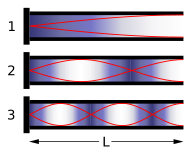
Open pipes (all harmonics, n=1,2,3,…) vs. closed pipes (odd harmonics only, n=1,3,5,…). The asymmetry of the closed pipe forbids the even harmonics. Credit: Wikimedia Commons, CC BY-SA
A closed pipe has an antinode at the open end and a node at the closed end — the boundaries are different. This asymmetry changes everything. The fundamental fits only one quarter of a wavelength, and only odd harmonics are present.
Drawing Standing Waves: The Strategy
Recipe for any standing wave problem:
Identify boundary conditions (node or antinode at each end).
Draw the fundamental — the simplest wave that satisfies both boundaries.
Count how many half-wavelengths (or quarter-wavelengths) fit.
Use the formula to find λ and f.
For the fundamental (n=1):
String / open pipe: one half-wavelength fits in L, so λ1=2L.
Closed pipe: one quarter-wavelength fits in L, so λ1=4L.
Harmonics vs. Overtones
This terminology trips people up. The fundamental is the 1st harmonic. Overtones are all frequencies above the fundamental.
A 0.6 m string is fixed at both ends. Wave speed = 300 m/s. What is the fundamental frequency? What is the third harmonic?
Click to reveal answer
f1=250 Hz; f3=750 Hz.f1=v/(2L)=300/1.2=250 Hz. For a string (both ends fixed), all harmonics: fn=nf1, so f3=3×250=750 Hz.
A closed pipe (one open, one closed) is 0.85 m long. Sound speed = 340 m/s. What is the fundamental? What is the next possible harmonic?
Click to reveal answer
f1=100 Hz; next is f3=300 Hz.f1=v/(4L)=340/3.4=100 Hz. Closed pipes only have odd harmonics, so the next is the 3rd: f3=3×100=300 Hz. (No 2nd harmonic exists.)
How do you tell whether a standing wave system supports all harmonics or only odd harmonics?
Click to reveal answer
Look at the boundaries. Both ends the same type (both nodes or both antinodes) → all harmonics (strings fixed at both ends, open pipes). Ends different (one node, one antinode) → odd harmonics only (closed pipes). The asymmetry forbids the even harmonics.
You see lightning, then seconds later hear the thunderclap. You yell across a canyon and your echo takes a moment to come back. You can hear an approaching train through the rail long before you hear it through the air.
All these everyday experiences point to the same fact: sound is a mechanical wave with a finite speed, and that speed depends on what it travels through. Light is essentially instantaneous on Earthly scales (~3×10⁸ m/s). Sound is much slower (~340 m/s in air). The mismatch is what creates the delay between the lightning flash and the thunder.
Sound Is a Longitudinal Pressure Wave
When a speaker cone pushes forward, it compresses the air molecules right in front of it. Those molecules push their neighbors. The neighbors push their neighbors. A wave of compression travels outward from the source. Behind each compression, the air spreads into a region of lower density called a rarefaction.
Sound requires a medium. No particles, no compressions, no sound — which is why there’s no sound in the vacuum of space, despite what every sci-fi movie ever made would have you believe.
Speed of Sound in Different Media
The speed of sound depends on two properties of the medium:
Stiffness (how strongly molecules push back when compressed). Stiffer = faster.
Density (how much mass is being moved). Denser = slower (more inertia).
In practice, solids are much stiffer than liquids and gases — by orders of magnitude — so the stiffness effect dominates and sound moves fastest in solids.
Medium
Approximate sound speed
Air (20°C)
340 m/s
Water
1500 m/s
Soft tissue
1540 m/s
Bone
4000 m/s
Steel
5000 m/s
Temperature and Sound Speed
In a gas, higher temperature means molecules move faster on average — and faster molecules transmit compressions more quickly. Higher temperature → faster sound speed in air.
A useful approximation: sound speed in air rises by about 0.6 m/s per 1°C. At 0°C, v≈331 m/s. At 20°C, v≈343 m/s. The MCAT usually gives 340 m/s, or specifies the value to use.
Why Speed Matters Clinically
The speed of sound in soft tissue (~1540 m/s) is the basis of ultrasound imaging. The machine sends out a pulse, times how long the echo takes to come back, and uses d=vt to calculate the depth of the reflecting structure (organ surface, fetal heart, tumor edge). Different tissues have slightly different speeds — and slightly different reflectivities — which is what produces image contrast.
The same echo-timing principle works for sonar (mapping the ocean floor), seismic surveys (finding oil and gas), bat echolocation, and dolphin echolocation. All of them rely on knowing v accurately so they can convert “echo arrival time” into “distance to reflector.”
You see a lightning flash and hear the thunder 4 seconds later. Approximately how far away was the lightning strike? (vsound=340 m/s)
Click to reveal answer
About 1360 m (1.4 km).d=vt=340×4=1360 m. Light travels so fast that the time for the flash to reach you is essentially zero — the entire delay is due to the finite speed of sound. (A useful folk rule: count seconds between flash and thunder, then divide by 5 to get miles, or by 3 to get kilometers.)
A 1000 Hz sound wave travels from air (v=340 m/s) into water (v=1500 m/s). What happens to frequency, speed, and wavelength?
Click to reveal answer
Frequency: 1000 Hz (unchanged). Speed: 1500 m/s. Wavelength: 1.5 m (was 0.34 m in air). Frequency depends on the source, not the medium. Speed is set by the new medium. Wavelength adjusts via λ=v/f.
An ultrasound machine sends a pulse and detects the echo 0.04 ms later. How deep is the reflecting structure? (vtissue=1540 m/s)
Click to reveal answer
About 3.1 cm. Round-trip distance: d=vt=1540×4×10−5=0.0616 m. Depth = round-trip / 2 = 0.0308 m ≈ 3.1 cm. Ultrasound machines do this calculation thousands of times per second to build up real-time images.
The human ear is staggeringly sensitive. It can detect sound waves with intensities as low as 10−12 W/m² (literally a mosquito flying across a quiet room) — and it can tolerate sounds a trillion times more intense before reaching the pain threshold.
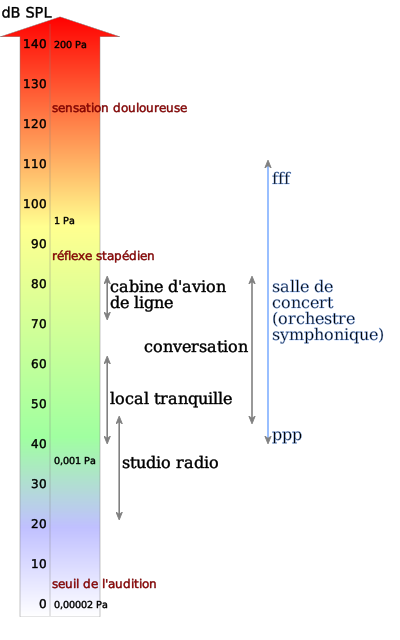
Because that range is so enormous, plain intensity numbers (in W/m²) become unwieldy fast. So we use a logarithmic scale — decibels (dB) — that compresses the trillion-fold range into a manageable 0–120. The MCAT loves decibels because they teach you how logarithms compress huge ranges, and because they show up in passages on hearing, music, hearing loss, and noise pollution.
Sound Intensity
Intensity is the power delivered per unit area, measured in W/m².
The Decibel Scale
Because intensity spans 12 orders of magnitude between the faintest audible sound and the pain threshold, we use a logarithmic compression:
The Key dB Shortcuts
You don’t need a calculator for MCAT decibel problems. These three rules cover almost every question:
Intensity change
dB change
2× intensity
+3 dB
10× intensity
+10 dB
100× intensity
+20 dB
1000× intensity
+30 dB
Going the other direction:
Every +10 dB → 10× more intense.
Every +20 dB → 100× more intense.
Every +30 dB → 1000× more intense.
The decibel scale compresses the enormous range of human hearing. Each 10 dB step represents a tenfold change in intensity. Threshold of hearing (0 dB) and threshold of pain (120 dB) span a factor of one trillion in intensity. Credit: Wikimedia Commons, CC BY-SA
Common Sound Levels
Sound
Intensity Level (dB)
Intensity (W/m²)
Threshold of hearing
0
10−12
Whisper
20
10−10
Quiet office
40
10−8
Normal conversation
60
10−6
Vacuum cleaner
80
10−4
Rock concert
110
10−1
Threshold of pain
120
100=1
Jet engine (nearby)
140
102
Hearing damage starts to happen with prolonged exposure above about 85 dB — which is why sustained exposure to loud music, lawnmowers, or industrial noise can cause permanent hearing loss over time.
Worked Example
A siren produces a sound level of 90 dB at 10 m away. What’s the sound level at 100 m?
Distance grows by 10× (from 10 m to 100 m).
Intensity follows inverse square: I drops by 102=100.
dB change: 10log(1/100)=10×(−2)=−20 dB.
New level: 90−20=70 dB.
So a siren that’s painfully loud right next to you (90 dB) drops to “loud TV” level (70 dB) just 100 m away. This is why ambulances need to be very loud at the source — they’re projecting outward from a point.
A sound has intensity 10−5 W/m². What is its sound level in decibels? (I0=10−12 W/m²)
Click to reveal answer
70 dB.β=10log(I/I0)=10log(10−5/10−12)=10log(107)=70 dB. About the loudness of a typical conversation or a TV at moderate volume.
How much more intense is a 100 dB sound than a 60 dB sound?
Click to reveal answer
10,000× more intense. Difference: 40 dB. Each 10 dB = 10× intensity, so 40 dB = 104=10,000. A jackhammer (100 dB) delivers 10,000× more sound power per area than normal conversation (60 dB) — that's why prolonged construction noise damages hearing.
A speaker has sound level 80 dB at 2 m. What is the sound level at 20 m?
Click to reveal answer
60 dB. Distance grew 10×, so intensity drops by 100 (inverse square). Δβ=10log(1/100)=−20 dB. New level: 80−20=60 dB.
In an idealized physics textbook, waves travel forever and oscillators swing indefinitely. In reality, energy is always lost to friction, air resistance, or absorption. Sound fades with distance. A plucked guitar string eventually goes silent. A pendulum eventually comes to rest.
The MCAT expects you to know why and how these losses happen — and to recognize the three regimes of damping (underdamped, critically damped, overdamped).
Attenuation of Sound
Attenuation is the decrease in sound intensity as a wave travels through a medium. Two main causes:
1. Geometric spreading. As a sound wave radiates outward from a point source, its energy spreads over an ever-larger spherical surface. Surface area = 4πr2, so intensity drops with the square of the distance.
2. Absorption. The medium itself turns sound energy into heat through internal friction between vibrating molecules. Higher frequencies are absorbed faster than lower frequencies — which is why you hear the bass thumping from a distant concert long before you can make out any vocals or high-frequency cymbal hits. Absorption depends on the medium’s properties and on the wave frequency.
Damping in Oscillating Systems
Damping is the loss of energy in an oscillating system due to friction, air resistance, or internal forces. A damped oscillation has shrinking amplitude over time, even though the frequency stays roughly the same (for the underdamped case).
Three regimes the MCAT expects you to know:
Underdamped — the system oscillates with gradually shrinking amplitude. Each swing is slightly smaller than the last. Examples: a pendulum swinging in air, a vibrating guitar string, a car bouncing after hitting a bump.
Critically damped — the system returns to equilibrium as quickly as possible without oscillating. This is the ideal setting for car shock absorbers — you want the car to settle quickly after a bump without bouncing back and forth.
Overdamped — the system returns to equilibrium slowly without oscillating. Like trying to swing a pendulum through honey — it just creeps back to center without ever overshooting.
A speaker produces a sound intensity of 0.01 W/m² at 2 m. What is the intensity at 6 m?
Click to reveal answer
About 1.1×10⁻³ W/m². Inverse square: distance tripled → intensity drops by 32=9. I=0.01/9≈0.0011 W/m². Same energy spread over 9× the area.
A pendulum swings in air and gradually comes to rest. Is this system underdamped, critically damped, or overdamped? What happens to its frequency?
Click to reveal answer
Underdamped. The pendulum oscillates back and forth with shrinking amplitude before stopping. Frequency stays roughly constant throughout the decay. Energy is gradually lost to air resistance and friction at the pivot, turning mechanical energy into heat.
Why do you hear the bass beat from a distant concert long before you can make out the lyrics?
Click to reveal answer
Higher frequencies are absorbed faster than lower frequencies. Bass (low frequency) is absorbed slowly by air and obstacles, so it carries far. The high-frequency content of vocals and cymbals is absorbed quickly, so it dies off long before the bass does. This is why "thump-thump-thump" is what you hear from a block away — only the bass survives.
You’ve heard the Doppler effect thousands of times without knowing the name. An ambulance siren sounds higher-pitched as it races toward you, then suddenly drops to a lower pitch the instant it passes. A car horn sounds higher as it approaches, lower as it pulls away. A train whistle does the same thing.
The siren itself is playing the same note the whole time. The sound didn’t change. What changed is how those sound waves arrive at your ear — and that depends on the relative motion between you and the source.
The Core Concept
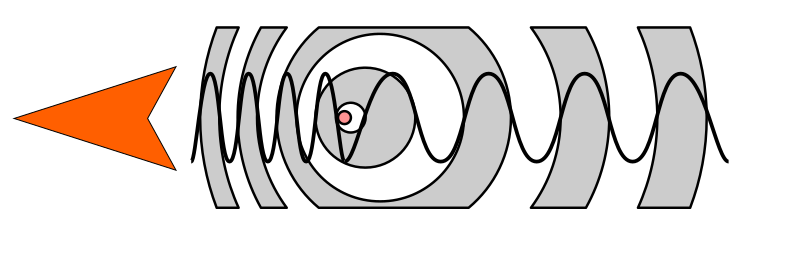
The Doppler effect. A moving source compresses wavefronts ahead of it (shorter wavelength, higher frequency) and stretches those behind it (longer wavelength, lower frequency). That’s why an approaching siren sounds higher-pitched and a receding siren sounds lower. Credit: Wikimedia Commons, CC BY-SA
When a sound source moves toward you, it “chases” its own waves, scrunching them together. The wavelengths in front of the source are shorter — meaning higher frequency. Behind the source, waves get stretched apart — longer wavelength, lower frequency.
The same effect happens if you (the observer) move toward or away from a stationary source. Moving toward the source, you intercept wave crests more often (higher perceived frequency). Moving away, the crests take longer to catch up to you (lower perceived frequency).
🎯 Predict First
An ambulance with a 400 Hz siren drives toward you at constant speed, passes you, and drives away at the same constant speed. What pitch do you hear?
Test your prediction with the simulation below. Set a source speed, press Play, and watch the wavefronts bunch together ahead of the moving source and spread apart behind it. Keep an eye on the observed frequency readout as the source passes the observer: it holds one steady value, then jumps.
Rather than memorizing sign rules from scratch, use the SASH mnemonic and a sanity check.
How to Use the Formula
The key to getting the signs right: the perceived frequency should increase when source and observer are approaching, and decrease when they’re moving apart.
Observer moving toward source:f′=f(v+vo)/v (more crests per second).
Observer moving away from source:f′=f(v−vo)/v.
Source moving toward observer:f′=fv/(v−vs) (compressed wavelengths in front).
Source moving away from observer:f′=fv/(v+vs).
Both moving: combine the appropriate signs.
After plugging in: check whether f′>f for approaching motion (or f′<f for receding). If your answer goes the wrong way, you flipped a sign.
Worked Example
An ambulance siren emits a 700 Hz tone. The ambulance moves toward a stationary observer at 30 m/s. Speed of sound = 340 m/s. What frequency does the observer hear?
The observer hears a higher pitch (768 > 700) — consistent with the source approaching. Once the ambulance passes and starts moving away, the formula flips to f′=fv/(v+vs)=700×340/370≈643 Hz. That sudden drop from ~768 Hz to ~643 Hz is exactly the “weeooooowwwww” you hear as a siren passes.
Doppler Effect for Light
A fire truck with a 600 Hz siren moves away from a stationary observer at 20 m/s. What frequency does the observer hear? (vsound=340 m/s)
Click to reveal answer
About 567 Hz. Source receding, observer stationary: f′=fv/(v+vs)=600×340/360≈567 Hz. Lower frequency because source is moving away (SASH: source away → longer wavelength → lower f).
A stationary siren emits 500 Hz. An observer drives toward the siren at 34 m/s. What frequency does the observer hear? (vsound=340 m/s)
Click to reveal answer
550 Hz. Observer approaching, source stationary: f′=f(v+vo)/v=500×374/340=550 Hz. Observer hears higher pitch — they’re intercepting crests faster than usual.
In Doppler ultrasound, the reflected wave from a red blood cell moving toward the transducer comes back at a higher frequency than the emitted wave. Why?
Click to reveal answer
Two Doppler shifts in succession. The cell sees an incoming wave of higher frequency than emitted (it’s “approaching” the source). When it reflects the wave back, the cell now acts as a moving source approaching the transducer → another upshift. The net result is double the standard Doppler shift, and the size of the shift tells the doctor how fast the blood is flowing.
When two guitarists play notes that are almost — but not quite — the same frequency, you hear a strange rhythmic pulsing: the sound swells and fades, swells and fades. The two notes briefly add up to make a louder sound, then drift out of phase and partially cancel, then add up again.
That wavering effect is called beats, and it’s a direct consequence of the superposition principle from §7.3. Piano tuners, guitarists, and orchestra musicians all use beats to tune their instruments — when the beats slow to nothing, the two notes are exactly in tune.
This section also clears up a common confusion: the difference between physical sound properties (frequency, intensity) and the subjective perceptions they produce (pitch, loudness).
Beat Frequency
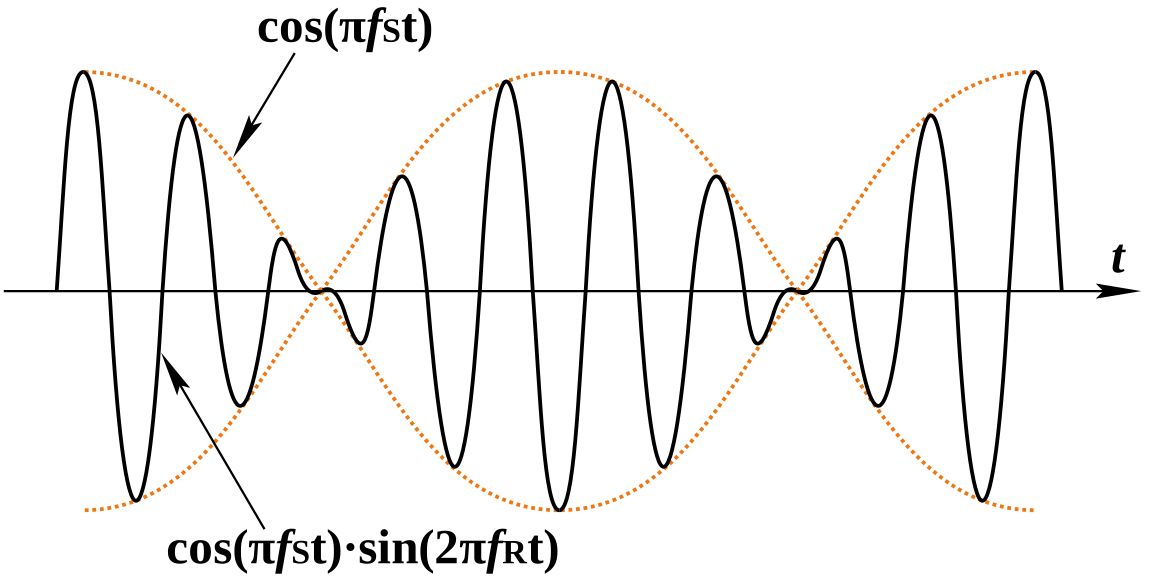
The beat pattern. Two waves with slightly different frequencies create an amplitude envelope that rises and falls at fbeat=∣f1−f2∣. Piano tuners listen for this pulsing and adjust until the beats disappear. Credit: Wikimedia Commons, CC BY-SA
When two waves with slightly different frequencies overlap, they alternate between constructive interference (peaks align → loud moment) and destructive interference (peaks offset → quiet moment). The rate of this loud-quiet cycle is the beat frequency.
Practical Uses of Beats
Piano tuners use beats to tune. They strike a tuning fork (known frequency) alongside a piano string and listen for beats. If they hear 3 beats per second, the string is 3 Hz off. They tighten or loosen until the beats slow down and vanish — zero beats means the two frequencies are exactly equal.
Guitarists use the same trick. Hold the same note on two adjacent strings, listen for beats, and tune the second string up or down until the beats disappear. It’s an incredibly precise method — humans can detect beats as slow as a few per second, which corresponds to frequencies matching within a fraction of a Hz.
Pitch, Frequency, Loudness, and Intensity
The MCAT expects you to distinguish between the physical properties of sound and the subjective perception of those properties. These terms are not interchangeable.
Physical property
Symbol/unit
Subjective perception
Frequency
f (Hz)
Pitch
Intensity
I (W/m²)
Loudness
Waveform / harmonics
—
Timbre (tone quality)
Pitch is the subjective perception of frequency. Higher frequency → higher pitch. A 440 Hz tone sounds like the note A above middle C; an 880 Hz tone sounds like A one octave higher.
Loudness is the subjective perception of intensity. Higher intensity → louder sound. But loudness is not linearly proportional to intensity — it’s roughly logarithmic, which is why the decibel scale was invented (§7.6).
Timbre (tone quality) is what lets you distinguish a violin from a piano playing the same note at the same loudness. It depends on the mix of harmonics present in the sound — the violin and piano produce different overtone patterns.
Two tuning forks produce 512 Hz and 518 Hz. What beat frequency does a listener hear? If one fork is adjusted to 515 Hz, what's the new beat frequency?
Click to reveal answer
Initially 6 beats/s; after adjustment 3 beats/s.fbeat=∣f1−f2∣. As frequencies get closer, beats slow down. When the frequencies match exactly, beats disappear (which is how you know you're in tune).
A student says "this sound is higher-pitched because the intensity is greater." What's wrong with this statement?
Click to reveal answer
Pitch is determined by frequency, not intensity. Greater intensity makes a sound *louder*, not higher-pitched. A *louder* 200 Hz tone is still low-pitched. A *quiet* 4000 Hz whistle is still high-pitched.
A 440 Hz tuning fork beats with a guitar string at 3 beats per second. The guitarist tightens the string and the beat frequency increases to 5 beats per second. Was the original string flat (lower frequency) or sharp (higher frequency)?
Click to reveal answer
The string was sharp (higher frequency). Tightening a string raises its frequency. If the string was originally at 443 Hz (sharp by 3), tightening would raise it further to ~445 Hz (sharp by 5) — beats *increase*. If the string had been flat at 437 Hz, tightening would raise it toward 440 — beats would *decrease*. Since beats *increased*, the string must have started above 440 Hz.
Human hearing spans a limited frequency window — roughly 20 Hz to 20,000 Hz. Below that window lies infrasound (felt as a rumble more than heard). Above it lies ultrasound (inaudible to us, but used by bats for echolocation and by doctors for imaging).
Beyond the limits of normal wave behavior lies a different phenomenon entirely: shock waves, which form when an object outruns the sound it’s producing. The sonic boom of a fighter jet is the everyday example.
This section gives you the relevant numbers and the basic physics of each regime.
The Frequency Spectrum of Sound
Category
Frequency range
Examples
Infrasound
< 20 Hz
Earthquakes, elephant communication, large explosions
Audible sound
20 Hz – 20,000 Hz
Speech, music, environmental noise
Ultrasound
> 20,000 Hz (20 kHz)
Medical imaging, bat echolocation, sonar
Human hearing sensitivity declines with age — especially at the high-frequency end. Most adults can’t hear above about 15,000–17,000 Hz, while a teenager with healthy ears can hear close to 20,000 Hz.
Ultrasound in Medicine
Key medical applications of ultrasound:
Prenatal imaging — visualizing a developing fetus without using ionizing radiation (a huge advantage over X-ray for soft tissues).
Echocardiography — imaging heart chambers and valves in real time.
Doppler ultrasound — measuring blood flow velocity using the Doppler shift of reflected waves (covered in §7.8).
Lithotripsy — using focused ultrasound shock waves to break up kidney stones non-invasively.
Shock Waves and the Mach Number
When a sound source moves faster than the speed of sound in the medium, it outruns its own waves. The wave fronts pile up into a cone-shaped pressure front called a shock wave. You hear this as a sonic boom when the cone passes over your ears.
A common misconception: a sonic boom isn’t a one-time event when the plane “breaks the sound barrier.” The shock cone trails behind the plane continuously whenever it’s supersonic, and anyone who hears the cone passing over them hears a boom — even though the plane has been supersonic for hours. That’s why the FAA banned supersonic flight over land for civilian aircraft like the Concorde — every flight would have boomed every house along the path.
A jet travels at 680 m/s through air where the speed of sound is 340 m/s. What is its Mach number? Does a shock wave form?
Click to reveal answer
Mach 2; yes, a shock wave forms.M=680/340=2. Since $M > 1$, the jet is supersonic — it outruns its own sound waves, creating a cone-shaped pressure front (sonic boom).
Why does medical ultrasound use high frequencies (1–20 MHz) rather than audible frequencies?
Click to reveal answer
Higher frequencies → shorter wavelengths → better spatial resolution. You can resolve smaller structures than with longer wavelengths. Audible-frequency wavelengths would be tens of centimeters long — too large to image any anatomical detail. The trade-off: higher frequencies are absorbed faster by tissue, so they don't penetrate as deeply. Choose frequency based on what you're trying to image.
A bat emits ultrasound at 50 kHz with λ=? in air (v=340 m/s)? Why is shorter wavelength helpful for echolocation?
Click to reveal answer
λ=6.8 mm.λ=v/f=340/50,000=0.0068 m = 6.8 mm. The short wavelength lets the bat resolve insect-sized prey — wavelengths shorter than the target give clear echoes. A wavelength much larger than the target would diffract around it and produce no useful echo.
A child on a swing. A mass bouncing on a spring. A plucked guitar string. The atoms in a molecule vibrating against their bonds. All of these are examples of simple harmonic motion (SHM) — one of the most fundamental types of periodic motion in physics.
The MCAT tests SHM with relentless focus on two questions: what determines the period, and what does the energy do? Get these two pieces and you can answer almost any SHM question — and avoid the classic traps the exam loves to set.
What Makes Motion “Simple Harmonic”?
Simple harmonic motion happens whenever a restoring force is proportional to displacement and directed back toward the equilibrium position. Pull a mass to the right of equilibrium on a spring, and the spring pulls left. Push it to the left, the spring pushes right. The farther you displace it, the harder the spring pulls back.
🎯 Predict First
A mass on a spring is pulled twice as far from equilibrium before being released. What happens to the period of its oscillation?
Use the simulation below to watch a spring and a pendulum oscillate side-by-side. Adjust mass, spring constant, length, and gravity to see how each variable changes the period — and pay close attention to which variables surprisingly don’t matter.
Amplitude
Spring
Pendulum
Hooke’s Law
The spring is the canonical SHM system. Hooke’s law gives the restoring force:
A spring with large k (stiff) takes a lot of force to stretch and snaps back hard. A spring with small k (soft) stretches easily and returns gently. (Full Hooke’s law treatment in §2.5.)
Period of a Mass-Spring System
Period of a Simple Pendulum
The Critical MCAT Trap: What Does NOT Affect the Period?
This is the single most-tested SHM concept.
Energy in SHM
SHM plotted over time. Displacement is sinusoidal. Velocity is maximum at equilibrium (zero displacement) and zero at the extremes. Acceleration always points opposite to displacement — the hallmark of a restoring force. Credit: Wikimedia Commons, CC BY-SA
In an ideal (frictionless) SHM system, total mechanical energy is conserved. Energy oscillates between kinetic and potential forms:
At maximum displacement (amplitude): all PE (PEspring=21kx2 is maximum). KE = 0. Velocity = 0.
At equilibrium (x=0): all KE (21mv2 is maximum). PE = 0. Velocity is maximum.
In between: mix of KE and PE, with KE+PE = constant.
| Position | Displacement | Velocity | KE | PE |
|----------|-------------|----------|----|----|
| Maximum displacement (±A) | Maximum | 0 | 0 | Maximum |
| Equilibrium (x=0) | 0 | Maximum | Maximum | 0 |
A 2 kg mass hangs on a spring with k=200 N/m. What is the period? If the mass is replaced with 8 kg, what happens to the period?
Click to reveal answer
T≈0.63 s for 2 kg; T≈1.26 s for 8 kg.T=2πm/k. With 2 kg: T=2π0.01≈0.63 s. With 8 kg: T=2π0.04≈1.26 s. Quadrupling mass doubles the period (because T∝m).
A pendulum has period 2 s. If the bob’s mass is doubled, what’s the new period? If the length is quadrupled, what’s the new period?
Click to reveal answer
Mass doubled: still 2 s. Pendulum period doesn’t depend on mass. Length quadrupled: 4 s.T=2πL/g. Quadrupling L doubles T (4=2).
A mass on a spring oscillates with amplitude A. At what point is velocity greatest? At what point is the restoring force greatest?
Click to reveal answer
Velocity max at x=0 (equilibrium); restoring force max at x=±A (extremes). Velocity peaks at equilibrium where all energy is kinetic. Force peaks at maximum displacement (since F=−kx). When one is max, the other is zero — they’re 90° out of phase.
Push a child on a swing at just the right moment — matching the natural rhythm of the swing — and the amplitude builds with each push. Push at the wrong rhythm, and the swing barely moves no matter how hard you push.
That dramatic difference is resonance: the amplification of oscillations when an external driving force matches the system’s natural frequency. Resonance is everywhere — guitar bodies, MRI machines, the song that always seems to rattle one specific window in your room, the famous Tacoma Narrows bridge collapse. This section also wraps up the chapter with the three other classic wave behaviors at boundaries: reflection, refraction, and diffraction.
Resonance
Every object that can vibrate has a natural frequency (or set of natural frequencies) determined by its physical properties — mass, stiffness, shape, size. When an external periodic force drives the system at that natural frequency, energy transfers very efficiently into the oscillation, and amplitude grows dramatically.
Examples of Resonance
Musical instruments. A guitar body resonates at certain frequencies, amplifying the sound from the strings. Different instruments have different resonant frequency profiles → different timbres.
Tacoma Narrows Bridge (1940). Wind-driven oscillations matched the bridge’s natural torsional frequency, causing total collapse. (Iconic black-and-white footage worth a quick search.)
MRI. Radio-frequency pulses tuned to the Larmor frequency of hydrogen nuclei cause resonance, producing the signal that builds the image.
Microwave oven. Microwaves at ~2.45 GHz resonate with rotational modes of water molecules — heating water-containing food much more efficiently than dry food.
Wave Reflection
When a wave hits a boundary between two media, part of it bounces back (reflection) and part continues into the new medium (transmission). Behavior at the boundary depends on whether the end is fixed or free.
Fixed end (hard boundary): the reflected wave is inverted (flipped upside down). A crest comes back as a trough. Think of a rope tied to a wall — a pulse sent toward the wall returns upside down.
Free end (soft boundary): the reflected wave is upright (same orientation). A crest comes back as a crest. Think of a rope tied to a ring that slides freely on a pole.
Wave Refraction
Refraction is the bending of a wave as it crosses from one medium to another where it has a different speed. When a wave enters a slower medium, it bends toward the normal (the imaginary line perpendicular to the boundary). When it enters a faster medium, it bends away from the normal.
Why? Different parts of the wavefront cross the boundary at different times. The part that hits the new medium first slows down (or speeds up), while the rest of the wavefront is still in the original medium — the result is that the whole wavefront pivots and changes direction. (Same reason a row of marchers pivots when one end hits a muddy patch.)
Wave Diffraction
Diffraction is the spreading of waves as they pass through an opening or around an obstacle. When a wave hits a gap comparable in size to its wavelength, it spreads out a lot. When the gap is much larger than the wavelength, the wave passes through with minimal spreading.
This is why you can hear someone talking around a corner (sound wavelengths are comparable to doorway sizes — they diffract well) but you can’t see them (visible light wavelengths are vastly smaller than doorway sizes, so light barely diffracts and travels in nearly straight lines).
Summary of Wave Behaviors at Boundaries
Phenomenon
What happens
Key rule
Reflection (fixed end)
Wave bounces back, inverted
Crest becomes trough
Reflection (free end)
Wave bounces back, upright
Crest stays a crest
Refraction
Wave bends at a boundary
Bends toward normal when slowing down
Diffraction
Wave spreads through gaps / around obstacles
Maximum when gap size ≈ wavelength
What is the condition for resonance? What happens to the amplitude at resonance vs. other driving frequencies?
Click to reveal answer
Resonance: fdriving=fnatural. At resonance, amplitude reaches its maximum because energy transfers most efficiently into the system. At other frequencies, amplitude is smaller because energy transfer is less efficient.
A pulse travels along a rope and hits a wall where the rope is firmly attached. Describe the reflected pulse.
Click to reveal answer
Inverted (crest becomes trough). The fixed end can't move, so the wave exerts a force on the wall and the wall exerts an equal-and-opposite reaction force (Newton's 3rd law), creating the inverted reflection.
You can hear someone talking around a corner but can't see them. Explain using diffraction.
Click to reveal answer
Sound wavelengths are comparable to doorway sizes; light wavelengths are vastly smaller. Sound (~cm to m) diffracts significantly around corners — it spreads into the area you're standing in. Visible light (~hundreds of nm) is many orders of magnitude smaller than doorways, so it barely diffracts and continues nearly in straight lines.