
The Doppler Effect
You’ve heard the Doppler effect thousands of times without knowing the name. An ambulance siren sounds higher-pitched as it races toward you, then suddenly drops to a lower pitch the instant it passes. A car horn sounds higher as it approaches, lower as it pulls away. A train whistle does the same thing.
The siren itself is playing the same note the whole time. The sound didn’t change. What changed is how those sound waves arrive at your ear — and that depends on the relative motion between you and the source.
The Core Concept
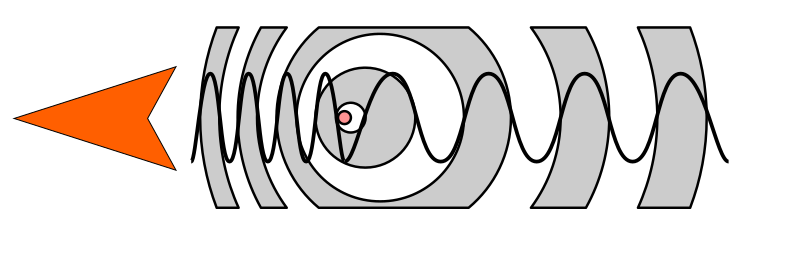
When a sound source moves toward you, it “chases” its own waves, scrunching them together. The wavelengths in front of the source are shorter — meaning higher frequency. Behind the source, waves get stretched apart — longer wavelength, lower frequency.
The same effect happens if you (the observer) move toward or away from a stationary source. Moving toward the source, you intercept wave crests more often (higher perceived frequency). Moving away, the crests take longer to catch up to you (lower perceived frequency).
An ambulance with a 400 Hz siren drives toward you at constant speed, passes you, and drives away at the same constant speed. What pitch do you hear?
Test your prediction with the simulation below. Set a source speed, press Play, and watch the wavefronts bunch together ahead of the moving source and spread apart behind it. Keep an eye on the observed frequency readout as the source passes the observer: it holds one steady value, then jumps.
The Doppler Equation
Rather than memorizing sign rules from scratch, use the SASH mnemonic and a sanity check.
How to Use the Formula
The key to getting the signs right: the perceived frequency should increase when source and observer are approaching, and decrease when they’re moving apart.
- Observer moving toward source: (more crests per second).
- Observer moving away from source: .
- Source moving toward observer: (compressed wavelengths in front).
- Source moving away from observer: .
- Both moving: combine the appropriate signs.
After plugging in: check whether for approaching motion (or for receding). If your answer goes the wrong way, you flipped a sign.
Worked Example
An ambulance siren emits a 700 Hz tone. The ambulance moves toward a stationary observer at 30 m/s. Speed of sound = 340 m/s. What frequency does the observer hear?
- Source approaching, observer stationary: .
- Hz.
The observer hears a higher pitch (768 > 700) — consistent with the source approaching. Once the ambulance passes and starts moving away, the formula flips to Hz. That sudden drop from ~768 Hz to ~643 Hz is exactly the “weeooooowwwww” you hear as a siren passes.
Doppler Effect for Light
About 567 Hz. Source receding, observer stationary: Hz. Lower frequency because source is moving away (SASH: source away → longer wavelength → lower ).
550 Hz. Observer approaching, source stationary: Hz. Observer hears higher pitch — they’re intercepting crests faster than usual.
Two Doppler shifts in succession. The cell sees an incoming wave of higher frequency than emitted (it’s “approaching” the source). When it reflects the wave back, the cell now acts as a moving source approaching the transducer → another upshift. The net result is double the standard Doppler shift, and the size of the shift tells the doctor how fast the blood is flowing.