
Standing Waves
Standing waves are one of the most heavily tested wave topics on the MCAT. They show up in passages about guitar strings, organ pipes, vocal cords, ear canals, and even atomic and molecular vibrations. The good news: once you understand the boundary conditions, every standing wave problem becomes a drawing exercise — sketch a picture, count wavelengths, plug into the formula.
A pipe that is closed at one end resonates at a fundamental frequency of 100 Hz. Which of these frequencies can it also resonate at?
Use the simulation below to check your prediction. Switch between the string and the two pipe types, then step through the harmonics and watch how the boundaries force a node (N) or antinode (A) at each end. Pay special attention to the closed pipe: the harmonic slider skips every even value because no even harmonic can satisfy both boundaries at once.
How Standing Waves Form
When a wave travels down a string fixed at both ends and reflects back, the incoming and reflected waves interfere with each other. At certain special frequencies, the interference produces a wave pattern that appears to stand still — specific points on the string never move (called nodes), while other points oscillate with maximum amplitude (called antinodes).
Nodes and Antinodes
- Nodes are points of zero displacement. The string (or air column) never moves there. Nodes come from perfect destructive interference between incoming and reflected waves.
- Antinodes are points of maximum displacement. They sit exactly halfway between adjacent nodes. Antinodes come from constructive interference.
Strings and Open Pipes (Both Ends the Same)
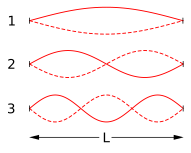
A string fixed at both ends has nodes at both ends. An open pipe has antinodes at both ends. Despite the different boundary conditions (node vs. antinode), the math works out the same for both — because both ends are the same type of boundary.
The fundamental (first harmonic, ) fits exactly half a wavelength in the length of the string or pipe. Each successive harmonic adds another half-wavelength.
| Harmonic | | Nodes (string) | Wavelength | Frequency |
|----------|---|----------------|------------|-----------|
| 1st (fundamental) | 1 | 2 (both ends) | | |
| 2nd | 2 | 3 | | |
| 3rd | 3 | 4 | | |
| 4th | 4 | 5 | | |
Closed Pipes (One Open End, One Closed End)
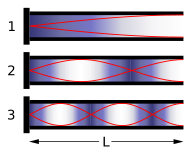
A closed pipe has an antinode at the open end and a node at the closed end — the boundaries are different. This asymmetry changes everything. The fundamental fits only one quarter of a wavelength, and only odd harmonics are present.
Drawing Standing Waves: The Strategy
Recipe for any standing wave problem:
- Identify boundary conditions (node or antinode at each end).
- Draw the fundamental — the simplest wave that satisfies both boundaries.
- Count how many half-wavelengths (or quarter-wavelengths) fit.
- Use the formula to find and .
For the fundamental ():
- String / open pipe: one half-wavelength fits in , so .
- Closed pipe: one quarter-wavelength fits in , so .
Harmonics vs. Overtones
This terminology trips people up. The fundamental is the 1st harmonic. Overtones are all frequencies above the fundamental.
| Term | String / Open Pipe | Closed Pipe |
|------|-------------------|-------------|
| Fundamental | 1st harmonic () | 1st harmonic () |
| 1st overtone | 2nd harmonic () | 3rd harmonic () |
| 2nd overtone | 3rd harmonic () | 5th harmonic () |
| 3rd overtone | 4th harmonic () | 7th harmonic () |
Hz; Hz. Hz. For a string (both ends fixed), all harmonics: , so Hz.
Hz; next is Hz. Hz. Closed pipes only have odd harmonics, so the next is the 3rd: Hz. (No 2nd harmonic exists.)
Look at the boundaries. Both ends the same type (both nodes or both antinodes) → all harmonics (strings fixed at both ends, open pipes). Ends different (one node, one antinode) → odd harmonics only (closed pipes). The asymmetry forbids the even harmonics.