
Superposition and Interference
When two people talk in a room at the same time, you hear both voices simultaneously. The sound waves don’t bounce off each other or get mangled — they just pass through each other, briefly overlap, and continue on their way as if the other wave wasn’t there.
That’s the superposition principle, and it’s one of the most powerful ideas in wave physics. It explains noise-canceling headphones, the colors of soap bubbles, the dark/bright bands in CD reflections, and why some seats at a concert hall sound great while others (just feet away) sound dead.
The Superposition Principle
When two or more waves occupy the same space at the same time, the total displacement at any point is the algebraic sum of the individual displacements. After passing through each other, the waves continue as if they had never met — each with its original amplitude, frequency, and direction.
Constructive Interference
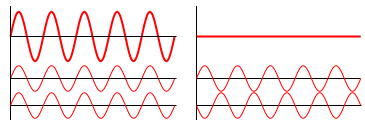
When two waves arrive at the same point in phase (crest meets crest, trough meets trough), their amplitudes add. The combined wave has a larger amplitude than either individually. If both waves have amplitude , the combined amplitude is .
Constructive interference happens when the path length difference between two coherent sources is a whole number of wavelengths:
Destructive Interference
When two waves arrive out of phase (crest meets trough), their amplitudes subtract. If both waves have equal amplitude, the result is zero — complete cancellation.
Destructive interference happens when the path length difference is half a wavelength off — half, one-and-a-half, two-and-a-half wavelengths, and so on:
Interactive Wave Explorer
Two identical sound waves arrive at the same point exactly 180 degrees out of phase. What is the result where they overlap?
Adjust the amplitude, frequency, and phase of two waves and watch them combine. Try the presets to see constructive interference (doubled amplitude), destructive interference (cancellation), and beats (pulsing loudness from slightly different frequencies).
In phase → amplitudes add (2A peak).
Partial Interference
Perfect constructive and destructive interference are special cases. Most of the time, waves overlap with some intermediate phase difference, producing partial reinforcement or partial cancellation. The resultant amplitude lies somewhere between zero and the full sum of the two amplitudes.
Path Length Difference Problems
The MCAT commonly presents two speakers (or two slits) emitting the same wave. A listener at some point P is at a different distance from each source. The question: does P experience constructive or destructive interference?
Step-by-step:
- Find the distance from each source to point P (call them and ).
- Compute the path length difference: .
- If the difference equals → constructive interference.
- If the difference equals → destructive interference.
Worked Example
Two speakers, separated by some distance, emit identical 1000 Hz tones in air ( m/s). A listener is 5.0 m from speaker A and 5.34 m from speaker B. Does the listener hear loud or quiet sound?
- Wavelength: m.
- Path difference: m = exactly.
- One whole wavelength → constructive → loud.
Move the listener slightly so the path difference becomes m = → destructive → quiet. This is exactly why concert halls have “dead spots” and “loud spots” — slight position changes can shift you between constructive and destructive interference.
Destructive. Path difference: m. Divide by : wavelengths. That’s — one-and-a-half wavelengths off, so destructive interference.
(a) 8 cm. (b) 0 cm. Constructive: amplitudes add → cm. Destructive: amplitudes subtract → (complete cancellation). These are the max and min possible resultants.
Max: 8 cm. Min: 2 cm. Constructive: cm. Destructive: cm (the bigger wave wins; cancellation is partial because the amplitudes don’t match).