
Transverse vs. Longitudinal Waves
All waves carry energy through a medium (or through space, in the case of light) — but they do it in one of two fundamentally different ways. The classification comes down to a single question:
Which direction do the particles move, relative to the direction the wave travels?
If they move perpendicular to the wave’s direction → transverse wave (like water waves, light, a vibrating guitar string).
If they move parallel to the wave’s direction → longitudinal wave (like sound, a Slinky compression, earthquake P-waves).
Once you can spot the difference, identifying any wave on the MCAT becomes automatic.
Transverse Waves
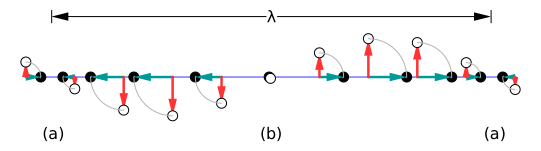
In a transverse wave, particles oscillate perpendicular to the direction of wave propagation. Picture shaking a rope up and down — the wave travels horizontally along the rope, but each point on the rope moves vertically.
Examples of transverse waves:
- Vibrating guitar string or shaken rope.
- Water surface waves (particles actually move in circles, but the displacement is perpendicular to wave direction).
- All electromagnetic (EM) waves: light, radio, X-rays, microwaves.
Important note: transverse waves can only travel through solids (which resist shear) or along surfaces. They can’t move through the interior of fluids — liquids and gases have no shear resistance, so there’s nothing to spring back perpendicularly. The big exception: EM waves, which need no medium at all and travel through pure vacuum.
Longitudinal Waves
In a longitudinal wave, particles oscillate parallel to the direction of wave propagation. Picture pushing and pulling one end of a Slinky — the coils bunch together (compression) and spread apart (rarefaction) as the wave travels along the Slinky’s length.
In a longitudinal wave, regions of high density are called compressions and regions of low density are called rarefactions. One wavelength spans from one compression to the next (or one rarefaction to the next).
Examples of longitudinal waves:
- Sound waves in any medium (air, water, solids). Sound is always longitudinal.
- Compression waves in a Slinky.
- Earthquake P-waves (“primary” — they arrive first because they’re faster).
Quick Comparison
| Feature | Transverse | Longitudinal |
|---|---|---|
| Particle motion | Perpendicular to propagation | Parallel to propagation |
| Key visual | Crests and troughs | Compressions and rarefactions |
| Travels through | Solids, surfaces, vacuum (EM only) | Solids, liquids, gases |
| Main example | Light, rope wave | Sound, Slinky compression |
Can a Wave Be Both?
Surface water waves actually do a bit of both — particles near the surface move in circular or elliptical paths, combining vertical (transverse) and horizontal (longitudinal) motion. For the MCAT, you can usually treat water waves as transverse when analyzing the surface profile.
Some materials (solids) can carry both types of waves at once. In an earthquake, the P-waves (primary, longitudinal) arrive first because they travel faster, followed by S-waves (secondary, transverse). S-waves can’t pass through the liquid outer core of the Earth — this is how seismologists discovered that Earth’s outer core is liquid. The S-wave shadow zone on the far side of the Earth proved it.