The human ear is staggeringly sensitive. It can detect sound waves with intensities as low as 10−12 W/m² (literally a mosquito flying across a quiet room) — and it can tolerate sounds a trillion times more intense before reaching the pain threshold.
Because that range is so enormous, plain intensity numbers (in W/m²) become unwieldy fast. So we use a logarithmic scale — decibels (dB) — that compresses the trillion-fold range into a manageable 0–120. The MCAT loves decibels because they teach you how logarithms compress huge ranges, and because they show up in passages on hearing, music, hearing loss, and noise pollution.
Sound Intensity
Intensity is the power delivered per unit area, measured in W/m².
The Decibel Scale
Because intensity spans 12 orders of magnitude between the faintest audible sound and the pain threshold, we use a logarithmic compression:
The Key dB Shortcuts
You don’t need a calculator for MCAT decibel problems. These three rules cover almost every question:
Intensity change
dB change
2× intensity
+3 dB
10× intensity
+10 dB
100× intensity
+20 dB
1000× intensity
+30 dB
Going the other direction:
Every +10 dB → 10× more intense.
Every +20 dB → 100× more intense.
Every +30 dB → 1000× more intense.
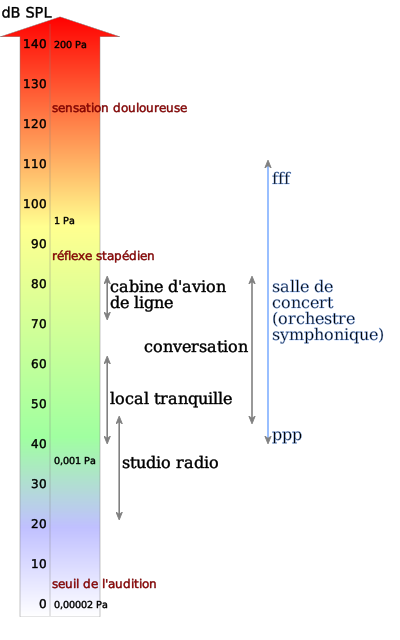
The decibel scale compresses the enormous range of human hearing. Each 10 dB step represents a tenfold change in intensity. Threshold of hearing (0 dB) and threshold of pain (120 dB) span a factor of one trillion in intensity. Credit: Wikimedia Commons, CC BY-SA
Common Sound Levels
Sound
Intensity Level (dB)
Intensity (W/m²)
Threshold of hearing
0
10−12
Whisper
20
10−10
Quiet office
40
10−8
Normal conversation
60
10−6
Vacuum cleaner
80
10−4
Rock concert
110
10−1
Threshold of pain
120
100=1
Jet engine (nearby)
140
102
Hearing damage starts to happen with prolonged exposure above about 85 dB — which is why sustained exposure to loud music, lawnmowers, or industrial noise can cause permanent hearing loss over time.
Worked Example
A siren produces a sound level of 90 dB at 10 m away. What’s the sound level at 100 m?
Distance grows by 10× (from 10 m to 100 m).
Intensity follows inverse square: I drops by 102=100.
dB change: 10log(1/100)=10×(−2)=−20 dB.
New level: 90−20=70 dB.
So a siren that’s painfully loud right next to you (90 dB) drops to “loud TV” level (70 dB) just 100 m away. This is why ambulances need to be very loud at the source — they’re projecting outward from a point.
A sound has intensity 10−5 W/m². What is its sound level in decibels? (I0=10−12 W/m²)
Click to reveal answer
70 dB.β=10log(I/I0)=10log(10−5/10−12)=10log(107)=70 dB. About the loudness of a typical conversation or a TV at moderate volume.
How much more intense is a 100 dB sound than a 60 dB sound?
Click to reveal answer
10,000× more intense. Difference: 40 dB. Each 10 dB = 10× intensity, so 40 dB = 104=10,000. A jackhammer (100 dB) delivers 10,000× more sound power per area than normal conversation (60 dB) — that's why prolonged construction noise damages hearing.
A speaker has sound level 80 dB at 2 m. What is the sound level at 20 m?
Click to reveal answer
60 dB. Distance grew 10×, so intensity drops by 100 (inverse square). Δβ=10log(1/100)=−20 dB. New level: 80−20=60 dB.