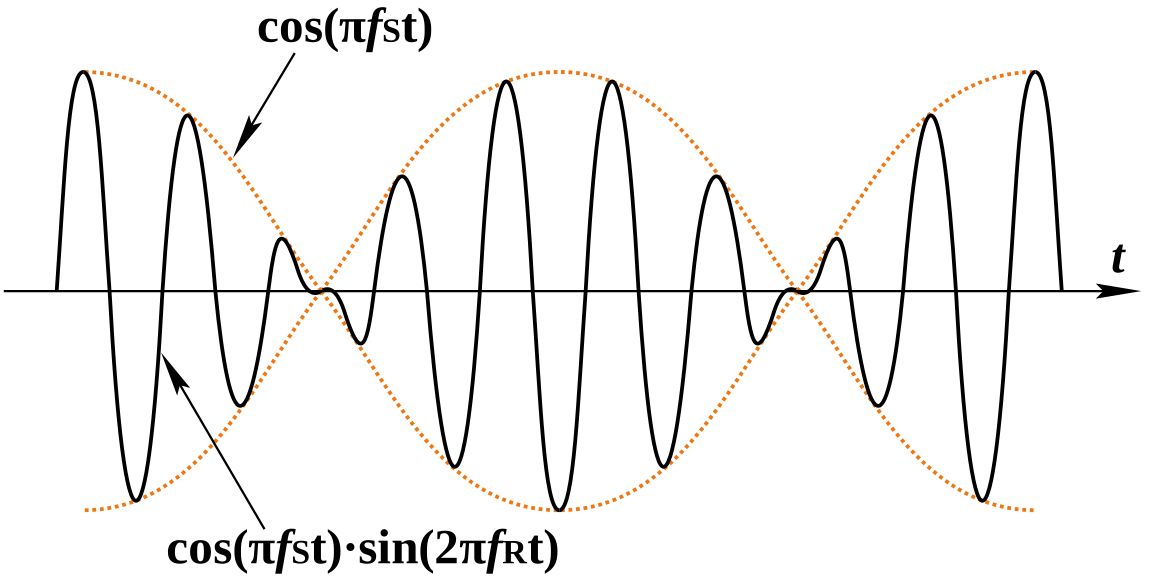
When two guitarists play notes that are almost — but not quite — the same frequency, you hear a strange rhythmic pulsing: the sound swells and fades, swells and fades. The two notes briefly add up to make a louder sound, then drift out of phase and partially cancel, then add up again.
That wavering effect is called beats, and it’s a direct consequence of the superposition principle from §7.3. Piano tuners, guitarists, and orchestra musicians all use beats to tune their instruments — when the beats slow to nothing, the two notes are exactly in tune.
This section also clears up a common confusion: the difference between physical sound properties (frequency, intensity) and the subjective perceptions they produce (pitch, loudness).
Beat Frequency
The beat pattern. Two waves with slightly different frequencies create an amplitude envelope that rises and falls at fbeat=∣f1−f2∣. Piano tuners listen for this pulsing and adjust until the beats disappear. Credit: Wikimedia Commons, CC BY-SA
When two waves with slightly different frequencies overlap, they alternate between constructive interference (peaks align → loud moment) and destructive interference (peaks offset → quiet moment). The rate of this loud-quiet cycle is the beat frequency.
Practical Uses of Beats
Piano tuners use beats to tune. They strike a tuning fork (known frequency) alongside a piano string and listen for beats. If they hear 3 beats per second, the string is 3 Hz off. They tighten or loosen until the beats slow down and vanish — zero beats means the two frequencies are exactly equal.
Guitarists use the same trick. Hold the same note on two adjacent strings, listen for beats, and tune the second string up or down until the beats disappear. It’s an incredibly precise method — humans can detect beats as slow as a few per second, which corresponds to frequencies matching within a fraction of a Hz.
Pitch, Frequency, Loudness, and Intensity
The MCAT expects you to distinguish between the physical properties of sound and the subjective perception of those properties. These terms are not interchangeable.
Physical property
Symbol/unit
Subjective perception
Frequency
f (Hz)
Pitch
Intensity
I (W/m²)
Loudness
Waveform / harmonics
—
Timbre (tone quality)
Pitch is the subjective perception of frequency. Higher frequency → higher pitch. A 440 Hz tone sounds like the note A above middle C; an 880 Hz tone sounds like A one octave higher.
Loudness is the subjective perception of intensity. Higher intensity → louder sound. But loudness is not linearly proportional to intensity — it’s roughly logarithmic, which is why the decibel scale was invented (§7.6).
Timbre (tone quality) is what lets you distinguish a violin from a piano playing the same note at the same loudness. It depends on the mix of harmonics present in the sound — the violin and piano produce different overtone patterns.
Two tuning forks produce 512 Hz and 518 Hz. What beat frequency does a listener hear? If one fork is adjusted to 515 Hz, what's the new beat frequency?
Click to reveal answer
Initially 6 beats/s; after adjustment 3 beats/s.fbeat=∣f1−f2∣. As frequencies get closer, beats slow down. When the frequencies match exactly, beats disappear (which is how you know you're in tune).
A student says "this sound is higher-pitched because the intensity is greater." What's wrong with this statement?
Click to reveal answer
Pitch is determined by frequency, not intensity. Greater intensity makes a sound *louder*, not higher-pitched. A *louder* 200 Hz tone is still low-pitched. A *quiet* 4000 Hz whistle is still high-pitched.
A 440 Hz tuning fork beats with a guitar string at 3 beats per second. The guitarist tightens the string and the beat frequency increases to 5 beats per second. Was the original string flat (lower frequency) or sharp (higher frequency)?
Click to reveal answer
The string was sharp (higher frequency). Tightening a string raises its frequency. If the string was originally at 443 Hz (sharp by 3), tightening would raise it further to ~445 Hz (sharp by 5) — beats *increase*. If the string had been flat at 437 Hz, tightening would raise it toward 440 — beats would *decrease*. Since beats *increased*, the string must have started above 440 Hz.