
Buffer Capacity
A buffer resists pH changes, but it cannot resist forever. Eventually, if you add enough acid or base, the buffer is overwhelmed and the pH changes dramatically. Buffer capacity tells you how much punishment the buffer can take before it breaks.
What Is Buffer Capacity?
Buffer capacity is the amount of strong acid or strong base that a buffer can absorb before its pH changes significantly (usually defined as more than 1 pH unit from pKa).
Buffer capacity depends on two factors:
- Total concentration of the buffer components - more buffer = more capacity
- The ratio of [A⁻]/[HA] - closest to 1:1 = maximum capacity
The Effective Buffer Range: pKa ± 1
A buffer works effectively only when the pH stays within approximately one pH unit of the pKa:
Effective buffer range = pKa ± 1
At the edges of this range:
- At pH = pKa + 1: [A⁻]/[HA] = 10 (10x more base form than acid form)
- At pH = pKa - 1: [HA]/[A⁻] = 10 (10x more acid form than base form)
Beyond these limits, one component is so depleted that the buffer can no longer resist pH changes effectively. The buffer “breaks.”
Why 1:1 Ratio Gives Maximum Capacity
When [A⁻] = [HA] (1:1 ratio, pH = pKa), the buffer has equal capacity to absorb both acid and base:
- Adding acid: uses up A⁻. Starting with lots of A⁻ means lots of capacity.
- Adding base: uses up HA. Starting with lots of HA means lots of capacity.
At a 1:1 ratio, both stockpiles are equal, giving balanced protection in both directions. If the ratio is 10:1, the buffer can absorb a lot of acid (plenty of A⁻) but very little base (almost no HA left).
How Concentration Affects Capacity
Compare two acetate buffers, both at pH = pKa = 4.74:
| Buffer | [CH₃COOH] | [CH₃COO⁻] | Capacity |
|---|---|---|---|
| Dilute | 0.010 M | 0.010 M | Low |
| Concentrated | 1.0 M | 1.0 M | High |
The concentrated buffer has 100 times more of each component, so it can neutralize 100 times more added acid or base before the ratio shifts beyond pKa ± 1.
What Happens When a Buffer Breaks
Once all of one component is consumed, the buffer ceases to function. For example, in an acetate buffer where you keep adding HCl:
- While buffer works: H⁺ + CH₃COO⁻ → CH₃COOH (pH barely changes)
- Buffer breaking point: all CH₃COO⁻ consumed
- After buffer breaks: added H⁺ accumulates freely, pH plummets rapidly
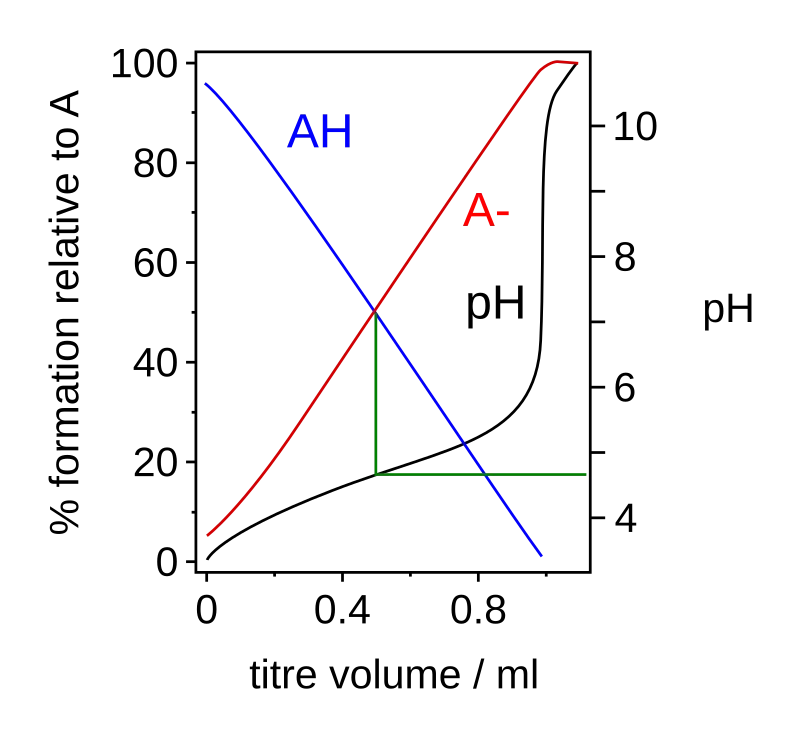
This “breaking” is visible on a titration curve as the steep rise or fall beyond the buffer region.
Choosing a Buffer for the MCAT
When a question asks you to select the best buffer for a given pH:
- Match pKa to desired pH (pKa should be within ±1 of target pH)
- The buffer pair must be a weak acid and its conjugate base (never a strong acid or strong base)
- Higher concentration = better buffer capacity
Preparing Buffers - Two Methods
Method 1: Mix a weak acid with the salt of its conjugate base directly.
- Example: mix CH₃COOH and CH₃COONa
Method 2: Start with excess weak acid and partially neutralize it with strong base.
- Example: add NaOH to CH₃COOH until half is converted to CH₃COO⁻
- This produces the same buffer (HA + A⁻) through a neutralization reaction
Both methods produce the same buffer. Method 2 is essentially what happens during the first half of a weak acid-strong base titration - which is why the buffer region appears on the titration curve.