There is not one definition of an acid - there are three. Each one expands on the last, casting a wider net over the kinds of reactions we call “acid-base.” The MCAT expects you to know all three, recognize when each applies, and understand why the broadest definition (Lewis) matters most in biochemistry.
Arrhenius Definition - The Narrow View
The Arrhenius definition is the simplest and oldest. It only works in water.
The limitation is obvious: this definition requires water. It cannot explain why NH₃ acts as a base when dissolved in a non-aqueous solvent, or why BF₃ behaves as an acid despite having no hydrogen atoms at all.
Brønsted-Lowry Definition - The Proton Transfer View
The Brønsted-Lowry definition removes the requirement for water. It focuses on proton transfer.
Brønsted-Lowry acid: a proton (H⁺) donor
Brønsted-Lowry base: a proton (H⁺) acceptor
In the reaction HCl + H₂O → H₃O⁺ + Cl⁻, HCl donates a proton to water (acid), and water accepts it (base). But in NH₃ + H₂O → NH₄⁺ + OH⁻, water donates a proton to ammonia - so now water is the acid and ammonia is the base.
This reveals an important property: water is amphoteric - it can act as either an acid or a base depending on its reaction partner.
Lewis Definition - The Broadest View
The Lewis definition abandons protons entirely and focuses on electron pairs.
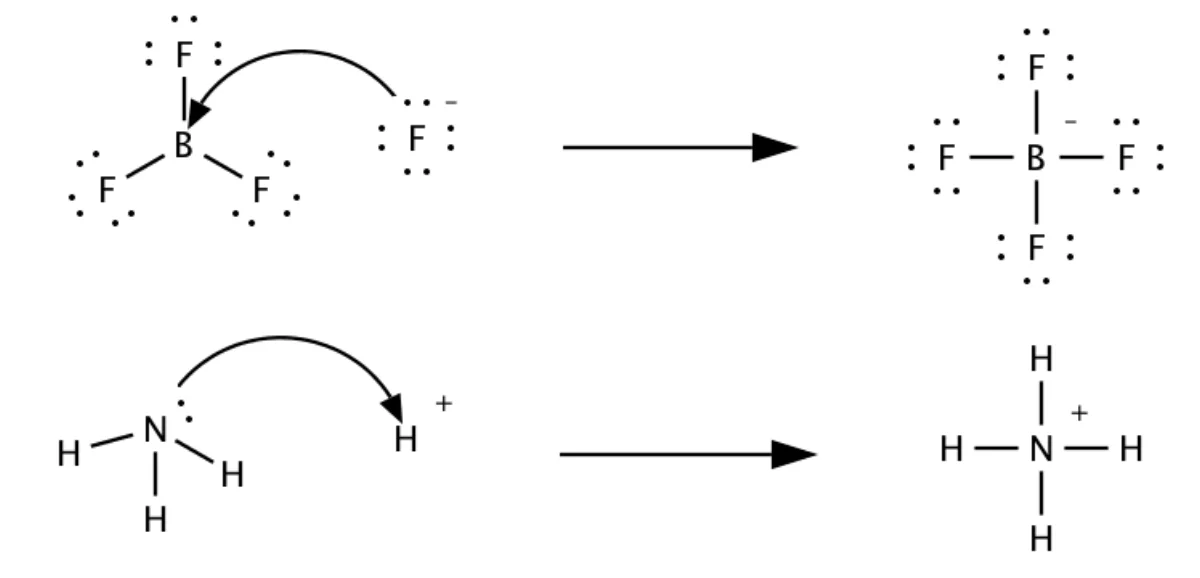
Lewis acid: an electron pair acceptor (has an empty orbital)
Lewis base: an electron pair donor (has a lone pair)
This is the most inclusive definition. Every Brønsted-Lowry acid is a Lewis acid, but Lewis acids also include species like BF₃, AlCl₃, and metal cations (Fe³⁺, Zn²⁺) - none of which have a proton to donate.
Example: When Fe³⁺ binds to water molecules in solution, Fe³⁺ is the Lewis acid (accepts electron pairs from water’s lone pairs) and H₂O is the Lewis base (donates its lone pairs). This is how hydration shells form around metal ions - and it is why transition metal chemistry is fundamentally Lewis acid-base chemistry.
Lewis acid-base reactions. Top: BF₃ (Lewis acid) accepts a lone pair from F⁻ (Lewis base), forming BF₄⁻. Bottom: NH₃ (Lewis base) donates its lone pair to H⁺ (Lewis acid), forming NH₄⁺. The curved arrows show the electron pair moving from the donor to the acceptor. Source: Wikimedia Commons.
How the Three Definitions Nest
Definition
Acid
Base
Scope
Arrhenius
Produces H⁺ in water
Produces OH⁻ in water
Narrowest - aqueous only
Brønsted-Lowry
Donates H⁺
Accepts H⁺
Medium - any solvent
Lewis
Accepts electron pair
Donates electron pair
Broadest - no proton needed
Each definition contains the one above it. Every Arrhenius acid is a Brønsted-Lowry acid. Every Brønsted-Lowry acid is a Lewis acid. But the reverse is not true - BF₃ is a Lewis acid but not a Brønsted-Lowry acid (no proton to donate).
BF₃ reacts with NH₃ to form F₃B-NH₃. Which acid-base definition(s) apply to this reaction?
Click to reveal answer
Only the Lewis definition. BF₃ has no proton to donate, so it is not a Brønsted-Lowry acid. It is not in aqueous solution producing H⁺, so it is not an Arrhenius acid. But BF₃ has an empty p orbital on boron that accepts a lone pair from NH₃ - making BF₃ a Lewis acid and NH₃ a Lewis base. This reaction cannot be classified as acid-base under Arrhenius or Brønsted-Lowry.
Water can act as both an acid and a base. What is this property called, and which definition explains it?
Click to reveal answer
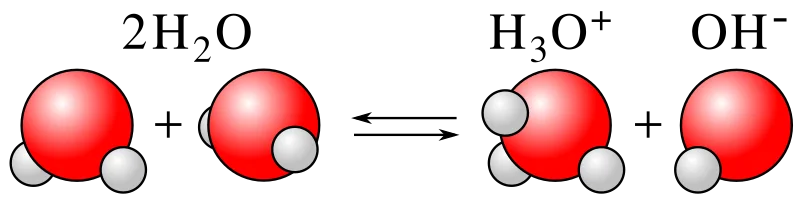
Amphoteric (or amphiprotic). The Brønsted-Lowry definition explains it: water can donate a proton (acting as an acid: H₂O → OH⁻ + H⁺) or accept a proton (acting as a base: H₂O + H⁺ → H₃O⁺). In autoionization, water acts as both simultaneously: H₂O + H₂O ⇌ H₃O⁺ + OH⁻.
Every time a Brønsted-Lowry acid donates a proton, it becomes something new - something that could accept a proton back. That “something new” is its conjugate base. Every acid-base reaction creates two conjugate pairs, and understanding this relationship is the key to predicting the direction of proton transfer.
What Conjugate Pairs Are
When an acid (HA) donates a proton, it becomes its conjugate base (A⁻). When a base (B) accepts a proton, it becomes its conjugate acid (BH⁺).
Example: CH₃COOH + H₂O ⇌ CH₃COO⁻ + H₃O⁺
Pair 1: CH₃COOH (acid) and CH₃COO⁻ (conjugate base) - differ by one H⁺
Pair 2: H₂O (base) and H₃O⁺ (conjugate acid) - differ by one H⁺
Every conjugate pair differs by exactly one proton. To find a conjugate base, remove one H⁺. To find a conjugate acid, add one H⁺.
The Inverse Strength Relationship
This is the single most important rule about conjugate pairs:
A strong acid has a very weak conjugate base. A weak acid has a relatively stronger conjugate base.
The same applies in reverse: a strong base has a very weak conjugate acid.
Acid
Strength
Conjugate Base
Strength
HCl
Strong
Cl⁻
Negligible (will not accept H⁺)
H₂SO₄
Strong
HSO₄⁻
Very weak
CH₃COOH
Weak (Ka=1.8×10⁻⁵)
CH₃COO⁻
Weak but functional
HCN
Very weak (Ka=6.2×10⁻¹⁰)
CN⁻
Relatively strong
H₂O
Very weak
OH⁻
Strong
Water's autoionization demonstrates conjugate pairs perfectly: one H₂O acts as an acid (donating H⁺ to become OH⁻) while another acts as a base (accepting H⁺ to become H₃O⁺). Each species differs from its conjugate by exactly one proton. Credit: Wikimedia Commons, Public Domain
Predicting the Direction of Proton Transfer
In any acid-base equilibrium, the proton transfers from the stronger acid to the stronger base. The equilibrium favors the side with the weaker acid and weaker base.
Rule: Equilibrium favors the formation of the weaker acid-base pair.
Example: Will HF donate a proton to CN⁻?
HF has Ka=6.8×10⁻⁴ (weak acid)
HCN has Ka=6.2×10⁻¹⁰ (much weaker acid)
Since HF is the stronger acid and CN⁻ is the stronger base, the proton transfers from HF to CN⁻. The equilibrium lies to the right: HF + CN⁻ ⇌ F⁻ + HCN.
Identifying Conjugate Pairs in Complex Reactions
For any Brønsted-Lowry reaction, use this method:
Find the species that lost a proton - it became a conjugate base
Find the species that gained a proton - it became a conjugate acid
Match each acid with its conjugate base (they differ by one H⁺)
Salt Hydrolysis - Conjugate Pairs in Action
When a salt dissolves in water, its ions may act as acids or bases through hydrolysis:
Salt Type
Example
Ion that Hydrolyzes
Solution pH
Strong acid + strong base
NaCl
Neither
Neutral (pH 7)
Weak acid + strong base
NaCH₃COO
CH₃COO⁻ (base)
Basic (pH > 7)
Strong acid + weak base
NH₄Cl
NH₄⁺ (acid)
Acidic (pH < 7)
Weak acid + weak base
NH₄CH₃COO
Both
Compare Ka vs. Kb
For the last case (both ions hydrolyze), compare Ka of the conjugate acid to Kb of the conjugate base. Whichever is larger determines the pH.
What is the conjugate base of H₂PO₄⁻? What is the conjugate acid of H₂PO₄⁻?
Click to reveal answer
Conjugate base: HPO₄²⁻ (remove one H⁺). Conjugate acid: H₃PO₄ (add one H⁺). H₂PO₄⁻ is amphoteric - it can act as either an acid or a base. This is common for intermediate species of polyprotic acids.
A solution of potassium cyanide (KCN) is dissolved in water. Is the solution acidic, basic, or neutral?
Click to reveal answer
Basic. K⁺ is a spectator ion (from the strong base KOH). CN⁻ is the conjugate base of the weak acid HCN. CN⁻ hydrolyzes water: CN⁻ + H₂O ⇌ HCN + OH⁻, producing hydroxide ions. A salt from a strong base and weak acid always gives a basic solution.
A strong acid or strong base dissociates completely in water. There is no equilibrium, no Ka, no partial reaction. Every molecule breaks apart into ions. This makes pH calculations for strong acids and bases trivially easy - but first, you need to memorize which ones are strong.
The Seven Strong Acids
There are exactly seven strong acids. Everything else is weak.
Strong Acid
Formula
Notes
Hydrochloric acid
HCl
Hydrohalic acid
Hydrobromic acid
HBr
Hydrohalic acid
Hydroiodic acid
HI
Hydrohalic acid
Nitric acid
HNO₃
Oxyacid
Sulfuric acid
H₂SO₄
Diprotic - only 1st dissociation is strong
Perchloric acid
HClO₄
Strongest common oxyacid
Chloric acid
HClO₃
Oxyacid
Why HF Is Weak
Students are often surprised that HF is not a strong acid. Fluorine is the most electronegative element - shouldn’t it pull the proton away most easily?
The answer lies in bond strength, not electronegativity. The H-F bond is extremely short and strong (bond energy 570 kJ/mol vs. 431 kJ/mol for H-Cl). This bond is so tough to break that HF only partially dissociates in water. Electronegativity determines polarity, but bond strength determines how easily the proton leaves.
The Strong Bases
Strong bases are the hydroxides of Group 1 metals and the heavier Group 2 metals. They dissociate completely in water.
Strong Base
Formula
Group
Lithium hydroxide
LiOH
Group 1
Sodium hydroxide
NaOH
Group 1
Potassium hydroxide
KOH
Group 1
Rubidium hydroxide
RbOH
Group 1
Cesium hydroxide
CsOH
Group 1
Calcium hydroxide
Ca(OH)₂
Group 2
Strontium hydroxide
Sr(OH)₂
Group 2
Barium hydroxide
Ba(OH)₂
Group 2
What “Complete Dissociation” Means for Calculations
For a strong acid like HCl at concentration c:
HCl → H⁺ + Cl⁻ (100% dissociation)
[H⁺] = c
No Ka needed, no ICE table needed
For a strong base like NaOH at concentration c:
NaOH → Na⁺ + OH⁻ (100% dissociation)
[OH⁻] = c
For Ca(OH)₂ at concentration c:
Ca(OH)₂ → Ca²⁺ + 2 OH⁻
[OH⁻] = 2c (two hydroxides per formula unit)
Sulfuric Acid - A Special Case
H₂SO₄ is diprotic. Its first dissociation is strong (complete), but its second dissociation is weak (Ka2=1.2×10⁻²).
H₂SO₄ → H⁺ + HSO₄⁻ (strong, 100%)
HSO₄⁻ ⇌ H⁺ + SO₄²⁻ (weak, Ka₂ = 0.012)
For dilute H₂SO₄ solutions on the MCAT, you can usually approximate that both protons dissociate fully, giving [H⁺] ≈ 2c. But for more concentrated solutions or precise calculations, only the first dissociation is truly complete.
Which of the following is NOT a strong acid: HCl, HF, HBr, HNO₃?
Click to reveal answer
HF is NOT a strong acid. Despite fluorine being the most electronegative element, the H-F bond is extremely short and strong, making it difficult to break. HF is a weak acid with Ka=6.8×10⁻⁴. The other three (HCl, HBr, HNO₃) are all in the "Strong Seven" and dissociate completely.
What is [OH⁻] in a 0.050 M Ba(OH)₂ solution?
Click to reveal answer
[OH⁻] = 0.10 M. Ba(OH)₂ is a strong base that dissociates completely: Ba(OH)₂ → Ba²⁺ + 2 OH⁻. Each formula unit produces 2 hydroxide ions, so [OH⁻] = 2 x 0.050 = 0.10 M. This is a common MCAT trap - forgetting the factor of 2 for Group 2 hydroxides.
Most acids and bases are weak. They do not hand over all their protons or accept all available protons. Instead, they reach an equilibrium - and the position of that equilibrium is described by Ka or Kb.
Weak Acid Equilibrium
A weak acid HA partially dissociates in water:
HA + H₂O ⇌ H₃O⁺ + A⁻
The equilibrium constant for this reaction is Ka (the acid dissociation constant):
Common weak acids and their Ka values:
Weak Acid
Formula
Ka
pKa
Hydrofluoric acid
HF
6.8×10⁻⁴
3.17
Nitrous acid
HNO₂
4.5×10⁻⁴
3.35
Acetic acid
CH₃COOH
1.8×10⁻⁵
4.74
Carbonic acid
H₂CO₃
4.3×10⁻⁷
6.37
Dihydrogen phosphate
H₂PO₄⁻
6.2×10⁻⁸
7.21
Hydrocyanic acid
HCN
6.2×10⁻¹⁰
9.21
Weak Base Equilibrium
A weak base B accepts a proton from water:
B + H₂O ⇌ BH⁺ + OH⁻
The equilibrium constant for this reaction is Kb (the base dissociation constant):
The Relationship Between Ka, Kb, and Kw
For any conjugate acid-base pair, the product of Ka and Kb always equals Kw:
Example: Acetic acid has Ka=1.8×10⁻⁵. What is Kb for the acetate ion (CH₃COO⁻)?
Kb=Kw/Ka=(1.0×10−14)/(1.8×10−5)=5.6×10−10
This confirms that acetate is a much weaker base than acetic acid is an acid.
pKa and pKb - The Log Scale
Just as pH = -log[H⁺], we define:
pKa = -log(Ka) - a smaller pKa means a stronger acid
pKb = -log(Kb) - a smaller pKb means a stronger base
The “p” operator simply converts to a more convenient scale. An acid with Ka=10−5 has pKa=5. An acid with Ka=10−10 has pKa=10. The smaller the pKa, the stronger the acid.
Percent Dissociation
For weak acids, percent dissociation tells you what fraction of the acid molecules have donated their proton:
% dissociation = ([H⁺] at equilibrium / initial [HA]) x 100
Key facts about percent dissociation:
Diluting a weak acid increases percent dissociation (Le Chatelier’s principle - adding water shifts equilibrium right)
Ka does not change with dilution (it is a constant at a given temperature)
A stronger weak acid (larger Ka) has a higher percent dissociation at the same concentration
Ammonia (NH₃) has Kb=1.8×10⁻⁵. What is Ka for the ammonium ion (NH₄⁺)?
Click to reveal answer
Ka=5.6×10⁻¹⁰. NH₃ and NH₄⁺ are a conjugate acid-base pair. Ka×Kb=Kw, so Ka=Kw/Kb=(1.0×10−14)/(1.8×10−5)=5.6×10−10. The pKa of NH₄⁺ is about 9.26, confirming it is a very weak acid.
Two acids: Acid A has pKa = 3.2, Acid B has pKa = 8.1. Which is the stronger acid? Which conjugate base is stronger?
Click to reveal answer
Acid A is the stronger acid (lower pKa = more dissociation). Conjugate base of Acid B is the stronger base (weaker acid = stronger conjugate base). Acid A's conjugate base has pKb = 14 - 3.2 = 10.8 (very weak base). Acid B's conjugate base has pKb = 14 - 8.1 = 5.9 (relatively stronger base).
The hydrogen ion concentration in biological systems spans an enormous range - from about 10 M in concentrated stomach acid to 10−15 M in strong drain cleaner. Working with numbers that vary over 16 orders of magnitude is clumsy, so chemists use a logarithmic scale: pH.
Autoionization of Water
Pure water is not truly “neutral” in the sense that it has no ions. Water molecules constantly transfer protons to each other:
H₂O + H₂O ⇌ H₃O⁺ + OH⁻
This is the autoionization (or self-ionization) of water. The equilibrium constant for this process is Kw:
Defining pH and pOH
The “p” operator means “negative log”:
pH = -log[H⁺]
pOH = -log[OH⁻]
And from Kw, we get the critical relationship:
The pH Scale Mapped Out
pH
[H⁺]
[OH⁻]
Classification
Example
0
1 M
10−14 M
Strongly acidic
Battery acid
1
0.1 M
10−13 M
Strongly acidic
Stomach acid (HCl)
2
0.01 M
10−12 M
Acidic
Lemon juice
3
10−3 M
10−11 M
Acidic
Vinegar
5
10−5 M
10−9 M
Weakly acidic
Black coffee
7
10−7 M
10−7 M
Neutral
Pure water
8
10−8 M
10−6 M
Weakly basic
Seawater
10
10−10 M
10−4 M
Basic
Milk of magnesia
13
10−13 M
0.1 M
Strongly basic
Oven cleaner
14
10−14 M
1 M
Strongly basic
Drain cleaner (NaOH)
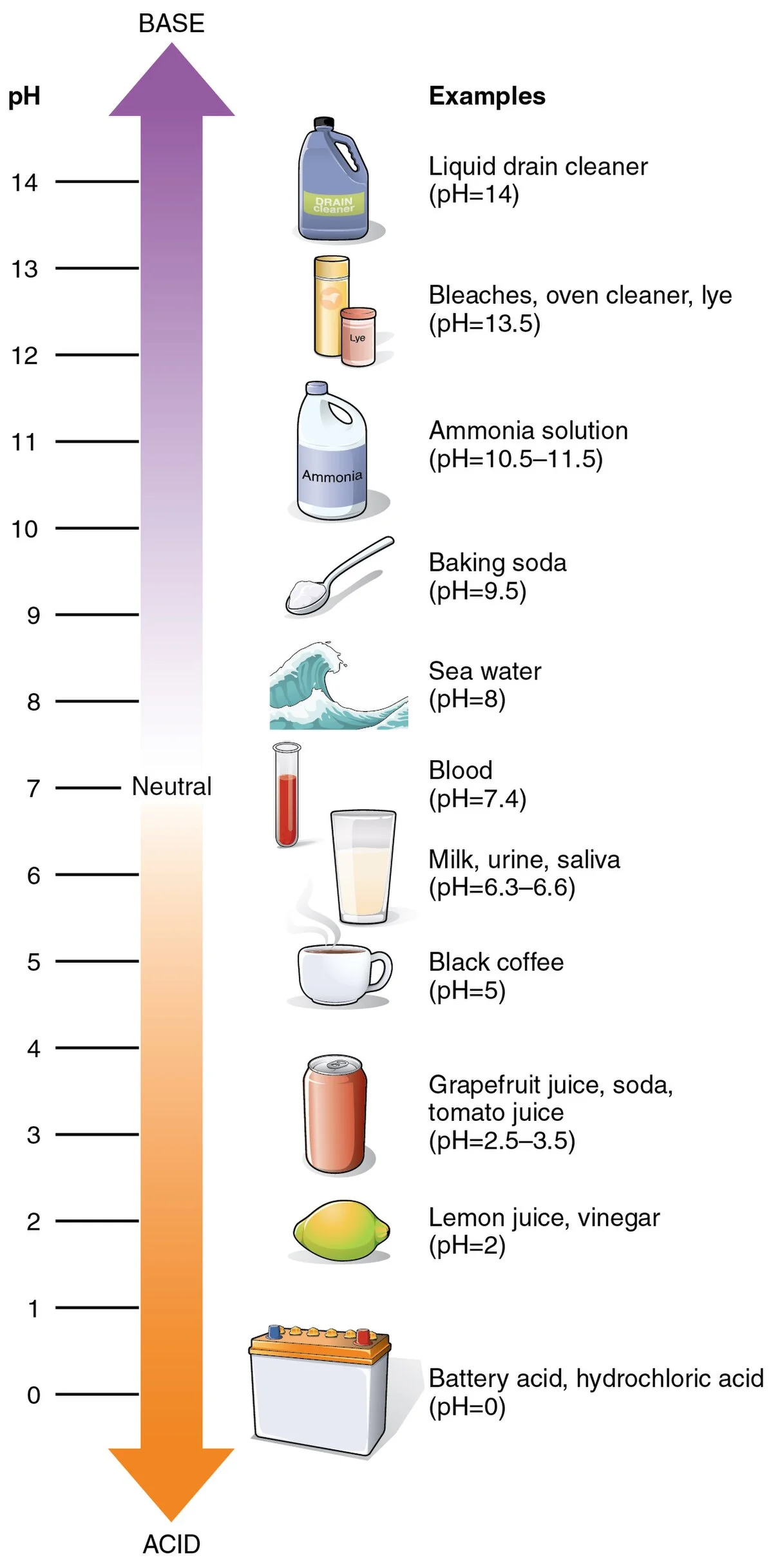
The pH scale with common substances. Battery acid (pH 0) and stomach acid (pH 1) are at the acidic extreme. Pure water sits at neutral (pH 7). Household bleach (pH 13) and drain cleaner (pH 14) are strongly basic. Source: Wikimedia Commons.
Converting Between pH and [H⁺]
Going from [H⁺] to pH:
If [H⁺] = 10⁻ˣ, then pH = x (exact power of 10 - easy)
If [H+]=3.5×10⁻⁴, then pH=−log(3.5×10⁻⁴)≈3.46
Going from pH to [H⁺]:
[H+]=10−pH
If pH = 5, then [H+]=10−5 M
If pH = 3.46, then [H+]=10−3.46≈3.5×10⁻⁴ M
Quick Estimation Tricks for the MCAT
The MCAT does not give you a calculator, so you need mental math shortcuts:
Exact powers of 10: If [H+]=10−3, pH = 3. Done.
Leading coefficient between 1 and 10: If [H+]=2×10⁻⁵, the pH is between 4 and 5 (closer to 5 since 2 is small). Specifically: −log(2)≈0.3, so pH≈5−0.3=4.7.
Know your logs: log(2) ≈ 0.3, log(3) ≈ 0.5, log(5) ≈ 0.7. These three values handle most MCAT pH calculations.
Temperature Dependence of Kw
Kw=10−14 is only valid at 25°C. At higher temperatures, Kw increases (autoionization is endothermic). At 37°C (body temperature), Kw≈2.4×10⁻¹⁴, meaning the neutral pH is slightly below 7 (about 6.8).
This means “neutral” does not always mean pH 7 - neutral means [H⁺] = [OH⁻], which only corresponds to pH 7 at 25°C.
A solution has [OH−]=5.0×10⁻³ M. What is the pH?
Click to reveal answer
pH = 11.7. First find pOH: pOH=−log(5.0×10⁻³)=3−log(5)=3−0.7=2.3. Then: pH=14−pOH=14−2.3=11.7. This is a basic solution (pH > 7), which makes sense since [OH⁻] is much larger than 10−7.
By how many times does [H⁺] change when the pH drops from 7.4 to 7.0?
Click to reveal answer
[H⁺] increases by a factor of about 2.5. At pH 7.4: [H+]=10−7.4≈4.0×10⁻⁸. At pH 7.0: [H+]=10−7=10.0×10⁻⁸. The ratio is 4.010.0 = 2.5. This illustrates why even small pH changes are physiologically significant - a drop of 0.4 pH units more than doubles the hydrogen ion concentration.
Calculating pH for strong acids and bases is the easiest type of acid-base problem. Because strong acids and bases dissociate completely, there is no equilibrium to solve - just arithmetic.
Strong Acid pH
For a monoprotic strong acid (like HCl, HBr, HI, HNO₃, HClO₃, HClO₄) at concentration c:
HCl → H⁺ + Cl⁻ (complete dissociation)
[H⁺] = c
pH = -log(c)
Example: What is the pH of 0.0020 M HCl?
[H+]=0.0020 M=2.0×10⁻³ M
pH=−log(2.0×10⁻³)=3−log(2)=3−0.3=2.7
Strong Base pH
For a monobasic strong base (like NaOH, KOH) at concentration c:
NaOH → Na⁺ + OH⁻ (complete dissociation)
[OH⁻] = c
pOH = -log(c)
pH = 14 - pOH
Example: What is the pH of 0.050 M NaOH?
[OH−]=0.050 M=5.0×10⁻² M
pOH=−log(5.0×10⁻²)=2−log(5)=2−0.7=1.3
pH = 14 - 1.3 = 12.7
For dibasic strong bases (like Ba(OH)₂, Ca(OH)₂):
[OH⁻] = 2c (two hydroxide ions per formula unit)
Example: What is the pH of 0.0010 M Ba(OH)₂?
[OH−]=2(0.0010)=0.0020 M=2.0×10⁻³ M
pOH = 3 - log(2) = 3 - 0.3 = 2.7
pH = 14 - 2.7 = 11.3
The Very Dilute Acid Trap
What is the pH of 10−8 M HCl?
If you naively calculate: pH=−log(10−8)=8.
But wait - pH 8 is basic! A solution of acid cannot be basic, no matter how dilute.
The problem: at 10−8 M, the contribution of H⁺ from the acid is comparable to the H⁺ from water’s autoionization (10−7 M). You must add both sources:
[H+]total=10−8+10−7=1.1×10⁻⁷ M
pH=−log(1.1×10⁻⁷)≈6.96 (just barely acidic, as expected)
Mixing Strong Acids and Strong Bases
When a strong acid and strong base are mixed, the net reaction is neutralization:
H⁺ + OH⁻ → H₂O
After mixing, determine which species is in excess:
Calculate moles of H⁺ = Macid x Vacid
Calculate moles of OH⁻ = Mbase x Vbase (multiply by 2 for dibasic)
The excess determines pH
Example: 50.0 mL of 0.10 M HCl is mixed with 30.0 mL of 0.10 M NaOH. What is the pH?
Moles H⁺ = (0.10)(0.050) = 0.0050 mol
Moles OH⁻ = (0.10)(0.030) = 0.0030 mol
Excess H⁺ = 0.0050 - 0.0030 = 0.0020 mol
Total volume = 80.0 mL = 0.080 L
[H+]=0.0020/0.080=0.025 M=2.5×10⁻² M
pH = 2 - log(2.5) ≈ 2 - 0.4 = 1.6
What is the pH of 0.0030 M HNO₃?
Click to reveal answer
pH = 2.5. HNO₃ is a strong acid, so [H+]=0.0030 M=3.0×10⁻³ M. pH=−log(3.0×10⁻³)=3−log(3)=3−0.5=2.5.
25 mL of 0.20 M HCl is mixed with 25 mL of 0.20 M NaOH. What is the pH?
Click to reveal answer
pH = 7.0. Moles of H⁺ = (0.20)(0.025) = 0.005 mol. Moles of OH⁻ = (0.20)(0.025) = 0.005 mol. Equal moles react completely - neither is in excess. The resulting solution is just NaCl in water (neutral salt), so pH = 7. This is the equivalence point of a strong acid-strong base titration.
Calculating pH for a weak acid or base requires an equilibrium calculation. The acid does not fully dissociate, so you need to solve for the equilibrium concentration of H⁺ using Ka and an ICE table.
Weak Acid pH - The ICE Table Method
For a weak acid HA with initial concentration c and acid dissociation constant Ka:
Step 1: Write the equilibrium and set up the ICE table.
On the MCAT, this rarely comes up because they typically give you concentrations and Ka values where the approximation works. But if you are told that Ka is 10−2 and c is 0.10, then c/Ka=10 - the approximation fails, and you need the quadratic (or they will give you enough information to avoid it).
Checking Your Answer
Always verify that your answer makes sense:
Weak acid solution: pH must be between 0 and 7 (acidic but not as low as a strong acid at the same concentration)
Weak base solution: pH must be between 7 and 14
Percent dissociation should be small (less than 5% if you used the approximation)
Higher concentration = lower pH for acids (more acid = more H⁺)
What is the pH of a 0.040 M solution of HCN (Ka=4.0×10⁻¹⁰)?
Click to reveal answer
pH = 5.4. Check approximation: 0.040/(4.0×10−10)=108>>100, so the approximation holds. [H+]=4.0×10−10×0.040=1.6×10−11=4.0×10⁻⁶. pH=−log(4.0×10⁻⁶)=6−log(4)=6−0.6=5.4.
Which has a lower pH: 0.10 M acetic acid (Ka=1.8×10⁻⁵) or 0.10 M HCN (Ka=6.2×10⁻¹⁰)?
Click to reveal answer
Acetic acid has the lower pH (more acidic). At the same concentration, the acid with the larger Ka dissociates more, producing more H⁺. Ka of acetic acid (1.8×10⁻⁵) is roughly 30,000 times larger than Ka of HCN (6.2×10⁻¹⁰). More dissociation = more H⁺ = lower pH.
Polyprotic acids have more than one proton to donate, but they do not give them all up at once. Each proton leaves in a separate step, and each step has its own Ka - getting progressively smaller as it becomes harder to pull a proton from an already-negative species.
Stepwise Dissociation
A diprotic acid like H₂CO₃ dissociates in two steps:
Step 1: H₂CO₃ ⇌ H⁺ + HCO₃⁻ (Ka1=4.3×10⁻⁷)
Step 2: HCO₃⁻ ⇌ H⁺ + CO₃²⁻ (Ka2=4.7×10⁻¹¹)
A triprotic acid like H₃PO₄ dissociates in three steps:
Step 1: H₃PO₄ ⇌ H⁺ + H₂PO₄⁻ (Ka1=7.5×10⁻³)
Step 2: H₂PO₄⁻ ⇌ H⁺ + HPO₄²⁻ (Ka2=6.2×10⁻⁸)
Step 3: HPO₄²⁻ ⇌ H⁺ + PO₄³⁻ (Ka3=4.8×10⁻¹³)
Why Each Ka Gets Smaller
Each successive Ka is always smaller than the previous one - typically by a factor of 104 to 106. The reason is electrostatic:
Removing the first proton from a neutral molecule (H₃PO₄) is relatively easy.
Removing the second proton from a negatively charged ion (H₂PO₄⁻) is harder because you are pulling a positive proton away from a negative species.
Removing the third proton from a doubly negative ion (HPO₄²⁻) is even harder.
Common Polyprotic Acids on the MCAT
Acid
Type
Ka₁
Ka₂
Ka₃
Biological Role
H₂SO₄
Diprotic
Strong
1.2×10⁻²
-
Lab acid
H₂CO₃
Diprotic
4.3×10⁻⁷
4.7×10⁻¹¹
-
Blood buffer system
H₃PO₄
Triprotic
7.5×10⁻³
6.2×10⁻⁸
4.8×10⁻¹³
DNA backbone, ATP
H₂C₂O₄
Diprotic
5.9×10⁻²
6.4×10⁻⁵
-
Oxalic acid (kidney stones)
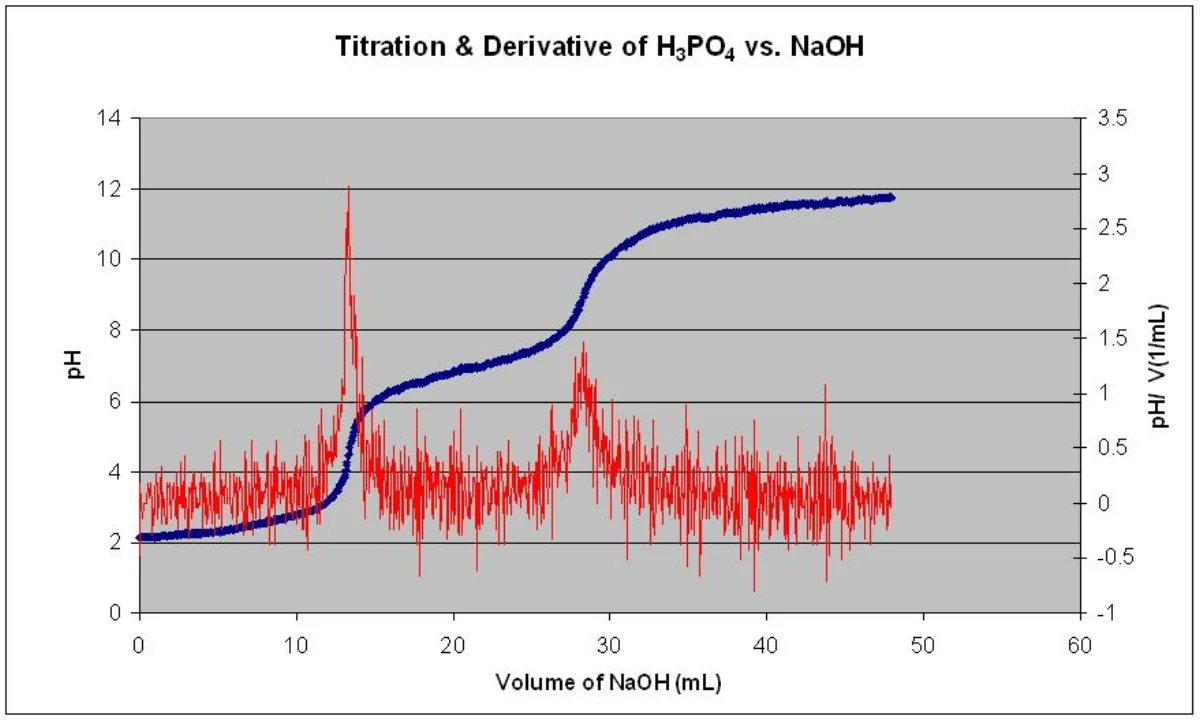
Titration curve of H₃PO₄ (a triprotic acid) titrated with NaOH. The blue curve shows two visible equivalence points, with the third occurring at very high pH. The red derivative curve highlights where the pH changes most rapidly. Each flat buffer region corresponds to a different conjugate pair. Source: Wikimedia Commons.
Calculating pH of a Polyprotic Acid
Because Ka1>>Ka2 (typically by 104 or more), the first dissociation produces nearly all of the H⁺ in solution. The second and third dissociations contribute negligible additional H⁺.
The shortcut: To find the pH of a polyprotic acid, use only Ka₁. Treat it as a monoprotic weak acid.
Example: What is the pH of 0.10 M H₂CO₃?
Use Ka1=4.3×10⁻⁷ only:
[H+]=Ka1×c=4.3×10−7×0.10=4.3×10⁻⁸≈2.1×10⁻⁴
pH≈4−log(2.1)≈4−0.3=3.7
(The second dissociation would add roughly 4.7×10⁻¹¹ M more H⁺ - completely negligible.)
Finding the Concentration of the Fully Deprotonated Species
Although Ka₂ does not affect pH significantly, MCAT questions sometimes ask for the concentration of the second or third conjugate base.
For a diprotic acid: the concentration of the fully deprotonated species (A²⁻) numerically equals Ka₂ (when the x-is-small approximation applies to the first dissociation).
This is because at equilibrium: Ka₂ = [H⁺][A²⁻] / [HA⁻]. Since [H⁺] ≈ [HA⁻] from the first dissociation, Ka₂ ≈ [A²⁻].
Amphoteric Intermediate Species
The intermediate species of a polyprotic acid (like HCO₃⁻ or H₂PO₄⁻) are amphoteric - they can act as either an acid or a base. The pH of a solution of the amphoteric species is approximated by:
pH ≈ (pKa₁ + pKa₂) / 2
This averages the two relevant pKa values, giving the pH at which the amphoteric species is most stable (neither donating nor accepting protons significantly).
Why is Ka₂ always smaller than Ka₁ for any polyprotic acid?
Click to reveal answer
Electrostatic attraction. After the first proton leaves, the remaining species is negatively charged. Removing a positive proton from a negative ion requires more energy than removing one from a neutral molecule. Each successive deprotonation increases the negative charge, making each subsequent proton harder to remove. This is reflected in progressively smaller Ka values.
What is the approximate pH of a 0.10 M NaHCO₃ solution? (Ka1 of H₂CO₃ =4.3×10⁻⁷, Ka2=4.7×10⁻¹¹)
Click to reveal answer
pH ≈ 8.3. HCO₃⁻ is amphoteric. pH ≈ (pKa₁ + pKa₂)/2 = (6.37 + 10.33)/2 = 216.7 ≈ 8.3. This makes sense - NaHCO₃ (baking soda) solutions are mildly basic.
A titration curve is a graph of pH versus the volume of titrant (acid or base) added. It tells you everything: the strength of the acid or base being titrated, the pKa, the equivalence point, and the buffer region. Reading titration curves quickly is one of the most tested skills in MCAT general chemistry.
The Anatomy of a Titration Curve
Every titration curve has these regions:
Initial point - pH before any titrant is added
Buffer region - the gradual rise (or fall) where both HA and A⁻ coexist
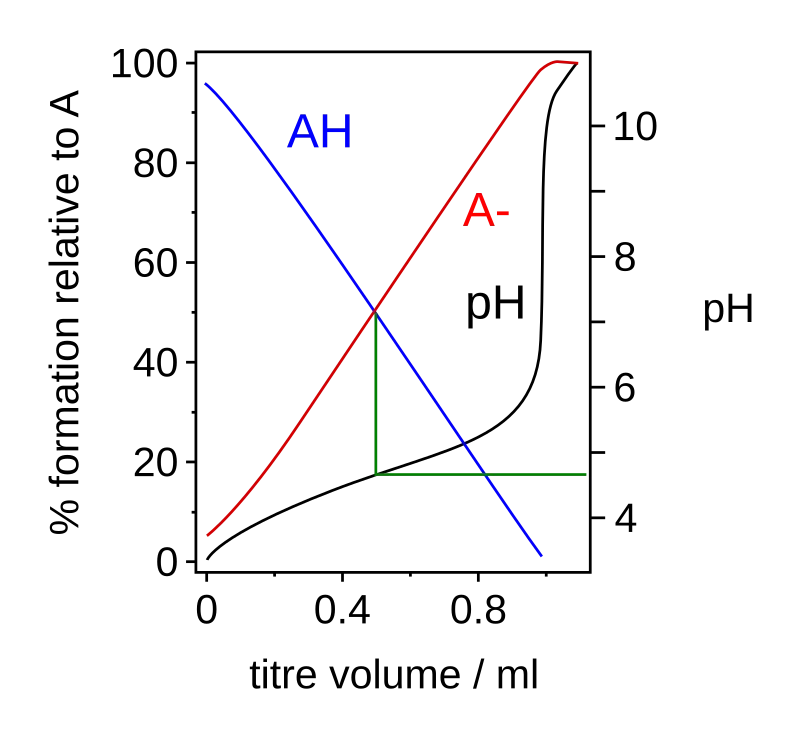
Half-equivalence point - exactly halfway to the equivalence point, where [HA] = [A⁻] and pH = pKa
Equivalence point - where moles of acid = moles of base (neutralization complete)
Post-equivalence region - excess titrant dominates the pH
Strong Acid + Strong Base Titration
Example: Titrating HCl with NaOH
Key features:
Initial pH: low (determined by [HCl])
Equivalence point pH: exactly 7.0 (only water and a neutral salt remain)
Curve shape: steep, dramatic jump centered at pH 7
No buffer region (strong acids have no conjugate base that buffers)
At the equivalence point: moles HCl = moles NaOH. The solution contains only NaCl and water - both neutral.
Weak Acid + Strong Base Titration
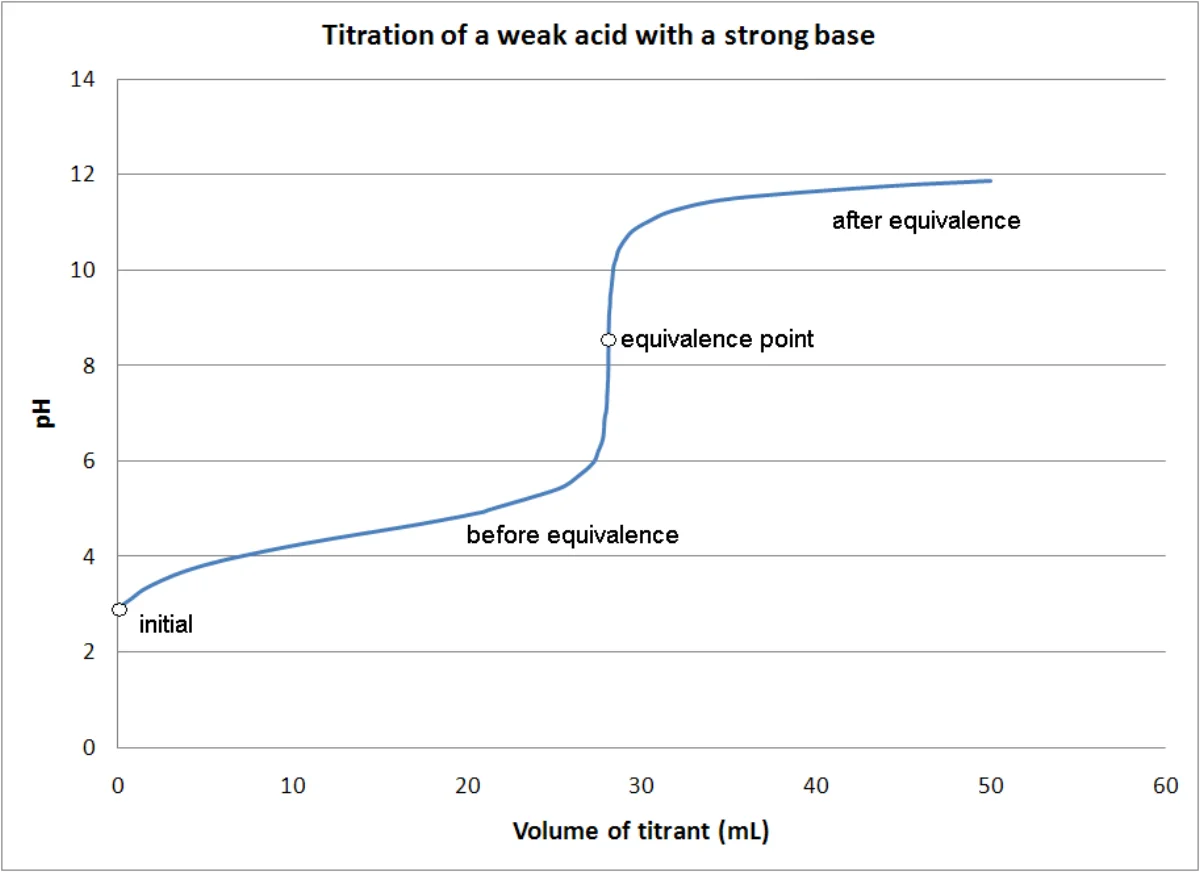
Example: Titrating CH₃COOH with NaOH
Key features:
Initial pH: higher than the strong acid case (weak acid, less H⁺)
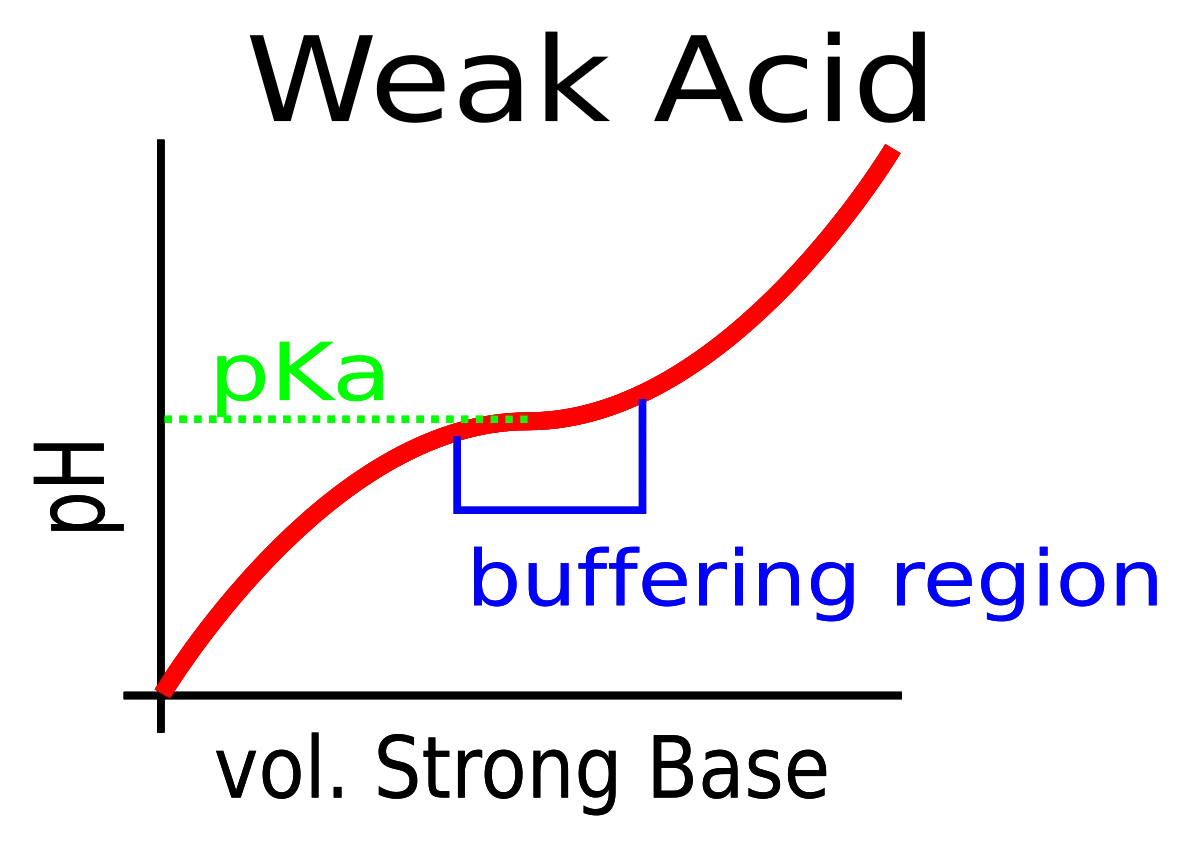
Buffer region: the flat area before the equivalence point where both CH₃COOH and CH₃COO⁻ coexist
Half-equivalence point: pH = pKa (this is how you find pKa experimentally)
Equivalence point pH: above 7 (the solution contains only the conjugate base CH₃COO⁻, which is a weak base)
Curve shape: gentler rise, equivalence point shifted above pH 7
Titration curve of a weak acid titrated with a strong base. The four labeled regions show: the initial point (low pH), the buffer region before equivalence, the equivalence point (above pH 7 because the conjugate base is basic), and the post-equivalence region where excess strong base dominates. Source: Wikimedia Commons.
Weak Base + Strong Acid Titration
Example: Titrating NH₃ with HCl
Key features:
Initial pH: above 7 (basic solution)
Buffer region: where both NH₃ and NH₄⁺ coexist
Half-equivalence point: pOH = pKb, so pH = 14 - pKb = pKa of the conjugate acid
Equivalence point pH: below 7 (the solution contains NH₄⁺, a weak acid)
Curve shape: pH decreases as acid is added, steep drop at equivalence
Summary: Equivalence Point pH
Titration Type
Equivalence Point pH
Why
Strong acid + strong base
Exactly 7
Only neutral salt remains
Weak acid + strong base
Above 7
Conjugate base of weak acid remains (basic)
Weak base + strong acid
Below 7
Conjugate acid of weak base remains (acidic)
Weak acid + weak base
Depends on Ka vs. Kb
Compare Ka of conjugate acid to Kb of conjugate base
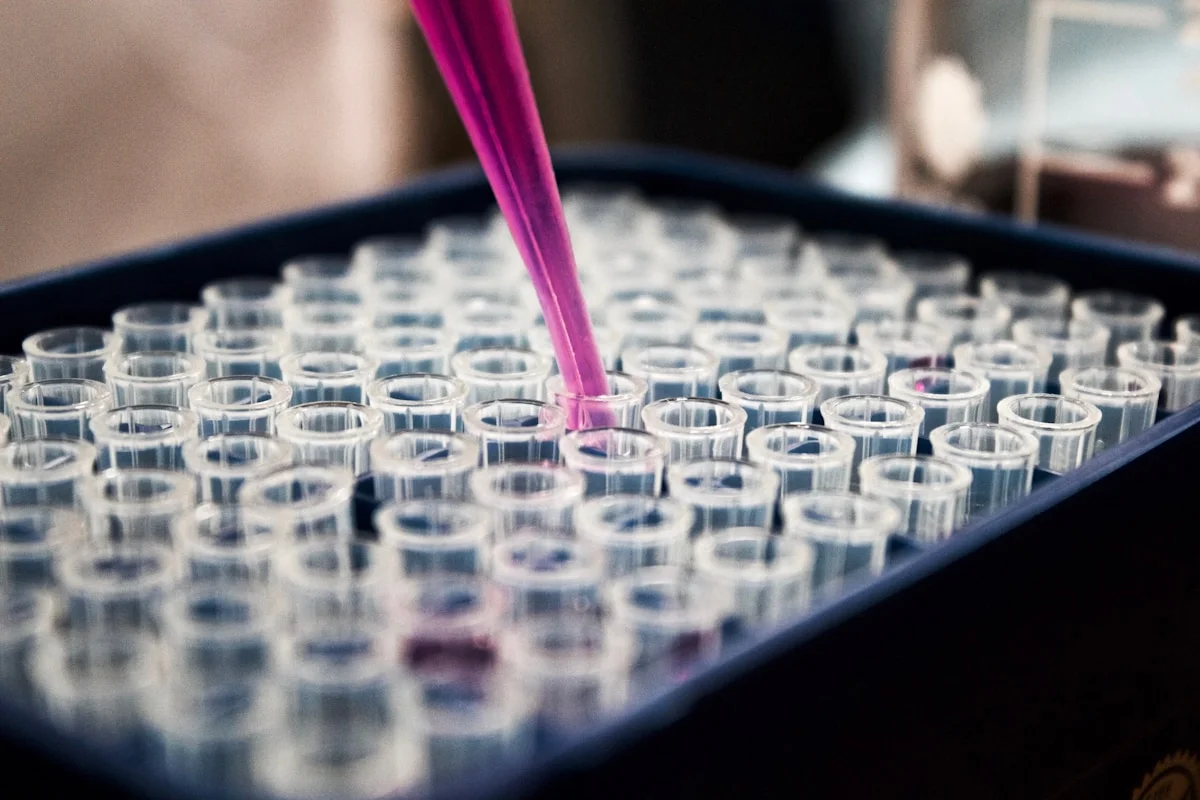
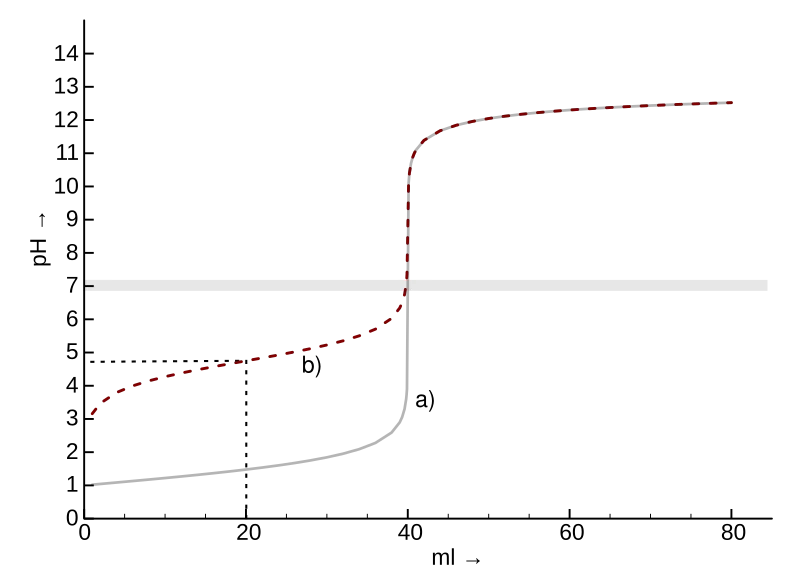
Acid-base chemistry in the lab. A pipette dispenses pink indicator solution into wells of a microplate. Color changes like this signal when a reaction endpoint has been reached. Source: Unsplash.Titration curves for HCl (strong acid, blue) and acetic acid (weak acid, red) titrated with NaOH. Key differences: the weak acid starts at a higher pH, shows a buffer region before the equivalence point, and has an equivalence point above pH 7 due to hydrolysis of the conjugate base. Credit: Wikimedia Commons, Public Domain
Reading a Titration Curve on the MCAT
When you see a titration curve, extract this information immediately:
Initial pH - read from the y-axis at volume = 0
Equivalence point - the steepest part of the curve (the inflection point of the steep rise)
Volume at equivalence - read from the x-axis at the equivalence point
Half-equivalence volume - half of the equivalence volume
pH at half-equivalence - this equals pKa (for weak acid titrated with strong base)
pH at equivalence - above 7 (weak acid) or below 7 (weak base) or exactly 7 (strong-strong)
Calculating the Equivalence Point
At the equivalence point:
moles of acid = moles of base
Macid x Vacid = Mbase x Vbase (for monoprotic acids and monobasic bases)
Solve for the unknown concentration or volume.
pH at the Equivalence Point of a Weak Acid Titration
At the equivalence point of a weak acid-strong base titration, all the HA has been converted to A⁻. The solution is equivalent to a solution of the sodium salt of the weak acid.
To find the pH: treat A⁻ as a weak base with Kb = Kw/Ka, and use [OH⁻] = √(Kb x c), where c is the concentration of A⁻ at the equivalence point (accounting for dilution).
A weak acid is titrated with NaOH. The equivalence point occurs at 25.0 mL of NaOH, and the pH at 12.5 mL of NaOH is 4.74. What is the pKa of the acid?
Click to reveal answer
pKa = 4.74. 12.5 mL is exactly half of 25.0 mL (the equivalence volume), so 12.5 mL is the half-equivalence point. At the half-equivalence point, [HA] = [A⁻], so pH = pKa. The acid is acetic acid (pKa = 4.74).
Is the equivalence point pH of a weak base titrated with a strong acid above 7, below 7, or exactly 7?
Click to reveal answer
Below 7 (acidic). At the equivalence point, all of the weak base has been converted to its conjugate acid. The conjugate acid of a weak base is itself a weak acid, which will donate protons to water and make the solution acidic. For example, titrating NH₃ with HCl produces NH₄⁺ at equivalence - a weak acid with Ka=5.6×10⁻¹⁰.
An acid-base indicator is a weak acid (or weak base) that changes color when it gains or loses a proton. The protonated form (HIn) has one color, and the deprotonated form (In⁻) has a different color. By choosing an indicator whose color change occurs near the equivalence point of your titration, you can visually detect when neutralization is complete.
How Indicators Work
An indicator is itself a weak acid in equilibrium:
HIn ⇌ H⁺ + In⁻
(Color A) (Color B)
The equilibrium constant for this dissociation is KIn:
KIn = [H⁺][In⁻] / [HIn]
When [H⁺] is high (acidic solution), the equilibrium shifts left → more HIn → Color A dominates
When [H⁺] is low (basic solution), the equilibrium shifts right → more In⁻ → Color B dominates
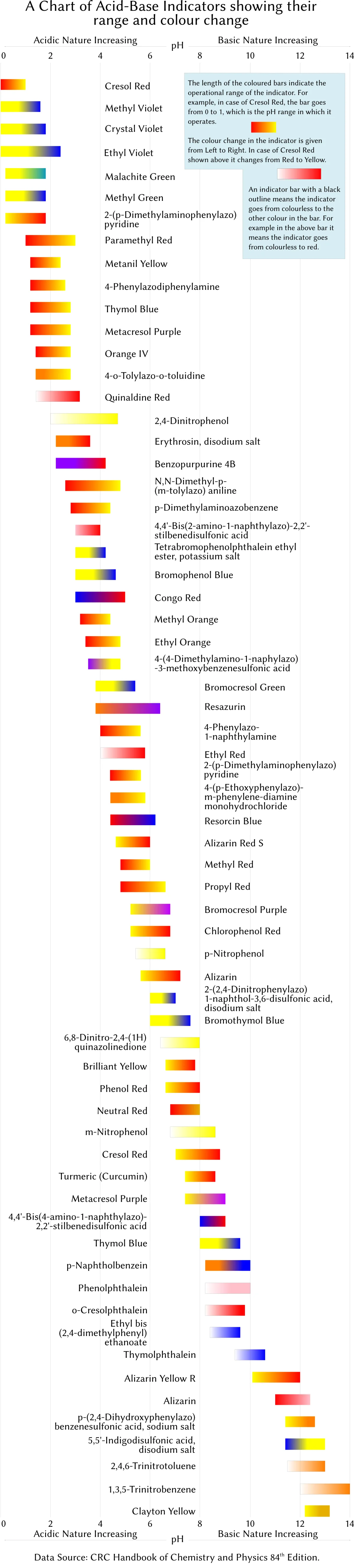
The color change occurs over a range of about 2 pH units centered on the pKIn (the pKa of the indicator).
Common Indicators
Indicator
Color (Acid)
Color (Base)
pH Range
pKIn
Methyl violet
Yellow
Violet
0.0 - 1.6
~0.8
Methyl orange
Red
Yellow
3.2 - 4.4
3.46
Bromocresol green
Yellow
Blue
3.8 - 5.4
4.7
Methyl red
Red
Yellow
4.8 - 6.0
5.0
Litmus
Red
Blue
5.0 - 8.0
6.5
Bromothymol blue
Yellow
Blue
6.0 - 7.6
7.1
Phenolphthalein
Colorless
Pink
8.2 - 10.0
9.4
Alizarin yellow R
Yellow
Red
10.1 - 12.0
11.0
Acid-base indicator color chart. Each horizontal bar shows the pH range over which an indicator changes color. Common MCAT indicators include methyl orange (red to yellow, pH 3-4), phenolphthalein (colorless to pink, pH 8-10), and bromothymol blue (yellow to blue, pH 6-8). Source: Wikimedia Commons, data from CRC Handbook of Chemistry and Physics.
Choosing the Right Indicator
The indicator must change color at a pH close to the equivalence point of the titration:
Titration Type
Equivalence Point pH
Best Indicator Choice
Strong acid + strong base
7.0
Bromothymol blue (6.0 - 7.6)
Weak acid + strong base
Above 7 (typically 8 - 10)
Phenolphthalein (8.2 - 10.0)
Weak base + strong acid
Below 7 (typically 4 - 6)
Methyl orange (3.2 - 4.4) or Methyl red (4.8 - 6.0)
The Endpoint vs. the Equivalence Point
These are not the same thing:
Equivalence point: the theoretical point where moles of acid = moles of base (exact neutralization)
Endpoint: the experimental point where the indicator changes color
A well-chosen indicator makes the endpoint approximately equal to the equivalence point. A poorly chosen indicator gives an inaccurate result because the color change occurs at the wrong pH.
Why the Color Change Spans About 2 pH Units
The indicator changes color gradually over a pH range of approximately pKIn ± 1. This is because:
At pH = pKIn - 1: [HIn] / [In⁻] = 10 (10x more acid form - Color A dominates)
At pH = pKIn + 1: [HIn] / [In⁻] = 0.1 (10x more base form - Color B dominates)
The human eye can generally detect when one form is about 10x more abundant than the other, which is why the visible transition covers about 2 pH units.
A student titrates 0.10 M NH₃ (a weak base) with 0.10 M HCl and uses phenolphthalein as the indicator. Will this give an accurate result?
Click to reveal answer
No. The equivalence point for a weak base-strong acid titration is below pH 7 (around pH 5 for ammonia). Phenolphthalein changes color at pH 8.2 - 10, which is far above the equivalence point. The indicator would change color well before the equivalence point is reached, causing the student to stop adding acid too early. A better choice would be methyl red (pH 4.8 - 6.0) or methyl orange (pH 3.2 - 4.4).
An indicator has pKIn = 5.0 and is yellow in acid, blue in base. What color is it at pH 3? At pH 7?
Click to reveal answer
At pH 3: yellow. At pH 7: blue. At pH 3, [H⁺] is high, pushing the equilibrium toward HIn (acid form = yellow). At pH 7, which is 2 units above pKIn, virtually all indicator is in the In⁻ form (base form = blue). The color transition would occur between approximately pH 4 and 6.
A buffer is a solution that resists changes in pH when small amounts of acid or base are added. Buffers are everywhere in biology - your blood, every cell in your body, and every biochemistry experiment relies on them. On the MCAT, buffers are one of the most frequently tested topics in all of general chemistry.
What Makes a Buffer
A buffer requires two components:
A weak acid (HA) - to neutralize any added base
Its conjugate base (A⁻) - to neutralize any added acid
Both must be present in significant amounts. Common buffer systems:
The conjugate base “soaks up” the added protons, converting to the weak acid. [A⁻] decreases slightly, [HA] increases slightly, but pH barely changes.
When base (OH⁻) is added:
HA + OH⁻ → A⁻ + H₂O
The weak acid neutralizes the added hydroxide, converting to the conjugate base. [HA] decreases slightly, [A⁻] increases slightly, but pH barely changes.
The buffer region on a weak acid titration curve. The flat, gently sloping section before the steep rise is the buffer region, where added base causes only small pH changes. The pKa (green dashed line) marks the midpoint of this region, where [HA] = [A⁻]. Source: OpenStax.
The Henderson-Hasselbalch Equation
This is the master equation for buffer chemistry:
Key Implications of Henderson-Hasselbalch
Condition
[A⁻] vs [HA]
log([A⁻]/[HA])
pH vs pKa
[A⁻] = [HA]
Equal
0
pH = pKa
[A⁻] > [HA]
More base form
Positive
pH > pKa
[A⁻] < [HA]
More acid form
Negative
pH < pKa
[A⁻] = 10[HA]
10x more base
+1
pH = pKa + 1
[HA] = 10[A⁻]
10x more acid
-1
pH = pKa - 1
Making a Buffer at a Specific pH
To prepare a buffer at a desired pH:
Choose a weak acid whose pKa is close to the desired pH (within ±1)
Use Henderson-Hasselbalch to calculate the required ratio [A⁻]/[HA]
Mix the weak acid and its conjugate base (usually as a sodium or potassium salt) in that ratio
Example: You want a buffer at pH 5.00 using acetic acid (pKa = 4.74).
pH = pKa + log([A⁻]/[HA])
5.00 = 4.74 + log([A⁻]/[HA])
log([A⁻]/[HA]) = 0.26
[A−]/[HA]=100.26≈1.8
You need about 1.8 times as much acetate as acetic acid.
The Bicarbonate Buffer System
The most important buffer in human physiology - and the foundation for understanding acid-base disorders in biology:
CO₂ + H₂O ⇌ H₂CO₃ ⇌ H⁺ + HCO₃⁻
At blood pH 7.40, using pKa₁ = 6.10 for the CO₂/HCO₃⁻ system:
pH = 6.10 + log([HCO₃⁻]/[CO₂])
7.40 = 6.10 + log([HCO₃⁻]/[CO₂])
log([HCO₃⁻]/[CO₂]) = 1.30
[HCO₃⁻]/[CO₂] = 20
Normal blood has about 20 times more bicarbonate than dissolved CO₂. This ratio maintains the pH at 7.40.
Using Henderson-Hasselbalch During a Titration
Henderson-Hasselbalch works at any point during a weak acid-strong base titration (except the initial point and the equivalence point):
Before any base is added: Use Ka and ICE table (no A⁻ yet)
Between initial and equivalence: Use Henderson-Hasselbalch (both HA and A⁻ present)
At half-equivalence: pH = pKa (simplest case)
At equivalence: Use Kb of the conjugate base (all HA converted to A⁻)
Past equivalence: Excess strong base determines pH
A buffer contains 0.30 M acetic acid and 0.30 M sodium acetate (pKa = 4.74). What is the pH? What happens to the pH if 0.01 mol of HCl is added to 1 L of this buffer?
Click to reveal answer
Initial pH = 4.74. [A⁻] = [HA], so log(1) = 0 and pH = pKa = 4.74. After adding 0.01 mol HCl: the H⁺ converts 0.01 mol of A⁻ to HA. New [A⁻] = 0.29 M, new [HA] = 0.31 M. pH = 4.74 + log(0.310.29) = 4.74 + log(0.935) = 4.74 - 0.03 = 4.71. The pH dropped by only 0.03 units. Without the buffer, 0.01 mol HCl in 1 L of water would give pH = 2.0 - a drop of nearly 5 pH units.
Which of the following would make a good buffer at pH 7.2? (A) HCl / NaCl (B) CH₃COOH / CH₃COONa (pKa 4.74) (C) H₂PO₄⁻ / HPO₄²⁻ (pKa 7.21) (D) NH₃ / NH₄Cl (pKa 9.25)
Click to reveal answer
C) H₂PO₄⁻ / HPO₄²⁻. A buffer works best when pH is within ±1 of pKa. The phosphate system has pKa₂ = 7.21, which is nearly identical to the target pH 7.2. Choice A fails because HCl is a strong acid (no equilibrium). Choice B has pKa = 4.74 (too far from 7.2). Choice D has pKa = 9.25 (also too far). This is why the phosphate buffer is used in biological experiments at physiological pH.
A buffer resists pH changes, but it cannot resist forever. Eventually, if you add enough acid or base, the buffer is overwhelmed and the pH changes dramatically. Buffer capacity tells you how much punishment the buffer can take before it breaks.
What Is Buffer Capacity?
Buffer capacity is the amount of strong acid or strong base that a buffer can absorb before its pH changes significantly (usually defined as more than 1 pH unit from pKa).
Buffer capacity depends on two factors:
Total concentration of the buffer components - more buffer = more capacity
The ratio of [A⁻]/[HA] - closest to 1:1 = maximum capacity
The Effective Buffer Range: pKa ± 1
A buffer works effectively only when the pH stays within approximately one pH unit of the pKa:
Effective buffer range = pKa ± 1
At the edges of this range:
At pH = pKa + 1: [A⁻]/[HA] = 10 (10x more base form than acid form)
At pH = pKa - 1: [HA]/[A⁻] = 10 (10x more acid form than base form)
Beyond these limits, one component is so depleted that the buffer can no longer resist pH changes effectively. The buffer “breaks.”
A buffer titration curve showing the effective buffer range. The relatively flat region around the half-equivalence point (where pH = pKa) is where the buffer resists pH changes most effectively. Outside the pKa ± 1 range, the buffer capacity drops sharply. Credit: Wikimedia Commons, CC BY-SA 4.0
Why 1:1 Ratio Gives Maximum Capacity
When [A⁻] = [HA] (1:1 ratio, pH = pKa), the buffer has equal capacity to absorb both acid and base:
Adding acid: uses up A⁻. Starting with lots of A⁻ means lots of capacity.
Adding base: uses up HA. Starting with lots of HA means lots of capacity.
At a 1:1 ratio, both stockpiles are equal, giving balanced protection in both directions. If the ratio is 10:1, the buffer can absorb a lot of acid (plenty of A⁻) but very little base (almost no HA left).
How Concentration Affects Capacity
Compare two acetate buffers, both at pH = pKa = 4.74:
Buffer
[CH₃COOH]
[CH₃COO⁻]
Capacity
Dilute
0.010 M
0.010 M
Low
Concentrated
1.0 M
1.0 M
High
The concentrated buffer has 100 times more of each component, so it can neutralize 100 times more added acid or base before the ratio shifts beyond pKa ± 1.
What Happens When a Buffer Breaks
Once all of one component is consumed, the buffer ceases to function. For example, in an acetate buffer where you keep adding HCl:
After buffer breaks: added H⁺ accumulates freely, pH plummets rapidly
This “breaking” is visible on a titration curve as the steep rise or fall beyond the buffer region.
Choosing a Buffer for the MCAT
When a question asks you to select the best buffer for a given pH:
Match pKa to desired pH (pKa should be within ±1 of target pH)
The buffer pair must be a weak acid and its conjugate base (never a strong acid or strong base)
Higher concentration = better buffer capacity
Preparing Buffers - Two Methods
Method 1: Mix a weak acid with the salt of its conjugate base directly.
Example: mix CH₃COOH and CH₃COONa
Method 2: Start with excess weak acid and partially neutralize it with strong base.
Example: add NaOH to CH₃COOH until half is converted to CH₃COO⁻
This produces the same buffer (HA + A⁻) through a neutralization reaction
Both methods produce the same buffer. Method 2 is essentially what happens during the first half of a weak acid-strong base titration - which is why the buffer region appears on the titration curve.
A buffer has pKa = 6.8. What is its effective pH range?
Click to reveal answer
pH 5.8 to 7.8. The effective buffer range is pKa ± 1 = 6.8 ± 1. At pH 5.8, the ratio [A⁻]/[HA] = 101 (mostly acid form). At pH 7.8, the ratio = 110 (mostly base form). Outside this range, the buffer cannot effectively resist pH changes.
Two buffers have the same pH (both at pH = pKa). Buffer X has a total concentration of 0.50 M. Buffer Y has a total concentration of 0.050 M. Which has greater buffer capacity?
Click to reveal answer
Buffer X has 10 times greater buffer capacity. Buffer capacity is directly proportional to the total concentration of buffer components. Buffer X has 10x more moles of HA and A⁻ per liter, so it can neutralize 10x more added acid or base before the ratio shifts beyond the effective range. Both are at maximum capacity (1:1 ratio), but X simply has more "shock absorber material."