There is not one definition of an acid - there are three. Each one expands on the last, casting a wider net over the kinds of reactions we call “acid-base.” The MCAT expects you to know all three, recognize when each applies, and understand why the broadest definition (Lewis) matters most in biochemistry.
Arrhenius Definition - The Narrow View
The Arrhenius definition is the simplest and oldest. It only works in water.
The limitation is obvious: this definition requires water. It cannot explain why NH₃ acts as a base when dissolved in a non-aqueous solvent, or why BF₃ behaves as an acid despite having no hydrogen atoms at all.
Brønsted-Lowry Definition - The Proton Transfer View
The Brønsted-Lowry definition removes the requirement for water. It focuses on proton transfer.
Brønsted-Lowry acid: a proton (H⁺) donor
Brønsted-Lowry base: a proton (H⁺) acceptor
In the reaction HCl + H₂O → H₃O⁺ + Cl⁻, HCl donates a proton to water (acid), and water accepts it (base). But in NH₃ + H₂O → NH₄⁺ + OH⁻, water donates a proton to ammonia - so now water is the acid and ammonia is the base.
This reveals an important property: water is amphoteric - it can act as either an acid or a base depending on its reaction partner.
Lewis Definition - The Broadest View
The Lewis definition abandons protons entirely and focuses on electron pairs.
Lewis acid: an electron pair acceptor (has an empty orbital)
Lewis base: an electron pair donor (has a lone pair)
This is the most inclusive definition. Every Brønsted-Lowry acid is a Lewis acid, but Lewis acids also include species like BF₃, AlCl₃, and metal cations (Fe³⁺, Zn²⁺) - none of which have a proton to donate.
Example: When Fe³⁺ binds to water molecules in solution, Fe³⁺ is the Lewis acid (accepts electron pairs from water’s lone pairs) and H₂O is the Lewis base (donates its lone pairs). This is how hydration shells form around metal ions - and it is why transition metal chemistry is fundamentally Lewis acid-base chemistry.
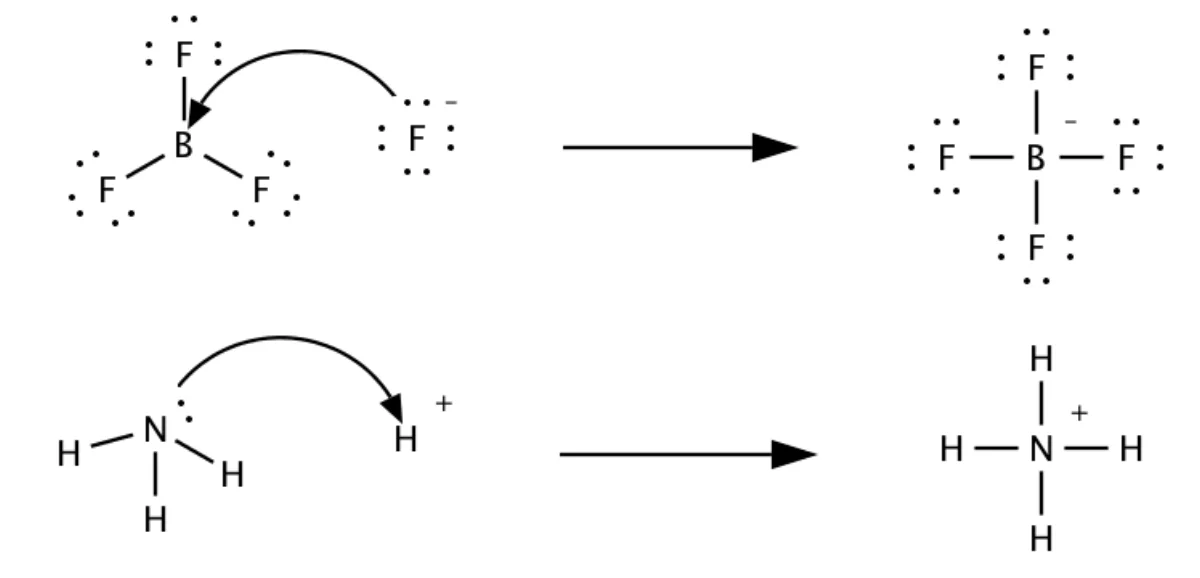
Lewis acid-base reactions. Top: BF₃ (Lewis acid) accepts a lone pair from F⁻ (Lewis base), forming BF₄⁻. Bottom: NH₃ (Lewis base) donates its lone pair to H⁺ (Lewis acid), forming NH₄⁺. The curved arrows show the electron pair moving from the donor to the acceptor. Source: Wikimedia Commons.
How the Three Definitions Nest
Definition
Acid
Base
Scope
Arrhenius
Produces H⁺ in water
Produces OH⁻ in water
Narrowest - aqueous only
Brønsted-Lowry
Donates H⁺
Accepts H⁺
Medium - any solvent
Lewis
Accepts electron pair
Donates electron pair
Broadest - no proton needed
Each definition contains the one above it. Every Arrhenius acid is a Brønsted-Lowry acid. Every Brønsted-Lowry acid is a Lewis acid. But the reverse is not true - BF₃ is a Lewis acid but not a Brønsted-Lowry acid (no proton to donate).
BF₃ reacts with NH₃ to form F₃B-NH₃. Which acid-base definition(s) apply to this reaction?
Click to reveal answer
Only the Lewis definition. BF₃ has no proton to donate, so it is not a Brønsted-Lowry acid. It is not in aqueous solution producing H⁺, so it is not an Arrhenius acid. But BF₃ has an empty p orbital on boron that accepts a lone pair from NH₃ - making BF₃ a Lewis acid and NH₃ a Lewis base. This reaction cannot be classified as acid-base under Arrhenius or Brønsted-Lowry.
Water can act as both an acid and a base. What is this property called, and which definition explains it?
Click to reveal answer
Amphoteric (or amphiprotic). The Brønsted-Lowry definition explains it: water can donate a proton (acting as an acid: H₂O → OH⁻ + H⁺) or accept a proton (acting as a base: H₂O + H⁺ → H₃O⁺). In autoionization, water acts as both simultaneously: H₂O + H₂O ⇌ H₃O⁺ + OH⁻.