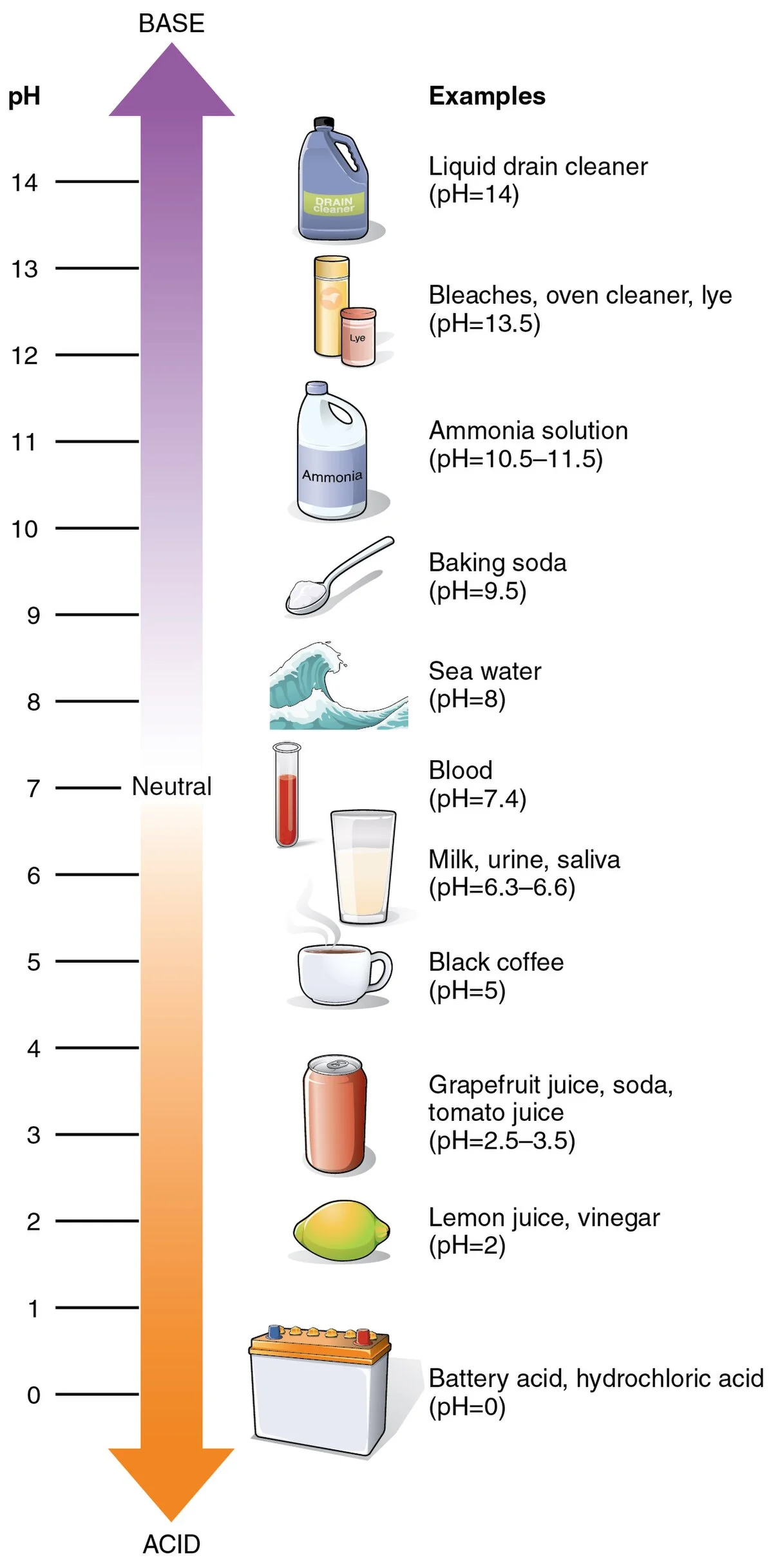
The hydrogen ion concentration in biological systems spans an enormous range - from about 10 M in concentrated stomach acid to 10−15 M in strong drain cleaner. Working with numbers that vary over 16 orders of magnitude is clumsy, so chemists use a logarithmic scale: pH.
Autoionization of Water
Pure water is not truly “neutral” in the sense that it has no ions. Water molecules constantly transfer protons to each other:
H₂O + H₂O ⇌ H₃O⁺ + OH⁻
This is the autoionization (or self-ionization) of water. The equilibrium constant for this process is Kw:
Defining pH and pOH
The “p” operator means “negative log”:
pH = -log[H⁺]
pOH = -log[OH⁻]
And from Kw, we get the critical relationship:
The pH Scale Mapped Out
pH
[H⁺]
[OH⁻]
Classification
Example
0
1 M
10−14 M
Strongly acidic
Battery acid
1
0.1 M
10−13 M
Strongly acidic
Stomach acid (HCl)
2
0.01 M
10−12 M
Acidic
Lemon juice
3
10−3 M
10−11 M
Acidic
Vinegar
5
10−5 M
10−9 M
Weakly acidic
Black coffee
7
10−7 M
10−7 M
Neutral
Pure water
8
10−8 M
10−6 M
Weakly basic
Seawater
10
10−10 M
10−4 M
Basic
Milk of magnesia
13
10−13 M
0.1 M
Strongly basic
Oven cleaner
14
10−14 M
1 M
Strongly basic
Drain cleaner (NaOH)
The pH scale with common substances. Battery acid (pH 0) and stomach acid (pH 1) are at the acidic extreme. Pure water sits at neutral (pH 7). Household bleach (pH 13) and drain cleaner (pH 14) are strongly basic. Source: Wikimedia Commons.
Converting Between pH and [H⁺]
Going from [H⁺] to pH:
If [H⁺] = 10⁻ˣ, then pH = x (exact power of 10 - easy)
If [H+]=3.5×10⁻⁴, then pH=−log(3.5×10⁻⁴)≈3.46
Going from pH to [H⁺]:
[H+]=10−pH
If pH = 5, then [H+]=10−5 M
If pH = 3.46, then [H+]=10−3.46≈3.5×10⁻⁴ M
Quick Estimation Tricks for the MCAT
The MCAT does not give you a calculator, so you need mental math shortcuts:
Exact powers of 10: If [H+]=10−3, pH = 3. Done.
Leading coefficient between 1 and 10: If [H+]=2×10⁻⁵, the pH is between 4 and 5 (closer to 5 since 2 is small). Specifically: −log(2)≈0.3, so pH≈5−0.3=4.7.
Know your logs: log(2) ≈ 0.3, log(3) ≈ 0.5, log(5) ≈ 0.7. These three values handle most MCAT pH calculations.
Temperature Dependence of Kw
Kw=10−14 is only valid at 25°C. At higher temperatures, Kw increases (autoionization is endothermic). At 37°C (body temperature), Kw≈2.4×10⁻¹⁴, meaning the neutral pH is slightly below 7 (about 6.8).
This means “neutral” does not always mean pH 7 - neutral means [H⁺] = [OH⁻], which only corresponds to pH 7 at 25°C.
A solution has [OH−]=5.0×10⁻³ M. What is the pH?
Click to reveal answer
pH = 11.7. First find pOH: pOH=−log(5.0×10⁻³)=3−log(5)=3−0.7=2.3. Then: pH=14−pOH=14−2.3=11.7. This is a basic solution (pH > 7), which makes sense since [OH⁻] is much larger than 10−7.
By how many times does [H⁺] change when the pH drops from 7.4 to 7.0?
Click to reveal answer
[H⁺] increases by a factor of about 2.5. At pH 7.4: [H+]=10−7.4≈4.0×10⁻⁸. At pH 7.0: [H+]=10−7=10.0×10⁻⁸. The ratio is 4.010.0 = 2.5. This illustrates why even small pH changes are physiologically significant - a drop of 0.4 pH units more than doubles the hydrogen ion concentration.