
Indicators
An acid-base indicator is a weak acid (or weak base) that changes color when it gains or loses a proton. The protonated form (HIn) has one color, and the deprotonated form (In⁻) has a different color. By choosing an indicator whose color change occurs near the equivalence point of your titration, you can visually detect when neutralization is complete.
How Indicators Work
An indicator is itself a weak acid in equilibrium:
HIn ⇌ H⁺ + In⁻
(Color A) (Color B)
The equilibrium constant for this dissociation is KIn:
KIn = [H⁺][In⁻] / [HIn]
- When [H⁺] is high (acidic solution), the equilibrium shifts left → more HIn → Color A dominates
- When [H⁺] is low (basic solution), the equilibrium shifts right → more In⁻ → Color B dominates
The color change occurs over a range of about 2 pH units centered on the pKIn (the pKa of the indicator).
Common Indicators
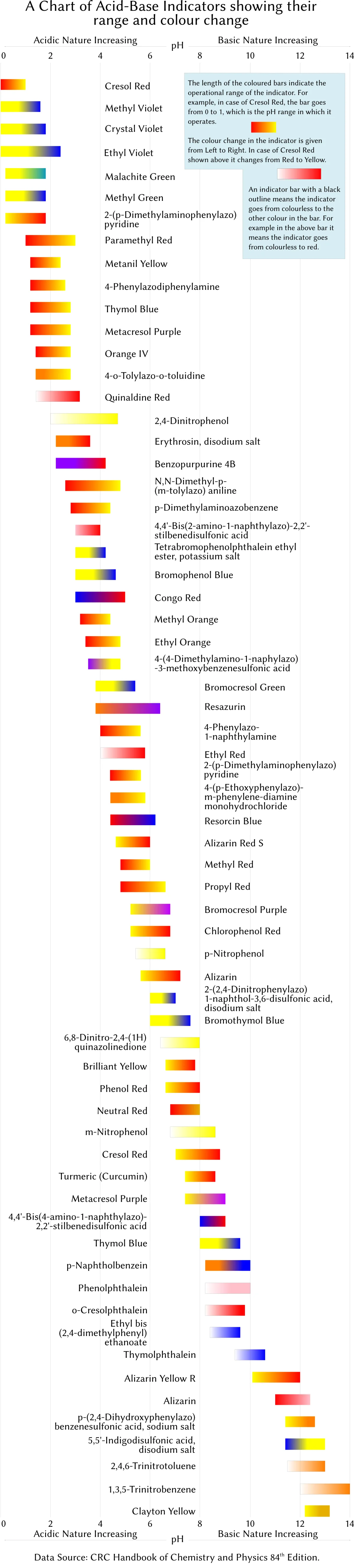
| Indicator | Color (Acid) | Color (Base) | pH Range | pKIn |
|---|---|---|---|---|
| Methyl violet | Yellow | Violet | 0.0 - 1.6 | ~0.8 |
| Methyl orange | Red | Yellow | 3.2 - 4.4 | 3.46 |
| Bromocresol green | Yellow | Blue | 3.8 - 5.4 | 4.7 |
| Methyl red | Red | Yellow | 4.8 - 6.0 | 5.0 |
| Litmus | Red | Blue | 5.0 - 8.0 | 6.5 |
| Bromothymol blue | Yellow | Blue | 6.0 - 7.6 | 7.1 |
| Phenolphthalein | Colorless | Pink | 8.2 - 10.0 | 9.4 |
| Alizarin yellow R | Yellow | Red | 10.1 - 12.0 | 11.0 |
Choosing the Right Indicator
The indicator must change color at a pH close to the equivalence point of the titration:
| Titration Type | Equivalence Point pH | Best Indicator Choice |
|---|---|---|
| Strong acid + strong base | 7.0 | Bromothymol blue (6.0 - 7.6) |
| Weak acid + strong base | Above 7 (typically 8 - 10) | Phenolphthalein (8.2 - 10.0) |
| Weak base + strong acid | Below 7 (typically 4 - 6) | Methyl orange (3.2 - 4.4) or Methyl red (4.8 - 6.0) |
The Endpoint vs. the Equivalence Point
These are not the same thing:
- Equivalence point: the theoretical point where moles of acid = moles of base (exact neutralization)
- Endpoint: the experimental point where the indicator changes color
A well-chosen indicator makes the endpoint approximately equal to the equivalence point. A poorly chosen indicator gives an inaccurate result because the color change occurs at the wrong pH.
Why the Color Change Spans About 2 pH Units
The indicator changes color gradually over a pH range of approximately pKIn ± 1. This is because:
- At pH = pKIn - 1: [HIn] / [In⁻] = 10 (10x more acid form - Color A dominates)
- At pH = pKIn: [HIn] / [In⁻] = 1 (equal amounts - mixed color)
- At pH = pKIn + 1: [HIn] / [In⁻] = 0.1 (10x more base form - Color B dominates)
The human eye can generally detect when one form is about 10x more abundant than the other, which is why the visible transition covers about 2 pH units.