Polyprotic acids have more than one proton to donate, but they do not give them all up at once. Each proton leaves in a separate step, and each step has its own Ka - getting progressively smaller as it becomes harder to pull a proton from an already-negative species.
Stepwise Dissociation
A diprotic acid like H₂CO₃ dissociates in two steps:
Step 1: H₂CO₃ ⇌ H⁺ + HCO₃⁻ (Ka1=4.3×10⁻⁷)
Step 2: HCO₃⁻ ⇌ H⁺ + CO₃²⁻ (Ka2=4.7×10⁻¹¹)
A triprotic acid like H₃PO₄ dissociates in three steps:
Step 1: H₃PO₄ ⇌ H⁺ + H₂PO₄⁻ (Ka1=7.5×10⁻³)
Step 2: H₂PO₄⁻ ⇌ H⁺ + HPO₄²⁻ (Ka2=6.2×10⁻⁸)
Step 3: HPO₄²⁻ ⇌ H⁺ + PO₄³⁻ (Ka3=4.8×10⁻¹³)
Why Each Ka Gets Smaller
Each successive Ka is always smaller than the previous one - typically by a factor of 104 to 106. The reason is electrostatic:
Removing the first proton from a neutral molecule (H₃PO₄) is relatively easy.
Removing the second proton from a negatively charged ion (H₂PO₄⁻) is harder because you are pulling a positive proton away from a negative species.
Removing the third proton from a doubly negative ion (HPO₄²⁻) is even harder.
Common Polyprotic Acids on the MCAT
Acid
Type
Ka₁
Ka₂
Ka₃
Biological Role
H₂SO₄
Diprotic
Strong
1.2×10⁻²
-
Lab acid
H₂CO₃
Diprotic
4.3×10⁻⁷
4.7×10⁻¹¹
-
Blood buffer system
H₃PO₄
Triprotic
7.5×10⁻³
6.2×10⁻⁸
4.8×10⁻¹³
DNA backbone, ATP
H₂C₂O₄
Diprotic
5.9×10⁻²
6.4×10⁻⁵
-
Oxalic acid (kidney stones)
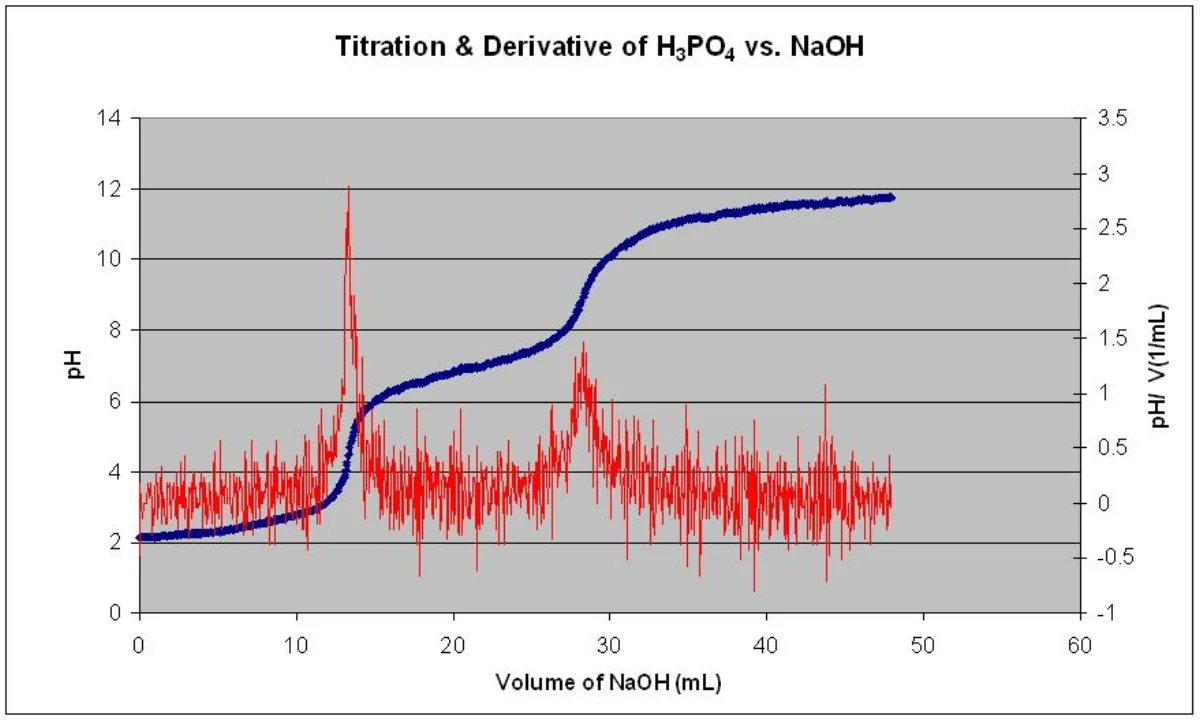
Titration curve of H₃PO₄ (a triprotic acid) titrated with NaOH. The blue curve shows two visible equivalence points, with the third occurring at very high pH. The red derivative curve highlights where the pH changes most rapidly. Each flat buffer region corresponds to a different conjugate pair. Source: Wikimedia Commons.
Calculating pH of a Polyprotic Acid
Because Ka1>>Ka2 (typically by 104 or more), the first dissociation produces nearly all of the H⁺ in solution. The second and third dissociations contribute negligible additional H⁺.
The shortcut: To find the pH of a polyprotic acid, use only Ka₁. Treat it as a monoprotic weak acid.
Example: What is the pH of 0.10 M H₂CO₃?
Use Ka1=4.3×10⁻⁷ only:
[H+]=Ka1×c=4.3×10−7×0.10=4.3×10⁻⁸≈2.1×10⁻⁴
pH≈4−log(2.1)≈4−0.3=3.7
(The second dissociation would add roughly 4.7×10⁻¹¹ M more H⁺ - completely negligible.)
Finding the Concentration of the Fully Deprotonated Species
Although Ka₂ does not affect pH significantly, MCAT questions sometimes ask for the concentration of the second or third conjugate base.
For a diprotic acid: the concentration of the fully deprotonated species (A²⁻) numerically equals Ka₂ (when the x-is-small approximation applies to the first dissociation).
This is because at equilibrium: Ka₂ = [H⁺][A²⁻] / [HA⁻]. Since [H⁺] ≈ [HA⁻] from the first dissociation, Ka₂ ≈ [A²⁻].
Amphoteric Intermediate Species
The intermediate species of a polyprotic acid (like HCO₃⁻ or H₂PO₄⁻) are amphoteric - they can act as either an acid or a base. The pH of a solution of the amphoteric species is approximated by:
pH ≈ (pKa₁ + pKa₂) / 2
This averages the two relevant pKa values, giving the pH at which the amphoteric species is most stable (neither donating nor accepting protons significantly).
Why is Ka₂ always smaller than Ka₁ for any polyprotic acid?
Click to reveal answer
Electrostatic attraction. After the first proton leaves, the remaining species is negatively charged. Removing a positive proton from a negative ion requires more energy than removing one from a neutral molecule. Each successive deprotonation increases the negative charge, making each subsequent proton harder to remove. This is reflected in progressively smaller Ka values.
What is the approximate pH of a 0.10 M NaHCO₃ solution? (Ka1 of H₂CO₃ =4.3×10⁻⁷, Ka2=4.7×10⁻¹¹)
Click to reveal answer
pH ≈ 8.3. HCO₃⁻ is amphoteric. pH ≈ (pKa₁ + pKa₂)/2 = (6.37 + 10.33)/2 = 216.7 ≈ 8.3. This makes sense - NaHCO₃ (baking soda) solutions are mildly basic.