
Buffers
A buffer is a solution that resists changes in pH when small amounts of acid or base are added. Buffers are everywhere in biology - your blood, every cell in your body, and every biochemistry experiment relies on them. On the MCAT, buffers are one of the most frequently tested topics in all of general chemistry.
What Makes a Buffer
A buffer requires two components:
- A weak acid (HA) - to neutralize any added base
- Its conjugate base (A⁻) - to neutralize any added acid
Both must be present in significant amounts. Common buffer systems:
- Acetic acid / sodium acetate (CH₃COOH / CH₃COO⁻)
- Carbonic acid / bicarbonate (H₂CO₃ / HCO₃⁻) - the blood buffer
- Dihydrogen phosphate / hydrogen phosphate (H₂PO₄⁻ / HPO₄²⁻) - intracellular buffer
- Ammonia / ammonium (NH₃ / NH₄⁺)
How a Buffer Works - The Mechanism
When acid (H⁺) is added:
A⁻ + H⁺ → HA
The conjugate base “soaks up” the added protons, converting to the weak acid. [A⁻] decreases slightly, [HA] increases slightly, but pH barely changes.
When base (OH⁻) is added:
HA + OH⁻ → A⁻ + H₂O
The weak acid neutralizes the added hydroxide, converting to the conjugate base. [HA] decreases slightly, [A⁻] increases slightly, but pH barely changes.
The Henderson-Hasselbalch Equation
This is the master equation for buffer chemistry:
Key Implications of Henderson-Hasselbalch
| Condition | [A⁻] vs [HA] | log([A⁻]/[HA]) | pH vs pKa |
|---|---|---|---|
| [A⁻] = [HA] | Equal | 0 | pH = pKa |
| [A⁻] > [HA] | More base form | Positive | pH > pKa |
| [A⁻] < [HA] | More acid form | Negative | pH < pKa |
| [A⁻] = 10[HA] | 10x more base | +1 | pH = pKa + 1 |
| [HA] = 10[A⁻] | 10x more acid | -1 | pH = pKa - 1 |
Making a Buffer at a Specific pH
To prepare a buffer at a desired pH:
- Choose a weak acid whose pKa is close to the desired pH (within ±1)
- Use Henderson-Hasselbalch to calculate the required ratio [A⁻]/[HA]
- Mix the weak acid and its conjugate base (usually as a sodium or potassium salt) in that ratio
Example: You want a buffer at pH 5.00 using acetic acid (pKa = 4.74).
pH = pKa + log([A⁻]/[HA])
5.00 = 4.74 + log([A⁻]/[HA])
log([A⁻]/[HA]) = 0.26
You need about 1.8 times as much acetate as acetic acid.
The Bicarbonate Buffer System
The most important buffer in human physiology - and the foundation for understanding acid-base disorders in biology:
CO₂ + H₂O ⇌ H₂CO₃ ⇌ H⁺ + HCO₃⁻
At blood pH 7.40, using pKa₁ = 6.10 for the CO₂/HCO₃⁻ system:
pH = 6.10 + log([HCO₃⁻]/[CO₂])
7.40 = 6.10 + log([HCO₃⁻]/[CO₂])
log([HCO₃⁻]/[CO₂]) = 1.30
[HCO₃⁻]/[CO₂] = 20
Normal blood has about 20 times more bicarbonate than dissolved CO₂. This ratio maintains the pH at 7.40.
Using Henderson-Hasselbalch During a Titration
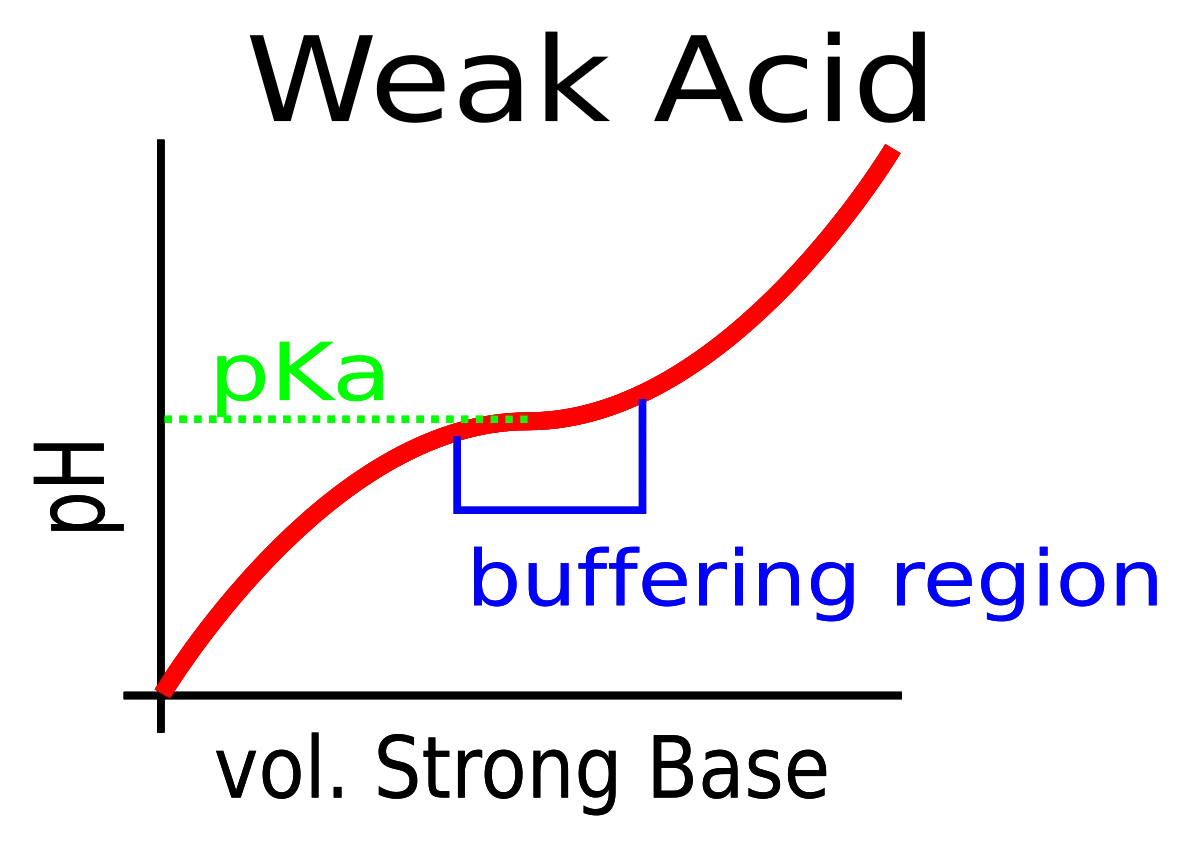
Henderson-Hasselbalch works at any point during a weak acid-strong base titration (except the initial point and the equivalence point):
- Before any base is added: Use Ka and ICE table (no A⁻ yet)
- Between initial and equivalence: Use Henderson-Hasselbalch (both HA and A⁻ present)
- At half-equivalence: pH = pKa (simplest case)
- At equivalence: Use Kb of the conjugate base (all HA converted to A⁻)
- Past equivalence: Excess strong base determines pH