Imagine you are timing how fast ice melts in a glass of water. You could measure how much ice is left every five minutes and calculate an average melting rate. Or you could zoom in on one specific moment and ask: “How fast is the ice melting right now?” Both approaches give you useful information, but they answer slightly different questions.
Chemical reaction rates work the same way. We can measure an average rate over a time interval, or we can determine the instantaneous rate at a specific point in time.
What Is Reaction Rate?
The reaction rate measures how quickly the concentration of a reactant decreases or a product increases over time. Rate is always positive, and it is expressed in units of molarity per second (M/s or mol/L·s).
For reactants, concentration decreases over time, so the change in concentration is negative. We add a negative sign to make the rate positive. For products, concentration increases, so no sign correction is needed.
Average Rate vs. Instantaneous Rate
The average rate is calculated over a time interval. If the concentration of reactant A drops from 0.50 M to 0.30 M over 10 seconds:
Average rate = (0.50 - 0.30) / 10 = 0.020 M/s
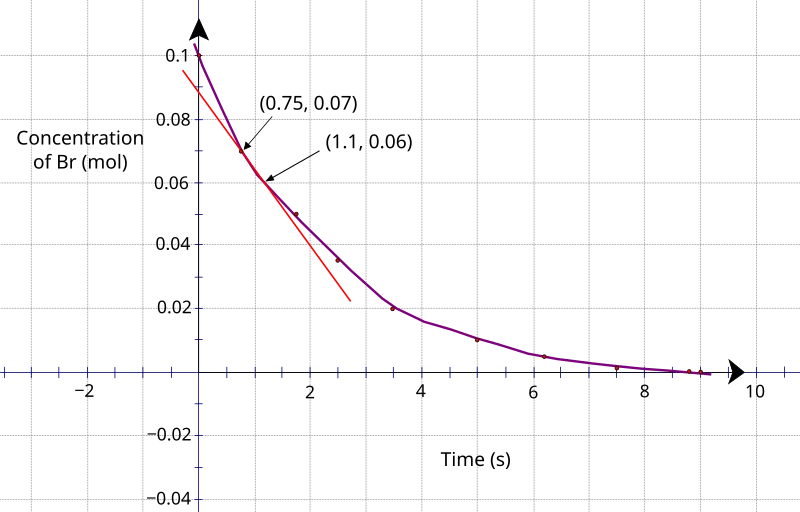
The instantaneous rate is the rate at one specific moment in time. Mathematically, it is the slope of the tangent line to the concentration-vs-time curve at that point. On the MCAT, you will most often work with initial rates - the instantaneous rate at the very beginning of the reaction (t = 0).
Concentration of a reactant (Br₂) decreasing over time. The steepness of the curve at any point represents the instantaneous rate — notice how the rate is highest at the beginning and slows as reactant is consumed. Credit: Wikimedia Commons, CC0
Stoichiometry and Rate
Different species in a reaction may disappear or appear at different rates because of their stoichiometric coefficients. Consider the reaction:
2 A + B → C
Two moles of A are consumed for every one mole of B. So A disappears twice as fast as B. To define a single “rate of reaction” that is the same regardless of which species you track, we divide each rate of change by the stoichiometric coefficient.
For example, in the reaction N₂ + 3 H₂ → 2 NH₃:
H₂ disappears 3 times faster than N₂
NH₃ appears 2 times faster than N₂
But the rate of reaction is the same no matter which species you track, once you divide by the coefficient
Units of Rate
Rate is always expressed as concentration per unit time. On the MCAT, this is almost always M/s (molarity per second), sometimes written as mol/(L·s).
For the reaction 2 NO + O₂ → 2 NO₂, if [O₂] decreases at 0.05 M/s, at what rate does [NO₂] increase?
Click to reveal answer
0.10 M/s. The stoichiometry shows that 2 moles of NO₂ are produced for every 1 mole of O₂ consumed. So the rate of appearance of NO₂ is twice the rate of disappearance of O₂: 2 x 0.05 = 0.10 M/s.
Why do chemists prefer to measure initial rates rather than rates measured later in the reaction?
Click to reveal answer
To minimize complications from the reverse reaction. At the start of a reaction, product concentrations are near zero, so the reverse reaction contributes negligibly to the observed rate. This gives a cleaner measurement of the forward reaction rate alone.
If reaction rate is the speedometer, the rate law is the owner’s manual that explains what controls the speed. The rate law is a mathematical equation that relates the reaction rate to the concentrations of the reactants. It is the single most important equation in this chapter.
The Rate Constant (k)
The rate constant k is a proportionality constant that is specific to a particular reaction at a particular temperature. A larger k means a faster reaction. Two key facts about k:
k changes with temperature. Increase the temperature and k increases (the reaction gets faster). This relationship is described by the Arrhenius equation, which we cover in Section 5.7.
k does not change with concentration. For a given reaction at a fixed temperature, k is truly constant regardless of how much reactant you add.
Reaction Orders
The exponents x and y in the rate law are called the reaction orders. They tell you how sensitive the rate is to changes in each reactant’s concentration.
Order 0: Rate is independent of that reactant’s concentration. Doubling [A] has no effect on rate.
Order 1: Rate is directly proportional to concentration. Double [A], double the rate.
Order 2: Rate is proportional to the square of concentration. Double [A], quadruple the rate.
The overall reaction order is the sum of all individual orders. For rate = k[A]²[B]¹, the overall order is 2 + 1 = 3 (third-order overall).
Two Exceptions Where Orders Match Coefficients
There are exactly two situations where the orders in the rate law match the stoichiometric coefficients:
The reaction occurs in a single elementary step. If the balanced equation represents the actual molecular event, then the coefficients are the orders.
You are given the mechanism and told which step is rate-determining. The coefficients of the reactants in the slow step become the orders.
In every other case, the rate law must be determined experimentally.
Rate Law vs. Equilibrium Expression
This is one of the most common traps on the MCAT. The rate law and the equilibrium expression look similar but mean completely different things.
Rate Law
Equilibrium Expression
Includes
Reactants only
Both reactants AND products
Exponents from
Experiment (or mechanism)
Balanced equation coefficients
Tells you
How fast the reaction goes
Where the reaction ends up
Symbol
k (rate constant)
Keq (equilibrium constant)
Units of k
The units of k depend on the overall reaction order. This is because the rate always has units of M/s, so k must have whatever units are needed to make the math work.
Overall Order
Rate Law
Units of k
0
rate = k
M/s (or M·s⁻¹)
1
rate = k[A]
s⁻¹
2
rate = k[A]²
M⁻¹·s⁻¹
3
rate = k[A]²[B]
M⁻²·s⁻¹
A reaction has rate = k[X]²[Y]. What is the overall order, and what are the units of k?
Click to reveal answer
Third order overall (2 + 1 = 3). Units of k: M⁻²·s⁻¹. The rate must be in M/s. Since [X]²[Y] has units of M³, k must be M/s divided by M³ = M⁻²·s⁻¹.
Can you determine the rate law for a reaction just by looking at the balanced equation?
Click to reveal answer
No - unless it is an elementary step. For multi-step reactions, the rate law must be determined experimentally. The stoichiometric coefficients of the overall balanced equation almost never match the reaction orders. Only for a single-step (elementary) reaction do the coefficients equal the orders.
The MCAT will not ask you to derive a rate law from first principles. Instead, it will hand you a table of experimental data and ask you to figure out the rate law from the numbers. This is one of the most predictable question types on the exam, and the method is the same every time.
The Method of Initial Rates
Here is the step-by-step process:
Step 1: Find two trials where only ONE reactant’s concentration changes while everything else stays the same.
Step 2: Compare how the rate changed when that concentration changed.
Step 3: Use the relationship Δrate = (Δconcentration)^order to solve for the order.
Step 4: Repeat for each reactant.
Step 5: Plug the orders back into the rate law and use any trial to solve for k.
Worked Example
Consider the reaction A + B → C + D at 300 K:
Trial
[A] (M)
[B] (M)
Initial Rate (M/s)
1
1.00
1.00
2.0
2
1.00
2.00
8.1
3
2.00
2.00
15.9
Finding the order with respect to B: Compare Trials 1 and 2. [A] is held constant at 1.00 M. [B] doubles from 1.00 to 2.00 M. The rate increases from 2.0 to 8.1 - approximately a factor of 4.
Since (2)^y = 4, y = 2. The reaction is second order with respect to B.
Finding the order with respect to A: Compare Trials 2 and 3. [B] is held constant at 2.00 M. [A] doubles from 1.00 to 2.00 M. The rate increases from 8.1 to 15.9 - approximately a factor of 2.
Since (2)^x = 2, x = 1. The reaction is first order with respect to A.
The rate law: rate = k[A]¹[B]² = k[A][B]²
Finding k: Plug in values from Trial 1:
2.0 = k(1.00)(1.00)²
k = 2.0 M⁻²·s⁻¹
Quick Reference: Common Patterns
Concentration Change
Rate Change
Order
x2
No change (x1)
0
x2
x2
1
x2
x4
2
x2
x8
3
x3
x3
1
x3
x9
2
x3
x27
3
What If No Two Trials Hold Everything Else Constant?
Sometimes the MCAT will give you data where no pair of trials isolates a single variable perfectly. In that case, you may need to:
Use the rate law algebraically. Write the rate law for two different trials and divide one equation by the other to cancel k.
If you already know one order, substitute it in and solve for the remaining unknown.
This is less common, but it does appear in harder questions.
In an experiment, tripling [A] causes the rate to increase 9-fold while [B] is held constant. What is the order with respect to A?
Click to reveal answer
Second order. (3)^x = 9. Since 3² = 9, x = 2. The reaction is second order with respect to A.
Why must rate laws be determined experimentally rather than predicted from the balanced equation?
Click to reveal answer
Because most reactions proceed through multiple steps. The balanced equation shows the overall stoichiometry, not the molecular-level mechanism. The rate law depends on the mechanism (specifically the rate-determining step), which cannot be deduced from the overall equation alone.
A zero-order reaction is the simplest type of kinetics: the rate does not depend on the concentration of reactants at all. No matter how much reactant you add, the reaction proceeds at the same constant speed.
Rate Law
For a zero-order reaction:
Integrated Rate Law
The integrated rate law lets you calculate the concentration of a reactant at any time t:
Graphical Analysis
Plotting [A] vs. time for a zero-order reaction gives a straight line with:
Slope = -k (negative because concentration decreases)
y-intercept = [A]₀
This is the simplest graph you will see in kinetics. If [A] vs. t is linear and decreasing, the reaction is zero order.
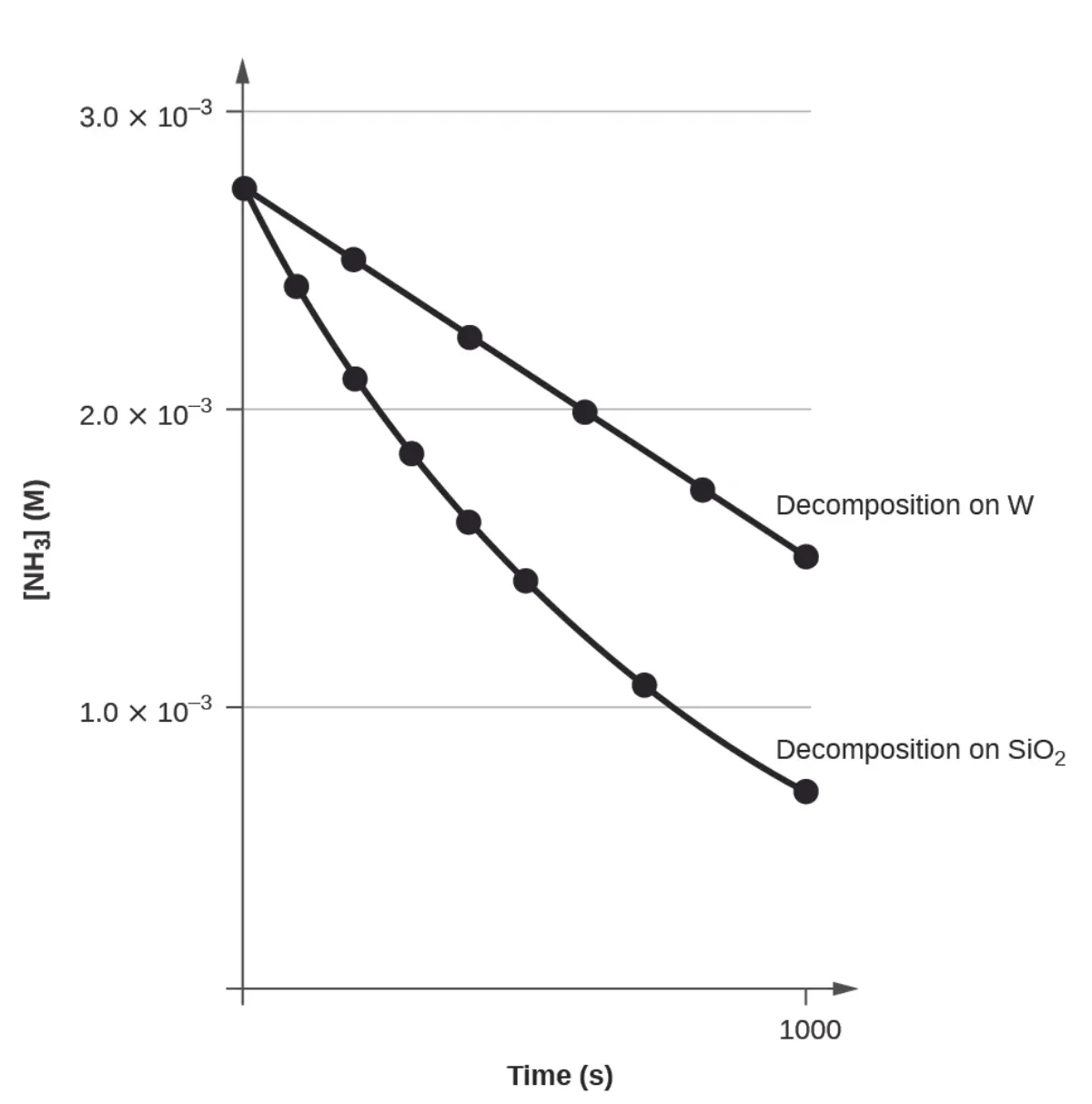
Decomposition of NH₃ on two different catalytic surfaces. On tungsten (W), the nearly linear decline in [NH₃] over time is characteristic of zero-order kinetics - the surface is saturated with reactant. On SiO₂, the curve shows non-zero-order behavior. Credit: OpenStax Chemistry 2e, CC BY 4.0
Half-Life
The half-life of a zero-order reaction is the time it takes for the concentration to drop to half its initial value:
What Can Change the Rate?
Since the rate equals k, the only ways to change the rate of a zero-order reaction are:
Change the temperature - this changes k via the Arrhenius equation
Add a catalyst - this lowers the activation energy, increasing k
Changing reactant concentrations has no effect. This is the defining feature of zero-order kinetics.
Enzyme kinetics is the classic place to see both orders in one curve. Slide the
substrate concentration: at low [S] the rate climbs with concentration, which is
first-order behavior, and once every active site is occupied the rate plateaus at
Vmax, which is zero-order.
AnimationEnzyme Kinetics (Michaelis–Menten)
Key idea
As substrate rises, rate climbs then plateaus at Vmax — every enzyme is busy. Km is the [S] giving half-Vmax (lower Km = tighter binding). Competitive inhibitors raise Km (more substrate beats them); noncompetitive inhibitors lower Vmax (substrate can't).
Slide [S] to move along the curve; switch the inhibitor to see Km and Vmax shift.
For a zero-order reaction, what happens to the rate when you double the concentration of the reactant?
Click to reveal answer
Nothing - the rate stays the same. In a zero-order reaction, rate = k. The rate is independent of reactant concentration. Only changing the temperature or adding a catalyst will change the rate.
Which graph gives a straight line for a zero-order reaction: [A] vs. t, ln[A] vs. t, or 1/[A] vs. t?
Click to reveal answer
[A] vs. t is linear for zero-order reactions. The integrated rate law [A]_t = [A]_0 - kt is in y = mx + b form. The slope is -k and the intercept is [A]_0.
First-order reactions are the most important reaction order for the MCAT. Radioactive decay, many drug metabolism pathways, and numerous biological processes follow first-order kinetics. If you learn only one reaction order thoroughly, make it this one.
Rate Law
Integrated Rate Law
Graphical Analysis
[A] vs. time: Curved (exponential decay). NOT linear.
ln[A] vs. time:Straight line with slope = -k and y-intercept = ln[A]₀.
A plot of ln[H₂O₂] vs. time for the decomposition of hydrogen peroxide. The straight line confirms first-order kinetics. The slope equals -k. Credit: OpenStax Chemistry 2e, CC BY 4.0
If you plot the data and ln[A] vs. t gives a straight line, you have confirmed first-order kinetics. This is the diagnostic test for first-order reactions.
Half-Life: The Star of First-Order Kinetics
The half-life is the time required for the concentration to drop to half its initial value. For first-order reactions:
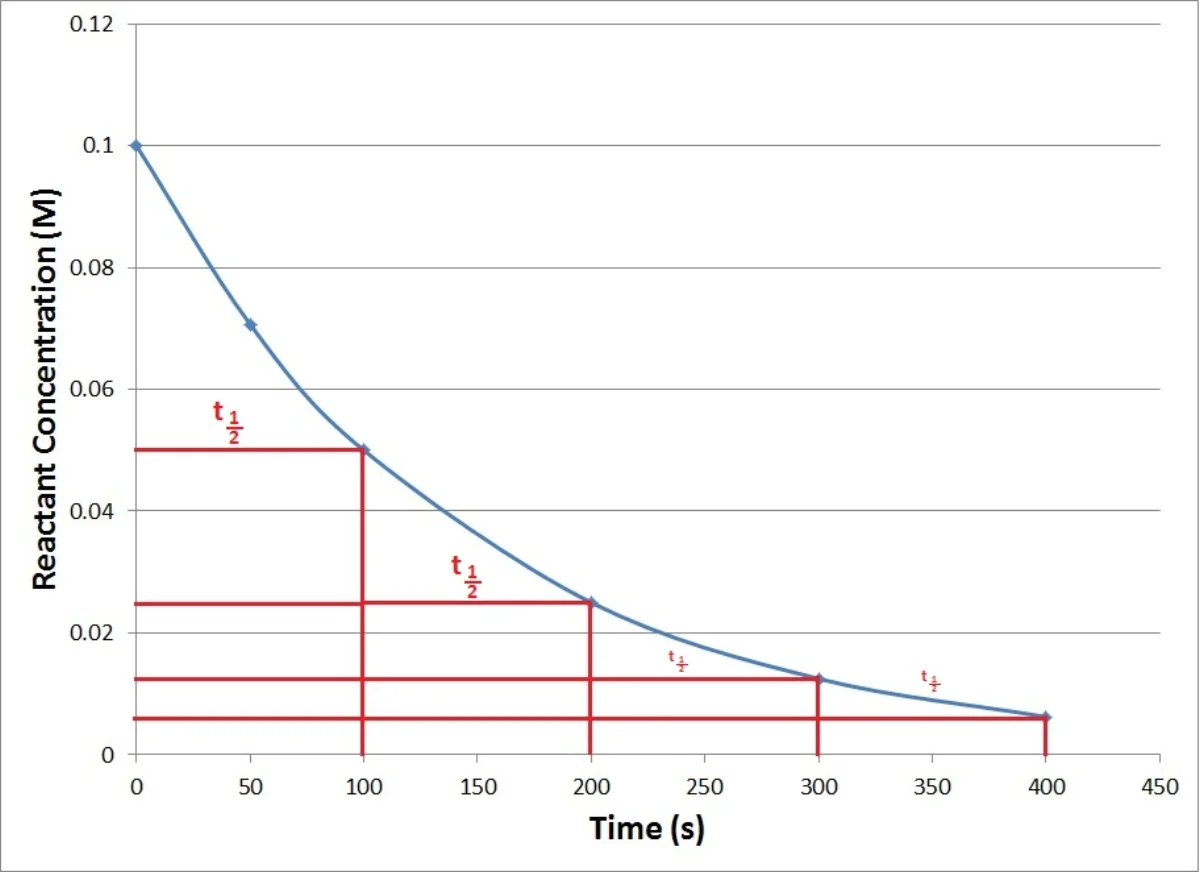
First-order decay with constant half-life. Each red bracket (t1/2) spans the same time interval (~100 s), even as the concentration drops. After one half-life: 0.10 → 0.05 M. After two: 0.05 → 0.025 M. After three: 0.025 → 0.0125 M. The half-life never changes - this is the defining feature of first-order kinetics. Credit: Lumen Learning / OpenStax Introductory Chemistry, CC BY 4.0
Calculating with Half-Lives
After n half-lives, the fraction of the original sample remaining is (21)^n:
Half-Lives Elapsed
Fraction Remaining
Percent Remaining
0
1
100%
1
21
50%
2
41
25%
3
81
12.5%
4
161
6.25%
5
321
3.125%
Radioactive Decay
Radioactive decay is the classic example of a first-order process. The rate of decay depends only on the amount of radioactive isotope present, not on temperature, pressure, or chemical environment.
Pharmacokinetics Connection
Most drugs are eliminated from the body via first-order kinetics. The half-life of a drug tells physicians how often to dose: if the half-life is 6 hours, giving a dose every 6 hours maintains a relatively stable blood concentration. This is why “take every 4-6 hours” appears on medication labels.
A radioactive isotope has a half-life of 8 hours. If you start with 120 mg, how much remains after 24 hours?
Click to reveal answer
15 mg. 24 hours / 8 hours per half-life = 3 half-lives. After 3 half-lives: 120 → 60 → 30 → 15 mg. Or use (21)³ x 120 = (81)(120) = 15 mg.
A first-order reaction has k = 0.0231 s⁻¹. What is the half-life?
Click to reveal answer
30 seconds. t_(21) = 0.693 / k = 0.693 / 0.0231 = 30 s. Note that 0.693 / 0.0231 can be estimated as 0.7 / 0.023 ≈ 30.
A second-order reaction is one where the rate depends on the square of one reactant’s concentration, or on the product of two reactants’ concentrations. Physically, this often corresponds to a reaction that requires two molecules to collide - a bimolecular event.
Rate Law
Second-order reactions can take two forms:
When the rate law is k[A][B] with first-order dependence on each of two reactants, it suggests a collision between one molecule of A and one molecule of B as the rate-determining step.
Integrated Rate Law
For a reaction that is second order with respect to a single reactant:
Graphical Analysis
[A] vs. time: Curved (not linear). The curve decreases steeply at first, then levels off.
ln[A] vs. time: Also curved (NOT linear). This rules out first-order.
1/[A] vs. time:Straight line with slope = +k and y-intercept = 1/[A]₀.
If 1/[A] vs. t gives a straight line, the reaction is second order. Note that the slope is positive (unlike zero-order and first-order, where the slope is negative).
Determining reaction order for the dimerization of C₄H₆. Left: ln[C₄H₆] vs. time is curved, ruling out first-order. Right: 1/[C₄H₆] vs. time is linear with a positive slope equal to k, confirming second-order kinetics. Credit: OpenStax Chemistry 2e, CC BY 4.0
Half-Life
This makes intuitive sense with the dance partner analogy: as the party empties out, it takes longer and longer to find someone to dance with.
Master Comparison Table
Property
Zero Order
First Order
Second Order
Rate Law
rate = k
rate = k[A]
rate = k[A]²
Integrated Law
[A] = [A]₀ - kt
ln[A] = ln[A]₀ - kt
1/[A] = 1/[A]₀ + kt
Linear Plot
[A] vs. t
ln[A] vs. t
1/[A] vs. t
Slope of Linear Plot
-k
-k
+k
Half-Life
[A]₀ / 2k
0.693 / k
1 / (k[A]₀)
Half-Life Depends on [A]₀?
Yes (shorter each time)
No (constant!)
Yes (longer each time)
Units of k
M·s⁻¹
s⁻¹
M⁻¹·s⁻¹
A reaction has a half-life that doubles each time. What is the reaction order?
Click to reveal answer
Second order. For second-order reactions, t_(21) = 1/(k[A]₀). As [A]₀ decreases by half each half-life, the next half-life is twice as long. Only second-order kinetics show increasing half-lives.
You plot three graphs: [A] vs. t, ln[A] vs. t, and 1/[A] vs. t. The 1/[A] vs. t plot is the only one that gives a straight line. What is the reaction order, and what does the slope equal?
Click to reveal answer
Second order. The slope equals +k (positive). For second-order reactions, 1/[A] = 1/[A]₀ + kt is linear with a positive slope equal to the rate constant k.
We know that increasing the temperature speeds up nearly all reactions. But by how much? The Arrhenius equation gives us the precise mathematical relationship between the rate constant k, the temperature T, and the activation energy Ea.
The Equation
Understanding the Variables
The frequency factor (A) represents how often molecules collide with the correct orientation. It depends on the physical characteristics of the molecules (size, shape) and the concentration. A larger A means more frequent, correctly oriented collisions.
The exponential term (e^(-Ea/RT)) represents the fraction of molecules that have enough energy to overcome the activation energy barrier. This fraction is always between 0 and 1.
How Temperature Affects k
The key to understanding the Arrhenius equation on the MCAT is the exponent -Ea/RT:
Increasing T makes the denominator RT larger, making Ea/RT smaller, making -Ea/RT less negative (closer to zero). Since e⁰ = 1, the exponential term gets larger, so k increases.
Increasing Ea makes Ea/RT larger, making -Ea/RT more negative. Since e^(-large number) is tiny, k decreases.
As T approaches infinity, -Ea/RT approaches zero, and k approaches A (the maximum possible rate constant).
The Arrhenius Plot
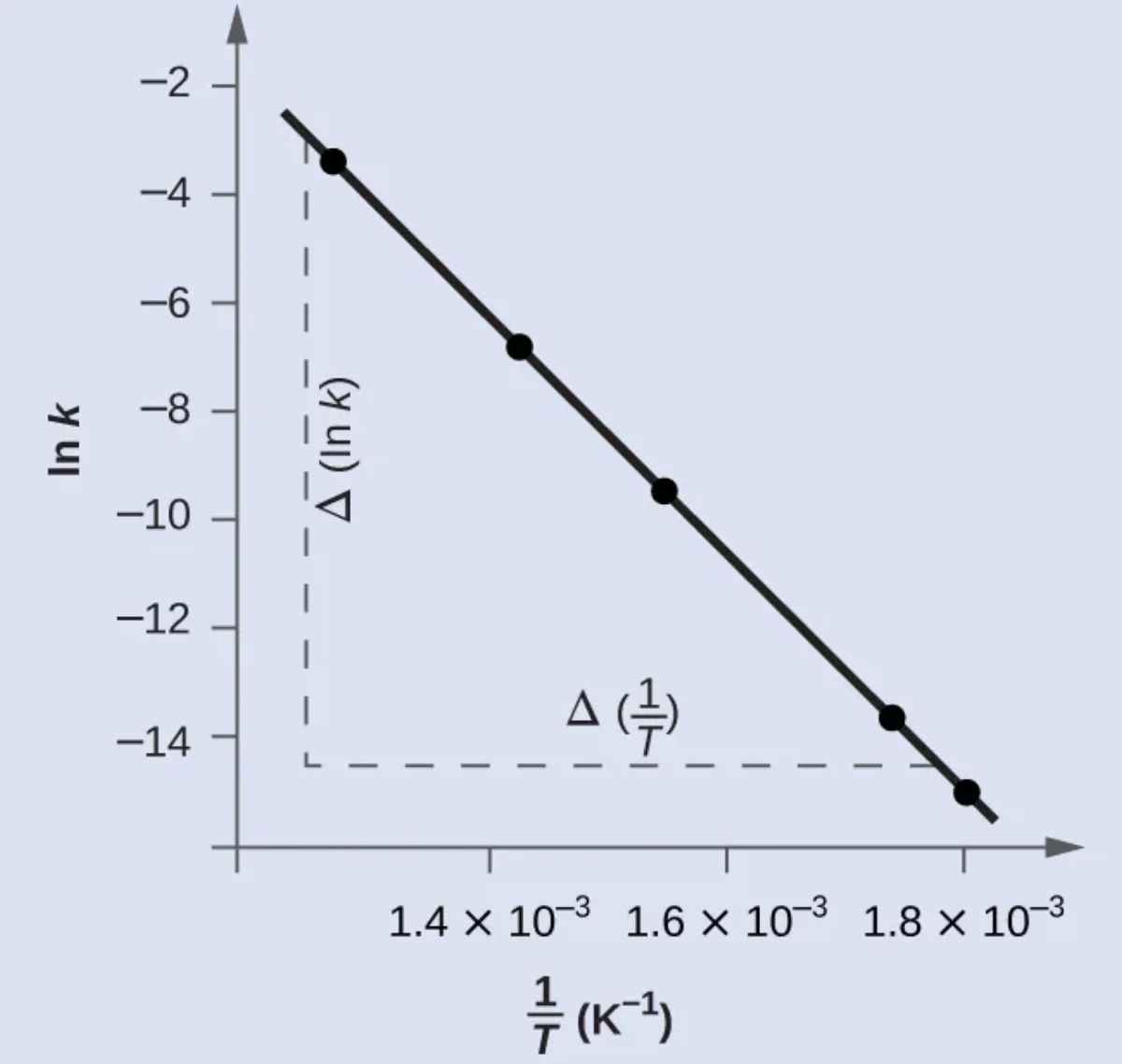
Taking the natural log of both sides of the Arrhenius equation gives a linear form:
Plotting ln(k) vs. 1/T gives a straight line. The slope is -Ea/R, so you can determine the activation energy from the slope:
Ea = -slope x R
A steeper (more negative) slope means a higher activation energy. The reaction is more sensitive to temperature changes.
An Arrhenius plot: ln(k) vs. 1/T gives a straight line with slope = -Ea/R. The dashed lines show how to calculate the slope from Δ(ln k) / Δ(1/T). Credit: OpenStax Chemistry 2e, CC BY 4.0
The Two-Point Form
If you know the rate constant at two different temperatures, you can find Ea without plotting:
On an Arrhenius plot (ln k vs. 1/T), what does the slope represent?
Click to reveal answer
Slope = -Ea / R. The slope is always negative (k increases with temperature, and 1/T decreases with temperature). A steeper slope indicates a larger activation energy. Ea can be calculated as Ea = -slope x R.
Two reactions have the same frequency factor A, but Reaction 1 has Ea = 50 kJ/mol and Reaction 2 has Ea = 100 kJ/mol. Which reaction is faster at 300 K?
Click to reveal answer
Reaction 1 is faster. A lower activation energy means the exponential term e^(-Ea/RT) is larger, giving a larger rate constant k. Since both reactions have the same A, the one with lower Ea has the larger k and therefore proceeds faster.
Why do reactions happen at all? At the molecular level, the answer is simple: molecules must collide. But not just any collision will do. Collision theory lays out the rules for what makes a collision productive.
The Two Requirements for an Effective Collision
For a collision between reactant molecules to produce products, two conditions must be met simultaneously:
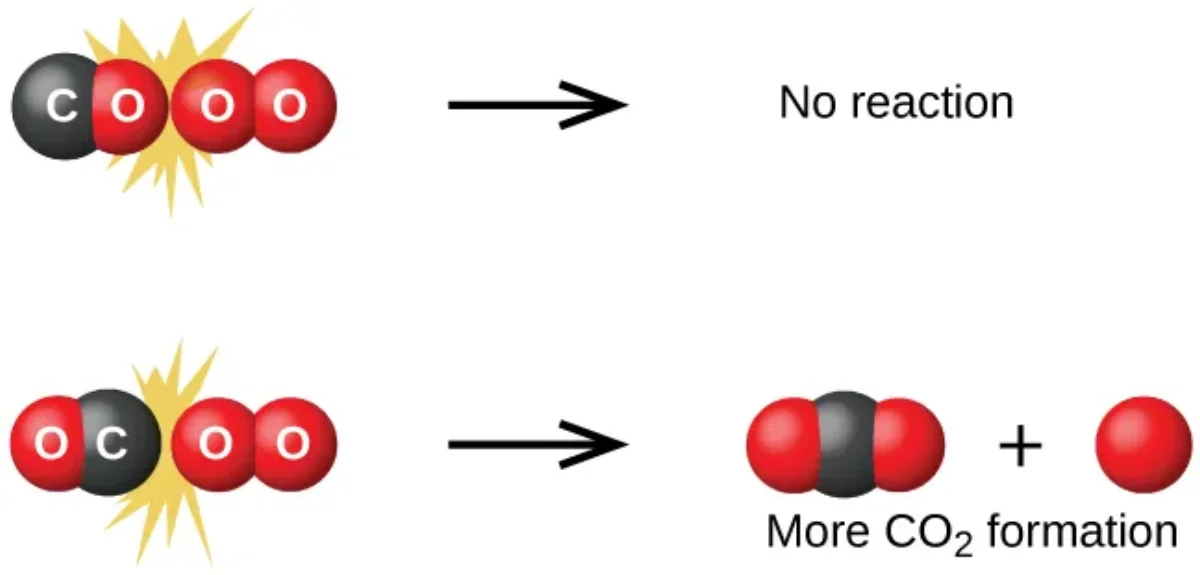
1. Sufficient energy. The colliding molecules must have a combined kinetic energy equal to or greater than the activation energy (Ea). If they collide too gently, they simply bounce off each other unchanged.
2. Correct orientation. The reactive parts of the molecules must be facing each other during the collision. A molecule of A might need to collide with the oxygen end of molecule B, not the nitrogen end.
Molecular orientation determines whether a collision is effective. Top: CO collides with O₂ in the wrong orientation - no reaction. Bottom: the carbon atom faces the O₂ molecule - CO₂ forms. Credit: OpenStax Chemistry 2e, CC BY 4.0
Collisions that meet both requirements are called effective collisions (or productive collisions). Only effective collisions lead to product formation.
The Rate Equation from Collision Theory
Factors That Increase the Collision Rate
Collision theory directly explains why each of these factors increases reaction rate:
Concentration: More molecules in a given volume means more collisions per second (Z increases). This is why increasing concentration usually increases rate - except for zero-order reactions, where the bottleneck is elsewhere.
Temperature: Temperature has a double effect. First, molecules move faster, so they collide more frequently (Z increases slightly). Second, and much more importantly, a higher fraction of molecules have enough energy to exceed Ea (f increases dramatically). The temperature effect is dominated by the energy factor.
Surface area (for heterogeneous reactions): Grinding a solid into a fine powder exposes more surface for collisions. This is why powdered sugar dissolves faster than sugar cubes.
Medium and viscosity: The physical environment of the reaction affects how freely molecules can move and collide. In a low-viscosity medium like water, molecules diffuse quickly and collide often. In a high-viscosity medium like glycerol or a thick gel, molecular movement is restricted, collisions are less frequent, and the reaction slows down. This is one reason biological reactions rely on enzymes - in the crowded, viscous environment of the cytoplasm, uncatalyzed collisions would be too infrequent to sustain life.
The Maxwell-Boltzmann Distribution
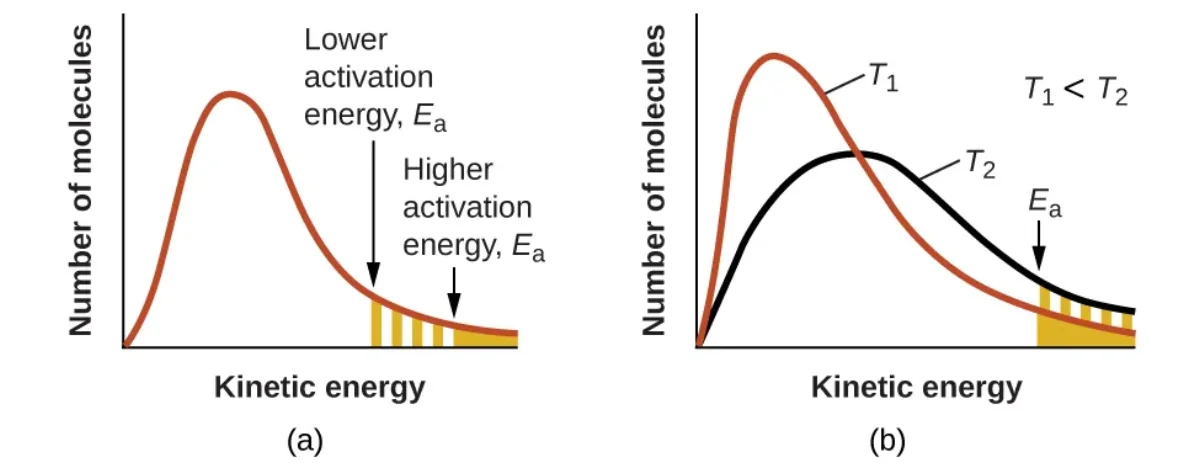
At any given temperature, not all molecules move at the same speed. The Maxwell-Boltzmann distribution describes the range of kinetic energies in a sample of gas molecules.
At a given temperature, some molecules move slowly, most move at moderate speed, and a few move very fast. The area under the curve to the right of Ea represents the fraction of molecules with enough energy to react.
When temperature increases:
The peak of the distribution shifts to the right (higher average energy)
The curve broadens and flattens
The area to the right of Ea increases significantly
More molecules can clear the activation energy barrier
(a) The shaded area represents the fraction of molecules with enough kinetic energy to exceed Ea. A lower Ea means more molecules can react. (b) At higher temperature T₂, the distribution broadens and more molecules have energy above Ea (larger shaded area). Credit: OpenStax Chemistry 2e, CC BY 4.0
Collision Theory vs. Transition State Theory
Collision theory and transition state theory are two models that explain the same phenomenon from different perspectives:
Feature
Collision Theory
Transition State Theory
Focus
Energy and orientation of collisions
Energy profile along the reaction path
Key concept
Effective collisions
Activated complex (transition state)
Approach
”All-or-nothing” - either there is enough energy or there is not
Continuous energy profile from reactants to products
Best for
Explaining why rate depends on concentration and temperature
Explaining reaction coordinate diagrams and catalysis
Both theories require the activation energy to be overcome. They are complementary, not contradictory.
What two conditions must be met for a molecular collision to be "effective" and lead to a reaction?
Click to reveal answer
1) Sufficient kinetic energy (at least equal to Ea), and 2) Correct molecular orientation. If either condition is not met, the molecules simply bounce apart without reacting. This is why only a small fraction of all collisions actually produce products.
Why does increasing temperature have a much larger effect on reaction rate than simply increasing collision frequency?
Click to reveal answer
Because temperature dramatically increases the fraction of molecules above Ea. While higher temperature does slightly increase collision frequency, the dominant effect is the exponential increase in the number of molecules with enough energy to overcome the activation energy barrier (as shown by the Maxwell-Boltzmann distribution).
If collision theory is the “bird’s-eye view” of reactions (molecules smashing into each other), transition state theory zooms in to show exactly what happens during the collision itself. It tracks the energy of the system as reactants transform into products, step by step.
The Transition State (Activated Complex)
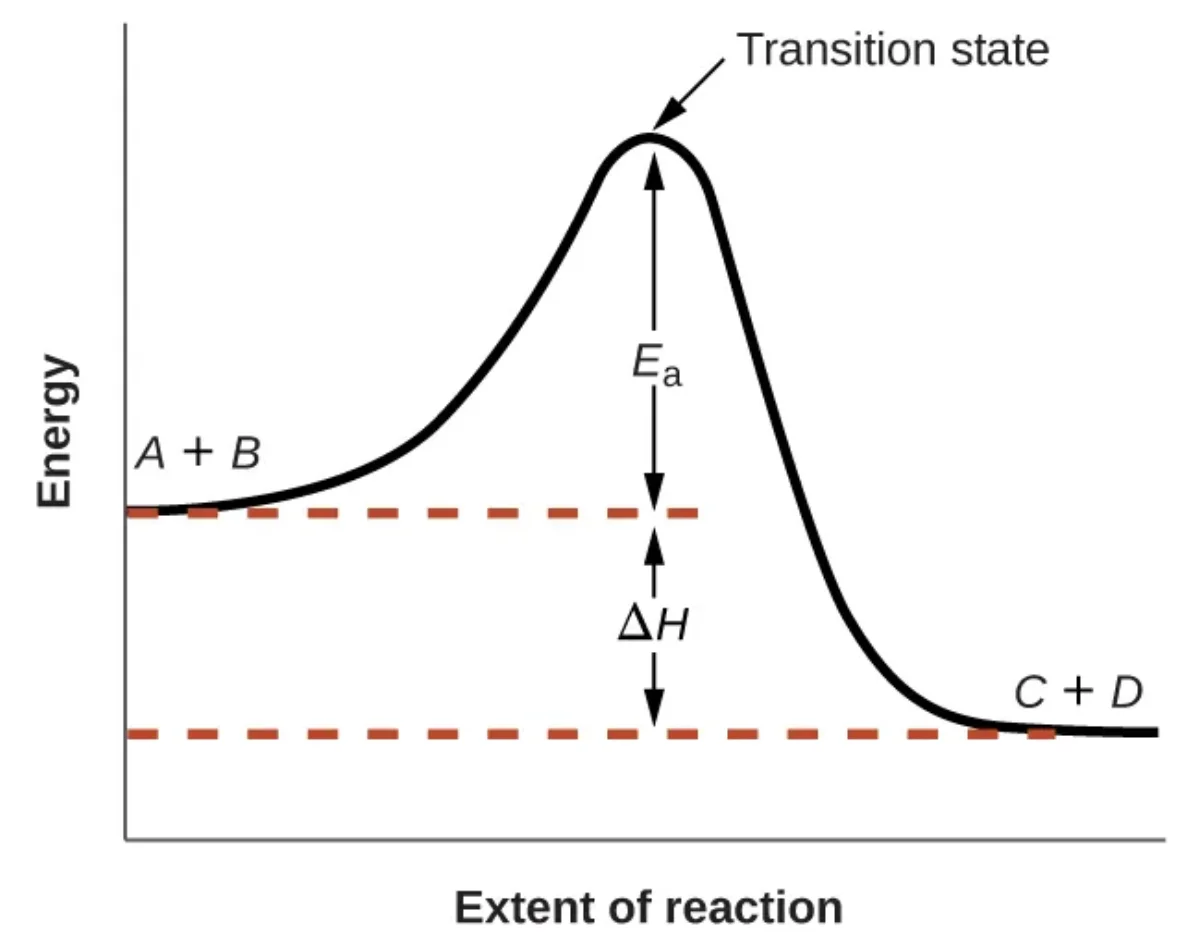
The transition state is the highest-energy point along the reaction pathway. At this point, old bonds are partially broken and new bonds are partially formed. The transition state is denoted by the symbol ‡ (double dagger).
Key properties of transition states:
They exist at the energy maximum on the reaction coordinate diagram
They are theoretical structures that cannot be isolated or observed directly
They have an extremely brief lifetime (on the order of femtoseconds)
Once formed, they can proceed forward to products OR fall back to reactants
Reading Reaction Coordinate Diagrams
A reaction coordinate diagram for an exothermic reaction. The peak represents the transition state, Ea is the activation energy, and ΔH is the enthalpy change. Credit: OpenStax Chemistry 2e, CC BY 4.0
A reaction coordinate diagram contains several important pieces of information:
Activation energy (Ea forward): The energy difference between the reactants and the transition state peak. This is the barrier the forward reaction must overcome.
Activation energy (Ea reverse): The energy difference between the products and the transition state peak. This is the barrier the reverse reaction must overcome.
Free energy of reaction (ΔG): The energy difference between products and reactants. This determines whether the reaction is exergonic or endergonic.
Exergonic vs. Endergonic Reactions
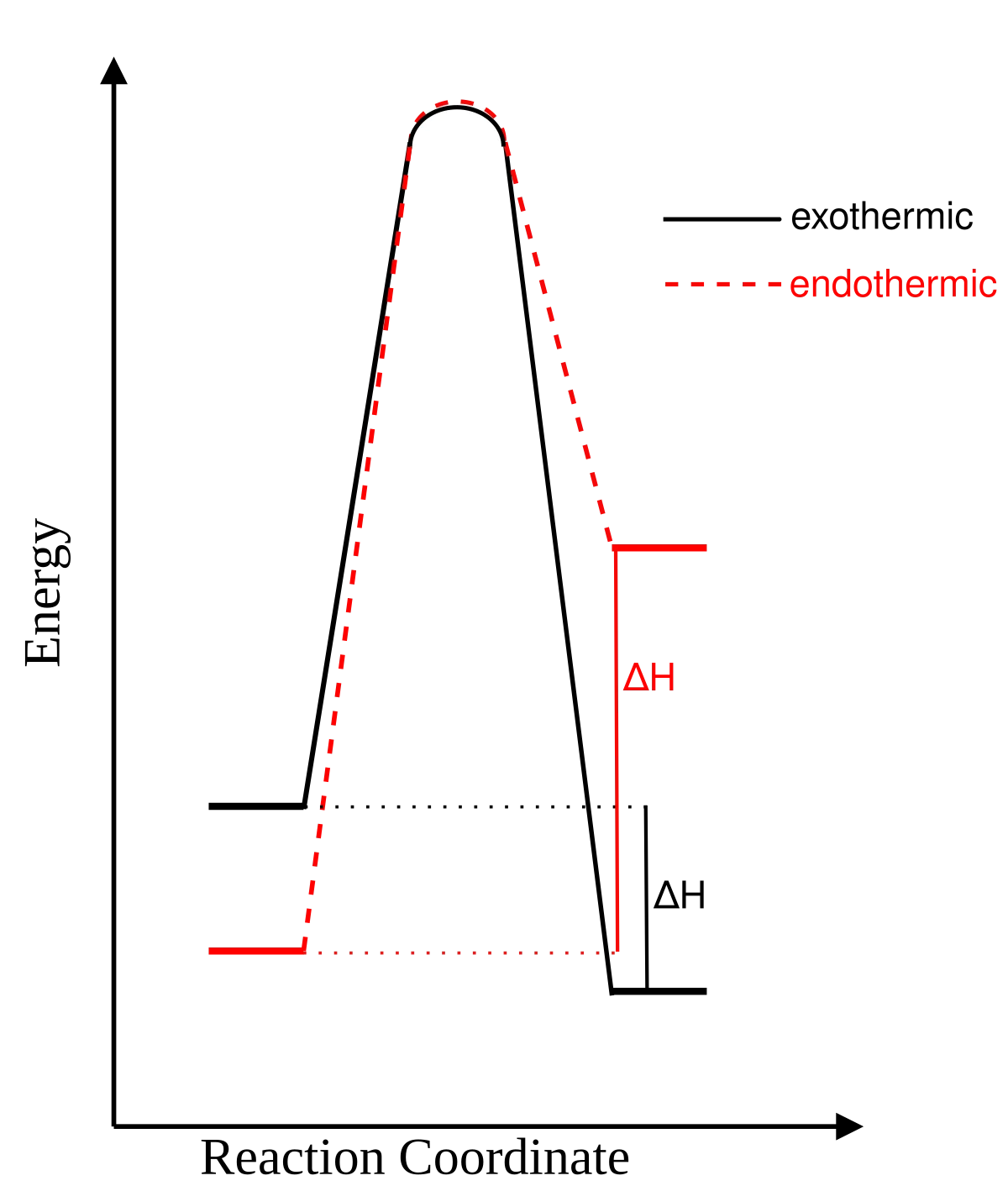
Exothermic reactions (black, solid) release energy: products are lower than reactants, ΔH is negative. Endothermic reactions (red, dashed) absorb energy: products are higher, ΔH is positive. Both must overcome the activation energy barrier at the transition state. Credit: Wikimedia Commons, CC BY-SA 3.0
Feature
Exergonic
Endergonic
ΔG
Negative
Positive
Products vs. Reactants
Products lower energy
Products higher energy
Spontaneous?
Yes (thermodynamically favored)
No (requires energy input)
Ea forward vs. Ea reverse
Ea forward < Ea reverse
Ea forward > Ea reverse
The Relationship Between Ea and ΔG
A critical concept: activation energy and ΔG are independent. A reaction can be exergonic (thermodynamically favorable) but still have a high activation energy (kinetically slow). Diamond converting to graphite is thermodynamically favorable but kinetically so slow that your engagement ring is safe.
On the diagram:
ΔG = Eproducts - Ereactants (where on the y-axis the reaction ends vs. starts)
Ea = Etransition state - Ereactants (how high you must climb)
Changing one does not automatically change the other. You can lower Ea (with a catalyst) without changing ΔG.
Intermediates vs. Transition States
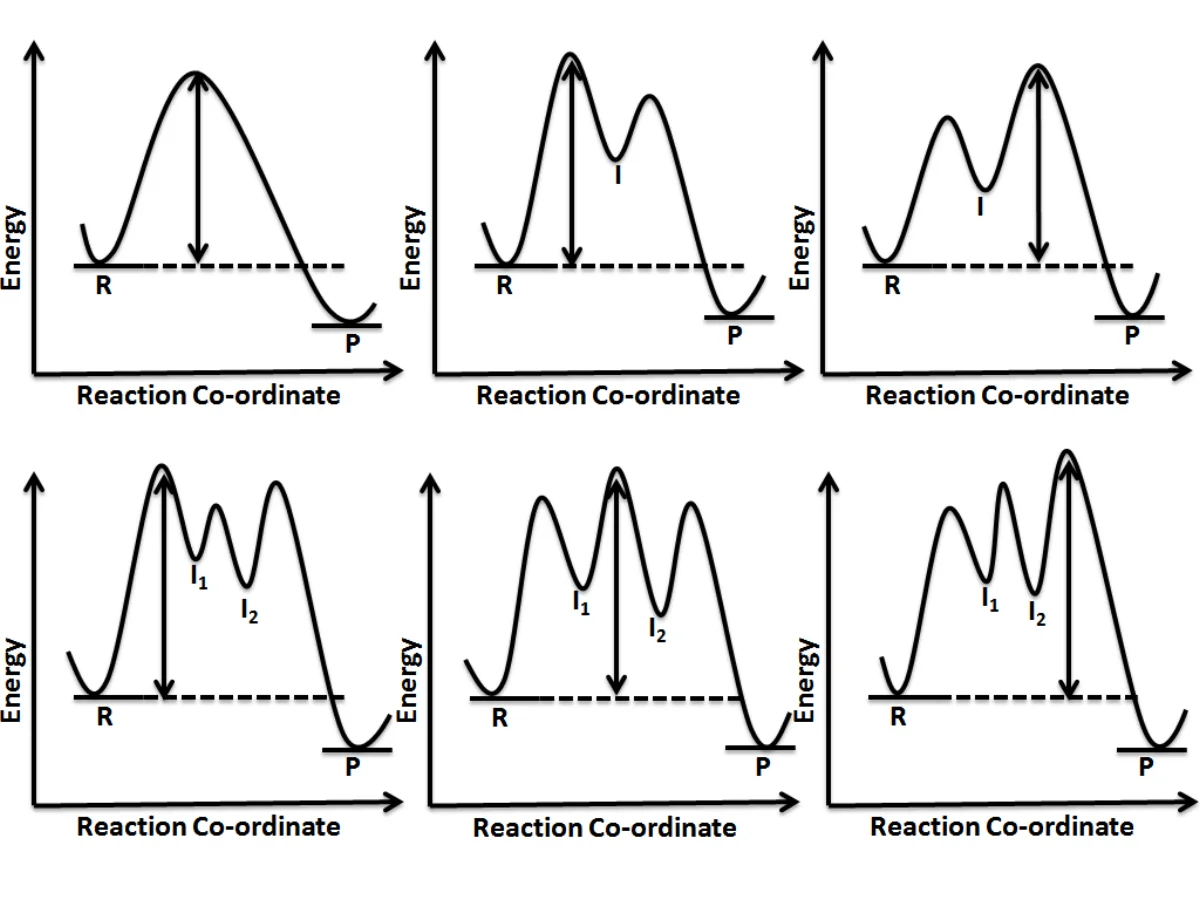
For multi-step reactions, the reaction coordinate diagram has multiple peaks and valleys:
Feature
Transition State
Intermediate
Energy position
Local maximum (peak)
Local minimum (valley)
Can be isolated?
No
Sometimes (briefly)
Stability
Maximally unstable
Relatively more stable
Symbol
‡ (double dagger)
Usually written as a chemical formula
Appears in overall equation?
No
No
Lifetime
Femtoseconds
Longer (but still short)
An intermediate sits in a valley between two peaks. It is a real molecule with a finite lifetime, formed after one elementary step and consumed in the next.
Reaction coordinate diagrams for multi-step mechanisms. Top row: one-step, two-step (with intermediate I), and two-step with a different rate-determining step. Bottom row: three-step mechanisms with two intermediates (I₁ and I₂). Peaks are transition states; valleys are intermediates. Credit: Wikimedia Commons, CC BY-SA 4.0
On a reaction coordinate diagram, what does the highest peak represent?
Click to reveal answer
The transition state of the rate-determining step. The highest peak has the largest activation energy barrier and corresponds to the slowest step in the mechanism. The rate of the overall reaction is determined by this step.
How do you distinguish an intermediate from a transition state on a reaction coordinate diagram?
Click to reveal answer
Intermediates are at local energy minima (valleys); transition states are at local energy maxima (peaks). Intermediates are real molecules that exist briefly between steps. Transition states are theoretical, highest-energy configurations that cannot be isolated.
A catalyst is a substance that speeds up a reaction without being consumed in the process. It participates in the reaction mechanism, but it is regenerated by the end - what goes in comes back out unchanged. Catalysts are arguably the most important concept connecting general chemistry kinetics to biochemistry, because enzymes are biological catalysts.
How Catalysts Work
Catalysts lower the activation energy (Ea) of a reaction. They do this by providing an alternative reaction pathway - a different mechanism with a lower energy barrier.
What catalysts DO:
Lower Ea for both the forward AND reverse reactions (by the same amount)
Increase the rate constant k (because k depends on Ea through the Arrhenius equation)
Speed up the approach to equilibrium
Interact with reactants (through adsorption or intermediate formation), then are regenerated
What catalysts DO NOT do:
Change ΔG or ΔH of the reaction
Change the equilibrium position (Keq is unchanged)
Change the concentrations of reactants or products at equilibrium
Get consumed in the overall reaction
Types of Catalysts
Homogeneous Catalysis
In homogeneous catalysis, the catalyst is in the same phase as the reactants. For example, an acid catalyst dissolved in an aqueous solution with aqueous reactants.
Example: The decomposition of hydrogen peroxide (H₂O₂) is catalyzed by iodide ions (I⁻) in aqueous solution. Both the catalyst and reactant are dissolved in water.
Heterogeneous Catalysis
In heterogeneous catalysis, the catalyst is in a different phase from the reactants. The most common example is a solid catalyst with gaseous or liquid reactants.
Example: A catalytic converter in a car uses solid platinum and palladium metals to catalyze the conversion of toxic exhaust gases (CO, NO) into less harmful products (CO₂, N₂). The solid metal surface provides sites where gas molecules can adsorb, react, and then desorb as products.
Heterogeneous catalysts work through adsorption - reactant molecules bind to the surface of the catalyst, which weakens their bonds and brings them into close proximity, making it easier for them to react.
Enzymatic Catalysis
Enzymes are biological catalysts - proteins that catalyze specific reactions in living organisms. They are extraordinarily efficient, often increasing reaction rates by factors of 106 to 1012 compared to the uncatalyzed reaction.
Key enzyme concepts for kinetics:
Enzymes lower Ea by stabilizing the transition state
At saturation (all active sites occupied), enzyme-catalyzed reactions become zero-order with respect to substrate
Enzymes do not change ΔG - they only speed up reactions that are already thermodynamically favorable
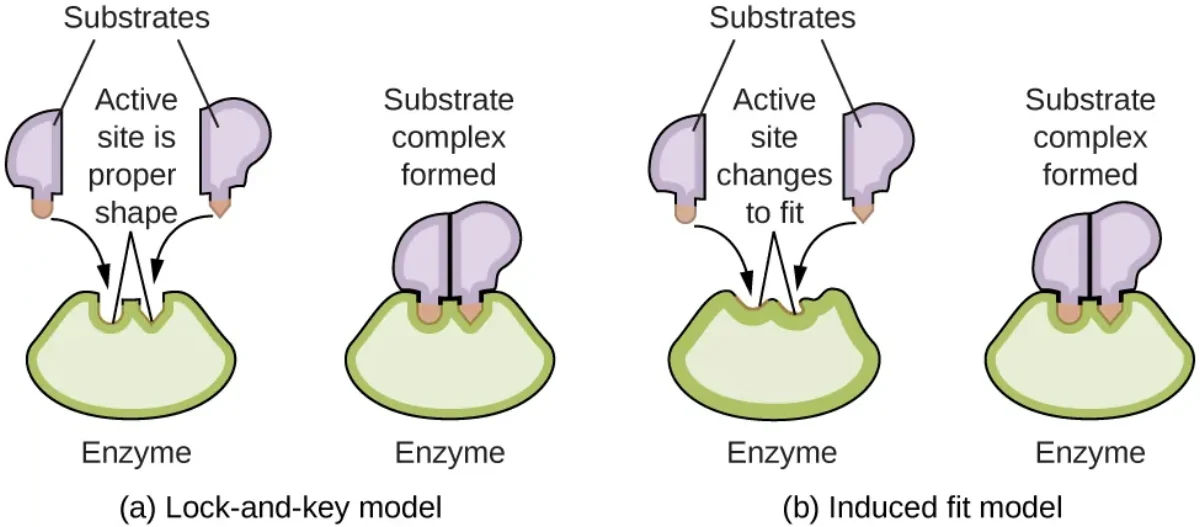
Two models of enzyme-substrate binding. (a) Lock-and-key model: the substrate fits the active site exactly. (b) Induced fit model: the enzyme's active site changes shape upon substrate binding. The induced fit model is more accurate for most enzymes. Credit: OpenStax Chemistry 2e, CC BY 4.0
Catalyst Effect on Reaction Coordinate Diagrams
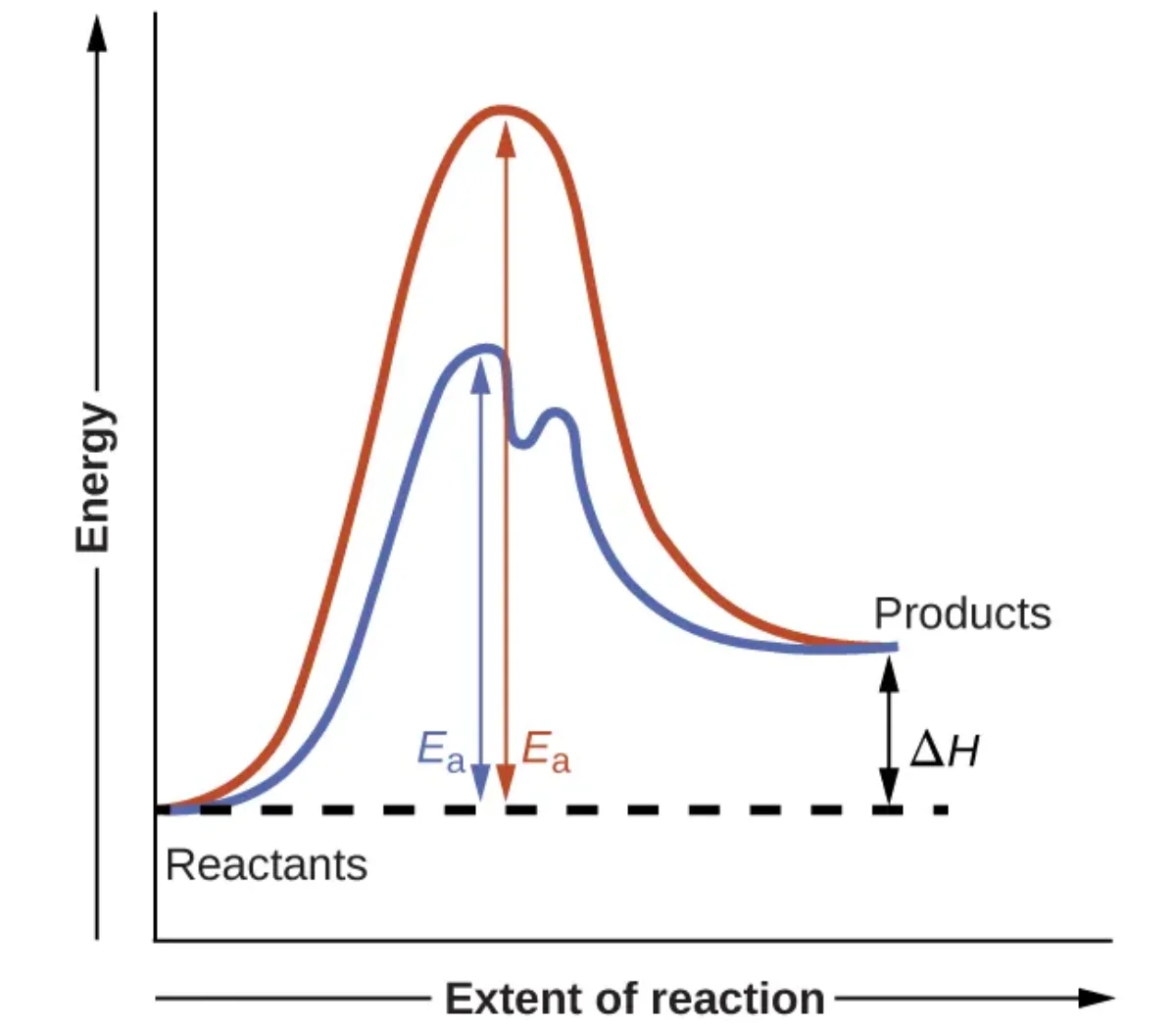
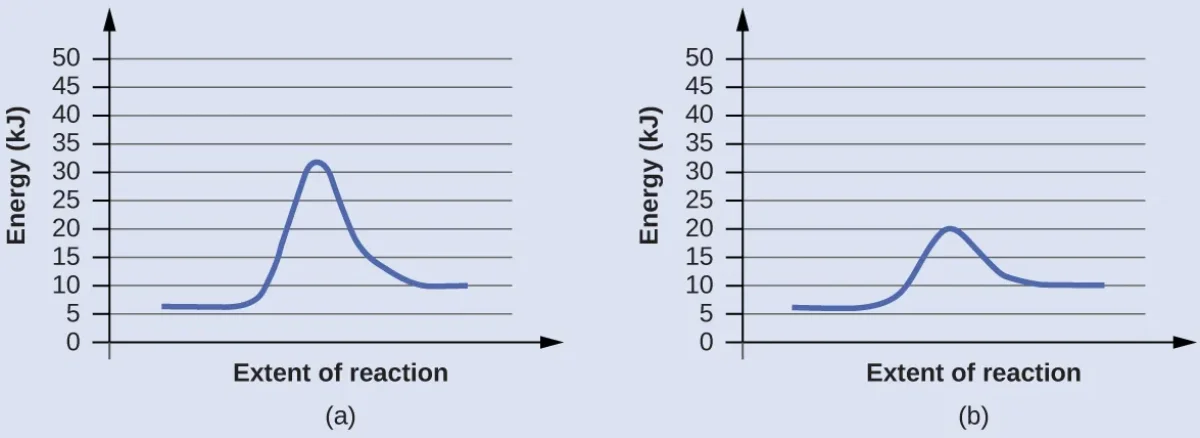
Comparison of catalyzed (blue) and uncatalyzed (red) reaction pathways. The catalyst provides an alternative pathway with lower activation energy (Ea) but does not change ΔH. Notice the catalyzed pathway may involve multiple steps (two peaks with an intermediate valley). Credit: OpenStax Chemistry 2e, CC BY 4.0(a) Uncatalyzed reaction with Ea of approximately 30 kJ. (b) The same reaction with a catalyst lowers Ea to approximately 20 kJ. The reactant and product energy levels are unchanged - only the barrier height decreases. Credit: OpenStax Chemistry 2e, CC BY 4.0
On a reaction coordinate diagram, adding a catalyst creates a new curve that:
Starts at the same energy level (same reactants)
Ends at the same energy level (same products)
Has a lower peak (reduced activation energy)
May have a different shape (different mechanism, possibly more steps)
The ΔG remains identical. Only the barrier height changes.
A catalyst is added to a reaction at equilibrium. What happens to the equilibrium concentrations?
Click to reveal answer
Nothing - the equilibrium concentrations do not change. A catalyst speeds up both the forward and reverse reactions equally, so Keq is unchanged. If the system is already at equilibrium, adding a catalyst has no effect on concentrations. It only matters if the system has not yet reached equilibrium (it gets there faster).
What is the difference between a homogeneous and heterogeneous catalyst?
Click to reveal answer
Phase. A homogeneous catalyst is in the same phase as the reactants (e.g., acid catalyst dissolved in aqueous solution). A heterogeneous catalyst is in a different phase (e.g., solid metal catalyzing a gas-phase reaction). Heterogeneous catalysts typically work through surface adsorption.
Most chemical reactions do not happen in a single collision. They proceed through a series of simpler steps, each involving only one or two molecules at a time. The complete sequence of these steps is the reaction mechanism - it is the molecular-level story of how reactants become products.
Elementary Steps
An elementary step is a single molecular event - one collision, one bond-breaking, one rearrangement. Unlike the overall balanced equation, elementary steps describe what actually happens at the molecular level.
For an elementary step (and ONLY for elementary steps), the rate law can be written directly from the stoichiometric coefficients. This is the one exception to the rule that “you can’t get the rate law from the equation.”
Molecularity
Molecularity describes how many reactant molecules participate in an elementary step:
Molecularity
Number of Molecules
Example
Rate Law
Unimolecular
1
A → products
rate = k[A]
Bimolecular
2
A + B → products
rate = k[A][B]
Bimolecular
2
2A → products
rate = k[A]²
Termolecular
3
A + B + C → products
rate = k[A][B][C]
The Rate-Determining Step (RDS)
The rate-determining step is the slowest elementary step in the mechanism. It acts as a kinetic bottleneck.
Key facts about the RDS:
The overall reaction rate equals the rate of the RDS
The rate law for the overall reaction is determined by the RDS
On a reaction coordinate diagram, the RDS corresponds to the highest energy barrier (tallest peak)
Speeding up the RDS speeds up the entire reaction
Deriving Rate Laws from Mechanisms
When the MCAT gives you a mechanism and asks for the rate law:
Step 1: Identify the slow (rate-determining) step.
Step 2: Write the rate law using the reactants and coefficients of that step. Since the RDS is an elementary step, you CAN use the coefficients as orders.
Step 3: Check whether any intermediates appear in your rate law. If so, you need to eliminate them (see Section 5.12 on the steady-state approximation).
Example: A Two-Step Mechanism
Consider:
Step 1: NO₂ + NO₂ → NO₃ + NO (slow)
Step 2: NO₃ + CO → NO₂ + CO₂ (fast)
Overall: NO₂ + CO → NO + CO₂
The slow step is Step 1, so the rate law is:
rate = k[NO₂]²
Notice that CO does not appear in the rate law even though it is a reactant in the overall equation. This is because CO only participates in the fast step, which is not rate-limiting. The MCAT loves this type of question.
Identifying Intermediates
An intermediate is a species that:
Is produced in one step and consumed in a later step
Does not appear in the overall balanced equation
Appears as a product in one elementary step and a reactant in another
In the example above, NO₃ is an intermediate. It is produced in Step 1 and consumed in Step 2. Cancel it out when adding the steps together, and it disappears from the overall equation.
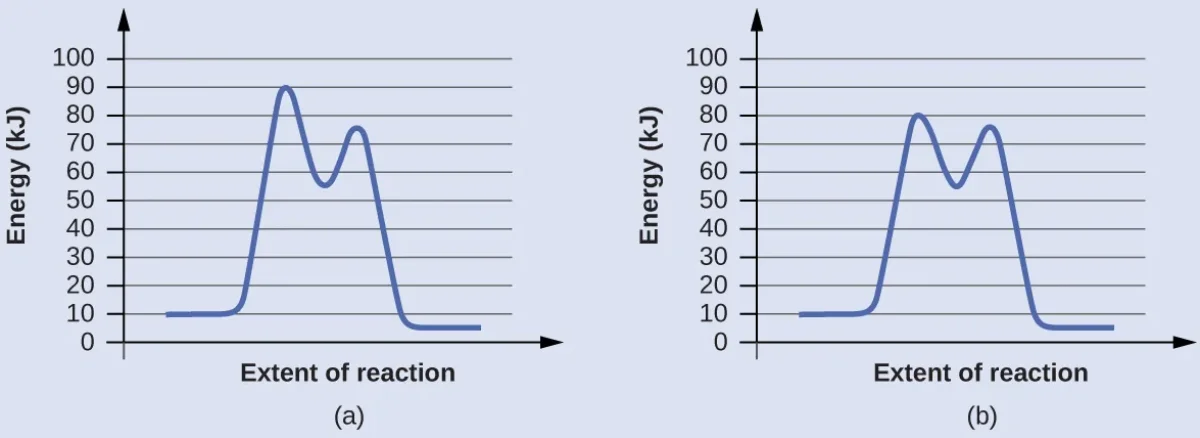
Multi-step reaction energy diagrams. (a) The first step has a higher energy barrier (~90 kJ), making it the rate-determining step. The valley between peaks represents the intermediate. (b) Both steps have similar barriers. The number of peaks equals the number of elementary steps; the tallest peak identifies the RDS. Credit: OpenStax Chemistry 2e, CC BY 4.0
Valid Mechanisms
For a proposed mechanism to be valid, it must satisfy two criteria:
The elementary steps must add up to the overall balanced equation. All intermediates must cancel out.
The rate law derived from the mechanism must match the experimentally determined rate law. If the predicted and observed rate laws disagree, the mechanism is wrong.
In a two-step mechanism, Step 1 is fast and Step 2 is slow. Which step determines the rate law?
Click to reveal answer
Step 2 (the slow step). The rate-determining step is always the slowest step in the mechanism. The rate law is written from the reactants and coefficients of the slow step, since it is an elementary step.
How do you identify an intermediate in a multi-step mechanism?
Click to reveal answer
An intermediate is produced in one step and consumed in a later step. It appears as a product in one elementary step and a reactant in another. When you add all the steps together, intermediates cancel out and do not appear in the overall balanced equation.
Sometimes the rate-determining step of a mechanism involves an intermediate - a species that does not appear in the overall reaction. Since intermediates are not something you can easily measure or control in an experiment, their concentrations cannot appear in the final rate law. You need a way to replace the intermediate with reactant concentrations. That is what the steady-state and pre-equilibrium approximations do.
The Problem: Intermediates in the Rate Law
Consider this mechanism:
Step 1: A + B ⇌ C (fast, reversible)
Step 2: C + D → E (slow)
The slow step determines the rate law: rate = k₂[C][D]
But C is an intermediate. We cannot report a rate law with [C] in it because C is not a reactant we can measure directly. We need to express [C] in terms of [A], [B], and other measurable quantities.
The Pre-Equilibrium Approximation
The pre-equilibrium approximation applies when a fast, reversible step occurs before the slow step. Since Step 1 is fast and reversible, it reaches equilibrium much faster than Step 2 consumes C. We can treat Step 1 as being at equilibrium:
Keq = k₁/k₋₁ = [C] / ([A][B])
Solving for [C]: [C] = (k₁/k₋₁)[A][B]
Substituting into the rate law:
rate = k₂[C][D] = k₂(k₁/k₋₁)[A][B][D]
Combining constants: rate = kobs[A][B][D]
where kobs = k₁k₂/k₋₁
When to Use Pre-Equilibrium
Use the pre-equilibrium approximation when:
A fast, reversible step occurs before the slow step
The fast step has time to reach equilibrium because the slow step is much slower
This is the most common scenario on the MCAT.
The Steady-State Approximation
The steady-state approximation is a more general approach. It assumes that after a brief initial period, the concentration of an intermediate remains approximately constant - its rate of production equals its rate of consumption.
For the intermediate C:
Rate of production of C = Rate of consumption of C
k₁[A][B] = k₋₁[C] + k₂[C][D]
Solve for [C] and substitute into the rate law for the slow step.
The steady-state approximation is more mathematically involved than pre-equilibrium. On the MCAT, pre-equilibrium is far more common, but you should recognize the steady-state concept if it appears in a passage.
Comparison of Approaches
Feature
Pre-Equilibrium
Steady-State
Assumption
Fast step reaches equilibrium
[Intermediate] is constant
When to use
Fast reversible step before slow step
Any intermediate
MCAT frequency
Common
Less common
Math difficulty
Easier (just use Keq)
Harder (set rates equal)
Result
Same final rate law
Same final rate law
Worked Example
Consider the mechanism for the reaction 2 NO + O₂ → 2 NO₂:
Step 1: 2 NO ⇌ N₂O₂ (fast, reversible)
Step 2: N₂O₂ + O₂ → 2 NO₂ (slow)
Rate from slow step: rate = k₂[N₂O₂][O₂]
N₂O₂ is an intermediate. Using pre-equilibrium on Step 1:
The experimentally observed rate law is rate = k[NO]²[O₂], which matches. This confirms the proposed mechanism is consistent with the data.
Why can't the final rate law contain the concentration of an intermediate?
Click to reveal answer
Because intermediates are not present in the starting reaction mixture and cannot be directly measured or controlled. The rate law must be expressed in terms of reactant concentrations (and possibly catalyst concentrations) that an experimenter can actually measure and manipulate. Intermediates must be algebraically eliminated using the pre-equilibrium or steady-state approximation.
A mechanism has Step 1: X ⇌ Y (fast, reversible) and Step 2: Y + Z → Products (slow). What is the overall rate law?
Click to reveal answer
rate = kobs[X][Z]. The slow step gives rate = k₂[Y][Z]. Y is an intermediate. From the fast equilibrium: K = [Y]/[X], so [Y] = K[X]. Substituting: rate = k₂K[X][Z] = kobs[X][Z].

![Graph of ln[H2O2] versus time in hours showing a straight line with negative slope, demonstrating first-order kinetics for hydrogen peroxide decomposition, with data points at 0, 6, 12, 18, and 24 hours](/images/books/general-chemistry/ch5/openstax-first-order.webp)
![Two side-by-side graphs for the dimerization of butadiene C4H6: left panel shows ln[C4H6] versus time in seconds with a curved line confirming the reaction is NOT first order, right panel shows 1/[C4H6] versus time with a straight line confirming second-order kinetics](/images/books/general-chemistry/ch5/openstax-rate-law-graphs.webp)