
Zero-Order Reactions
A zero-order reaction is the simplest type of kinetics: the rate does not depend on the concentration of reactants at all. No matter how much reactant you add, the reaction proceeds at the same constant speed.
Rate Law
For a zero-order reaction:
Integrated Rate Law
The integrated rate law lets you calculate the concentration of a reactant at any time t:
Graphical Analysis
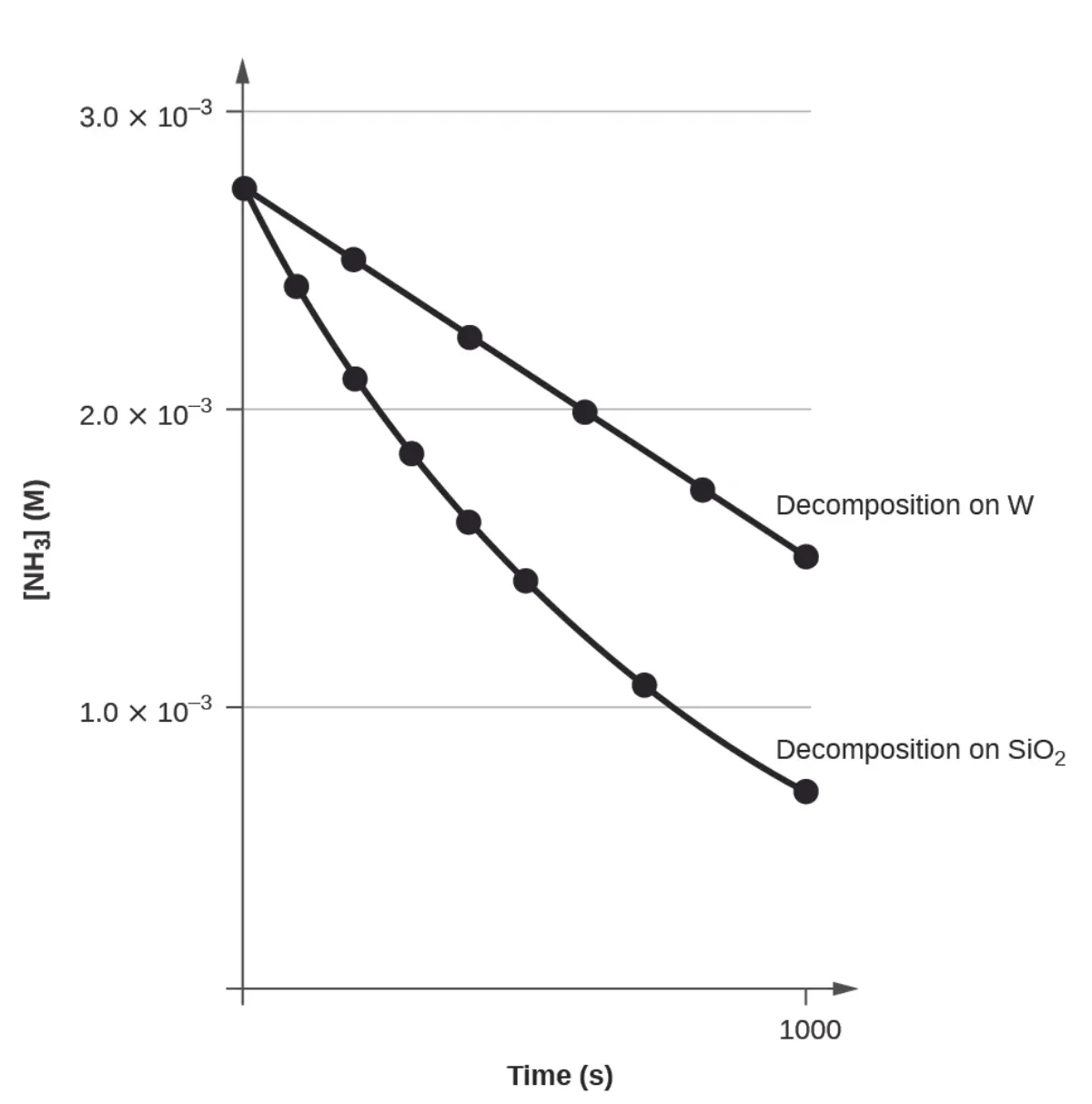
Plotting [A] vs. time for a zero-order reaction gives a straight line with:
- Slope = -k (negative because concentration decreases)
- y-intercept = [A]₀
This is the simplest graph you will see in kinetics. If [A] vs. t is linear and decreasing, the reaction is zero order.
Half-Life
The half-life of a zero-order reaction is the time it takes for the concentration to drop to half its initial value:
What Can Change the Rate?
Since the rate equals k, the only ways to change the rate of a zero-order reaction are:
- Change the temperature - this changes k via the Arrhenius equation
- Add a catalyst - this lowers the activation energy, increasing k
Changing reactant concentrations has no effect. This is the defining feature of zero-order kinetics.
Enzyme kinetics is the classic place to see both orders in one curve. Slide the
substrate concentration: at low [S] the rate climbs with concentration, which is
first-order behavior, and once every active site is occupied the rate plateaus at
Vmax, which is zero-order.
As substrate rises, rate climbs then plateaus at Vmax — every enzyme is busy. Km is the [S] giving half-Vmax (lower Km = tighter binding). Competitive inhibitors raise Km (more substrate beats them); noncompetitive inhibitors lower Vmax (substrate can't).
Nothing - the rate stays the same. In a zero-order reaction, rate = k. The rate is independent of reactant concentration. Only changing the temperature or adding a catalyst will change the rate.
[A] vs. t is linear for zero-order reactions. The integrated rate law [A]_t = [A]_0 - kt is in y = mx + b form. The slope is -k and the intercept is [A]_0.