
Reaction Mechanisms
Most chemical reactions do not happen in a single collision. They proceed through a series of simpler steps, each involving only one or two molecules at a time. The complete sequence of these steps is the reaction mechanism - it is the molecular-level story of how reactants become products.
Elementary Steps
An elementary step is a single molecular event - one collision, one bond-breaking, one rearrangement. Unlike the overall balanced equation, elementary steps describe what actually happens at the molecular level.
For an elementary step (and ONLY for elementary steps), the rate law can be written directly from the stoichiometric coefficients. This is the one exception to the rule that “you can’t get the rate law from the equation.”
Molecularity
Molecularity describes how many reactant molecules participate in an elementary step:
| Molecularity | Number of Molecules | Example | Rate Law |
|---|---|---|---|
| Unimolecular | 1 | A → products | rate = k[A] |
| Bimolecular | 2 | A + B → products | rate = k[A][B] |
| Bimolecular | 2 | 2A → products | rate = k[A]² |
| Termolecular | 3 | A + B + C → products | rate = k[A][B][C] |
The Rate-Determining Step (RDS)
The rate-determining step is the slowest elementary step in the mechanism. It acts as a kinetic bottleneck.
Key facts about the RDS:
- The overall reaction rate equals the rate of the RDS
- The rate law for the overall reaction is determined by the RDS
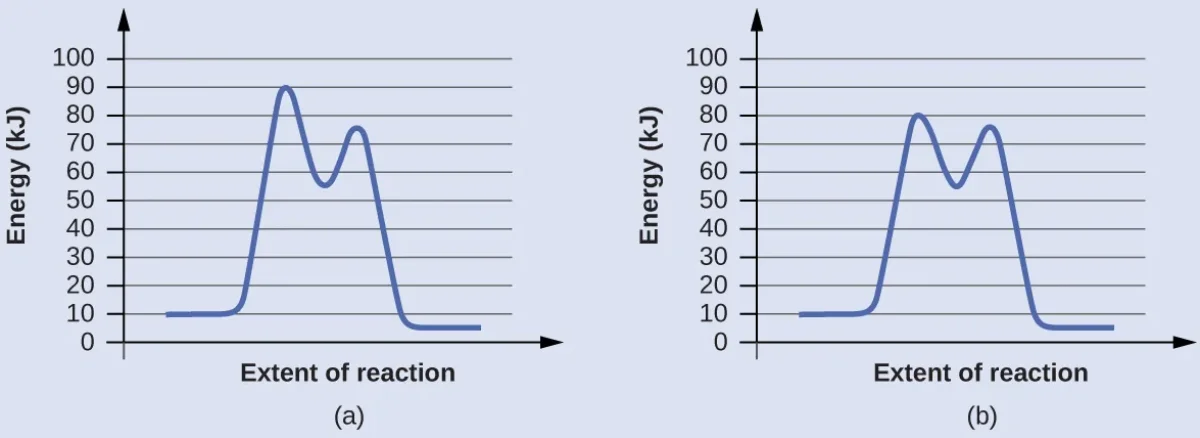
- On a reaction coordinate diagram, the RDS corresponds to the highest energy barrier (tallest peak)
- Speeding up the RDS speeds up the entire reaction
Deriving Rate Laws from Mechanisms
When the MCAT gives you a mechanism and asks for the rate law:
Step 1: Identify the slow (rate-determining) step.
Step 2: Write the rate law using the reactants and coefficients of that step. Since the RDS is an elementary step, you CAN use the coefficients as orders.
Step 3: Check whether any intermediates appear in your rate law. If so, you need to eliminate them (see Section 5.12 on the steady-state approximation).
Example: A Two-Step Mechanism
Consider:
Step 1: NO₂ + NO₂ → NO₃ + NO (slow)
Step 2: NO₃ + CO → NO₂ + CO₂ (fast)
Overall: NO₂ + CO → NO + CO₂
The slow step is Step 1, so the rate law is:
rate = k[NO₂]²
Notice that CO does not appear in the rate law even though it is a reactant in the overall equation. This is because CO only participates in the fast step, which is not rate-limiting. The MCAT loves this type of question.
Identifying Intermediates
An intermediate is a species that:
- Is produced in one step and consumed in a later step
- Does not appear in the overall balanced equation
- Appears as a product in one elementary step and a reactant in another
In the example above, NO₃ is an intermediate. It is produced in Step 1 and consumed in Step 2. Cancel it out when adding the steps together, and it disappears from the overall equation.
Valid Mechanisms
For a proposed mechanism to be valid, it must satisfy two criteria:
- The elementary steps must add up to the overall balanced equation. All intermediates must cancel out.
- The rate law derived from the mechanism must match the experimentally determined rate law. If the predicted and observed rate laws disagree, the mechanism is wrong.