First-order reactions are the most important reaction order for the MCAT. Radioactive decay, many drug metabolism pathways, and numerous biological processes follow first-order kinetics. If you learn only one reaction order thoroughly, make it this one.
Rate Law
Integrated Rate Law
Graphical Analysis
[A] vs. time: Curved (exponential decay). NOT linear.
ln[A] vs. time:Straight line with slope = -k and y-intercept = ln[A]₀.
A plot of ln[H₂O₂] vs. time for the decomposition of hydrogen peroxide. The straight line confirms first-order kinetics. The slope equals -k. Credit: OpenStax Chemistry 2e, CC BY 4.0
If you plot the data and ln[A] vs. t gives a straight line, you have confirmed first-order kinetics. This is the diagnostic test for first-order reactions.
Half-Life: The Star of First-Order Kinetics
The half-life is the time required for the concentration to drop to half its initial value. For first-order reactions:
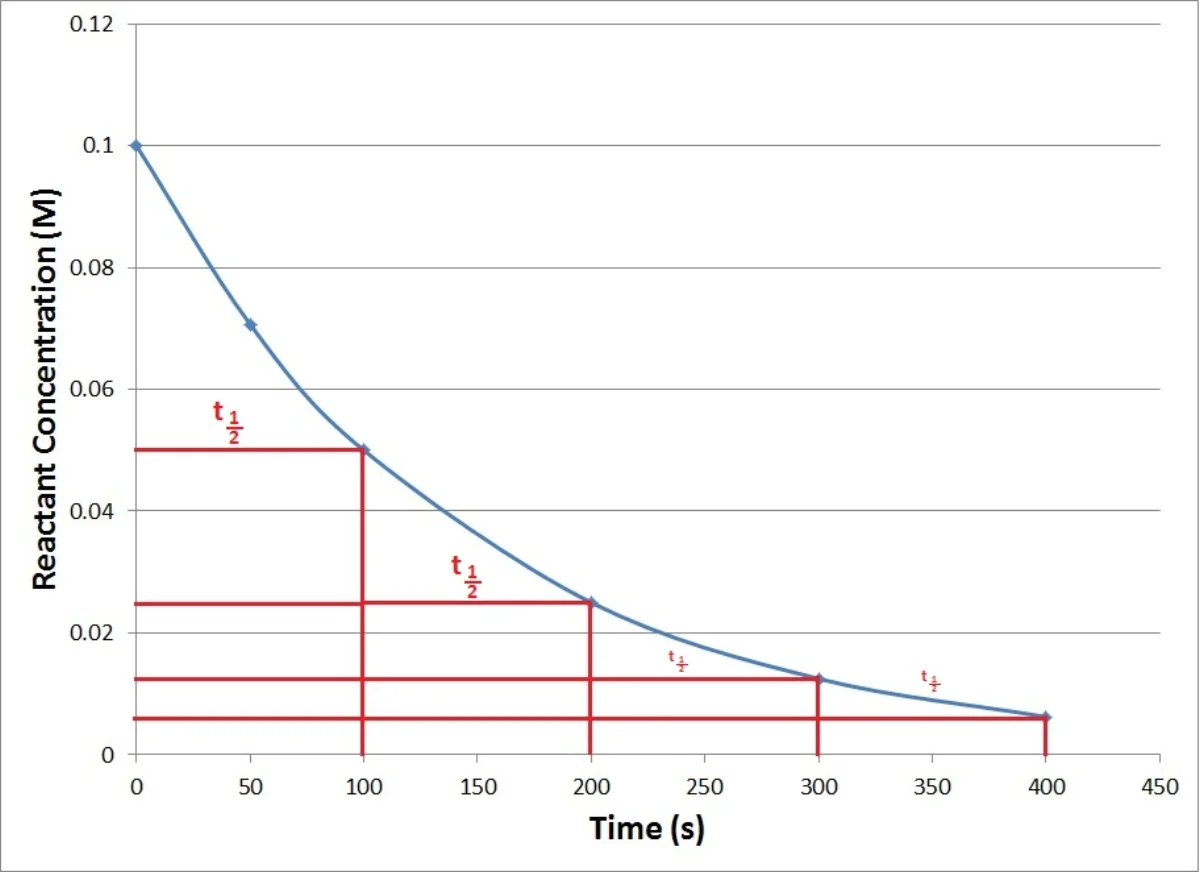
First-order decay with constant half-life. Each red bracket (t1/2) spans the same time interval (~100 s), even as the concentration drops. After one half-life: 0.10 → 0.05 M. After two: 0.05 → 0.025 M. After three: 0.025 → 0.0125 M. The half-life never changes - this is the defining feature of first-order kinetics. Credit: Lumen Learning / OpenStax Introductory Chemistry, CC BY 4.0
Calculating with Half-Lives
After n half-lives, the fraction of the original sample remaining is (21)^n:
Half-Lives Elapsed
Fraction Remaining
Percent Remaining
0
1
100%
1
21
50%
2
41
25%
3
81
12.5%
4
161
6.25%
5
321
3.125%
Radioactive Decay
Radioactive decay is the classic example of a first-order process. The rate of decay depends only on the amount of radioactive isotope present, not on temperature, pressure, or chemical environment.
Pharmacokinetics Connection
Most drugs are eliminated from the body via first-order kinetics. The half-life of a drug tells physicians how often to dose: if the half-life is 6 hours, giving a dose every 6 hours maintains a relatively stable blood concentration. This is why “take every 4-6 hours” appears on medication labels.
A radioactive isotope has a half-life of 8 hours. If you start with 120 mg, how much remains after 24 hours?
Click to reveal answer
15 mg. 24 hours / 8 hours per half-life = 3 half-lives. After 3 half-lives: 120 → 60 → 30 → 15 mg. Or use (21)³ x 120 = (81)(120) = 15 mg.
A first-order reaction has k = 0.0231 s⁻¹. What is the half-life?
Click to reveal answer
30 seconds. t_(21) = 0.693 / k = 0.693 / 0.0231 = 30 s. Note that 0.693 / 0.0231 can be estimated as 0.7 / 0.023 ≈ 30.

![Graph of ln[H2O2] versus time in hours showing a straight line with negative slope, demonstrating first-order kinetics for hydrogen peroxide decomposition, with data points at 0, 6, 12, 18, and 24 hours](/images/books/general-chemistry/ch5/openstax-first-order.webp)