
Reaction Rate
Imagine you are timing how fast ice melts in a glass of water. You could measure how much ice is left every five minutes and calculate an average melting rate. Or you could zoom in on one specific moment and ask: “How fast is the ice melting right now?” Both approaches give you useful information, but they answer slightly different questions.
Chemical reaction rates work the same way. We can measure an average rate over a time interval, or we can determine the instantaneous rate at a specific point in time.
What Is Reaction Rate?
The reaction rate measures how quickly the concentration of a reactant decreases or a product increases over time. Rate is always positive, and it is expressed in units of molarity per second (M/s or mol/L·s).
For reactants, concentration decreases over time, so the change in concentration is negative. We add a negative sign to make the rate positive. For products, concentration increases, so no sign correction is needed.
Average Rate vs. Instantaneous Rate
The average rate is calculated over a time interval. If the concentration of reactant A drops from 0.50 M to 0.30 M over 10 seconds:
Average rate = (0.50 - 0.30) / 10 = 0.020 M/s
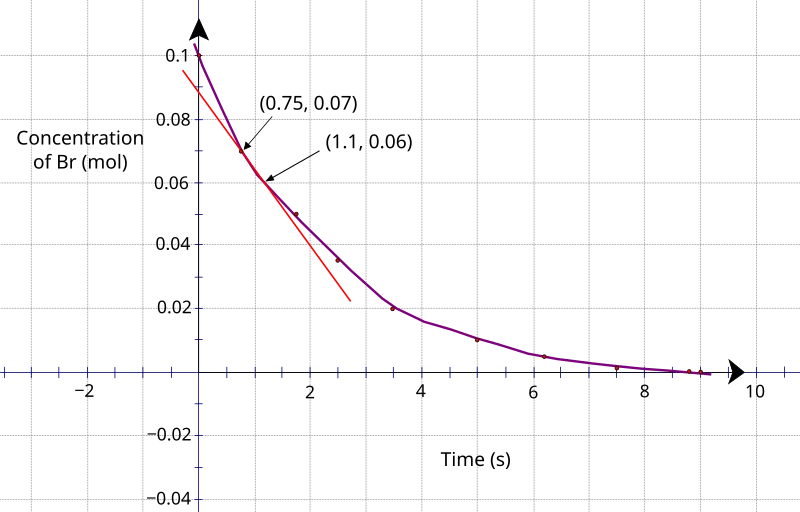
The instantaneous rate is the rate at one specific moment in time. Mathematically, it is the slope of the tangent line to the concentration-vs-time curve at that point. On the MCAT, you will most often work with initial rates - the instantaneous rate at the very beginning of the reaction (t = 0).
Stoichiometry and Rate
Different species in a reaction may disappear or appear at different rates because of their stoichiometric coefficients. Consider the reaction:
2 A + B → C
Two moles of A are consumed for every one mole of B. So A disappears twice as fast as B. To define a single “rate of reaction” that is the same regardless of which species you track, we divide each rate of change by the stoichiometric coefficient.
For example, in the reaction N₂ + 3 H₂ → 2 NH₃:
- H₂ disappears 3 times faster than N₂
- NH₃ appears 2 times faster than N₂
- But the rate of reaction is the same no matter which species you track, once you divide by the coefficient
Units of Rate
Rate is always expressed as concentration per unit time. On the MCAT, this is almost always M/s (molarity per second), sometimes written as mol/(L·s).