Drop a strip of zinc metal into a beaker of blue copper sulfate solution. Within minutes, the solution fades and a reddish film of copper coats the zinc. Zinc atoms are handing electrons directly to copper ions - a spontaneous redox reaction. The problem? All the energy is wasted as heat. None of it does useful work.
A galvanic cell solves this by physically separating the two half-reactions. Instead of electrons jumping directly from zinc to copper in the same beaker, the zinc sits in one container and the copper sits in another. The only path for electrons is through an external wire - and on the way, those electrons can power a lightbulb, a motor, or your phone.
The Daniell Cell - The Classic Example
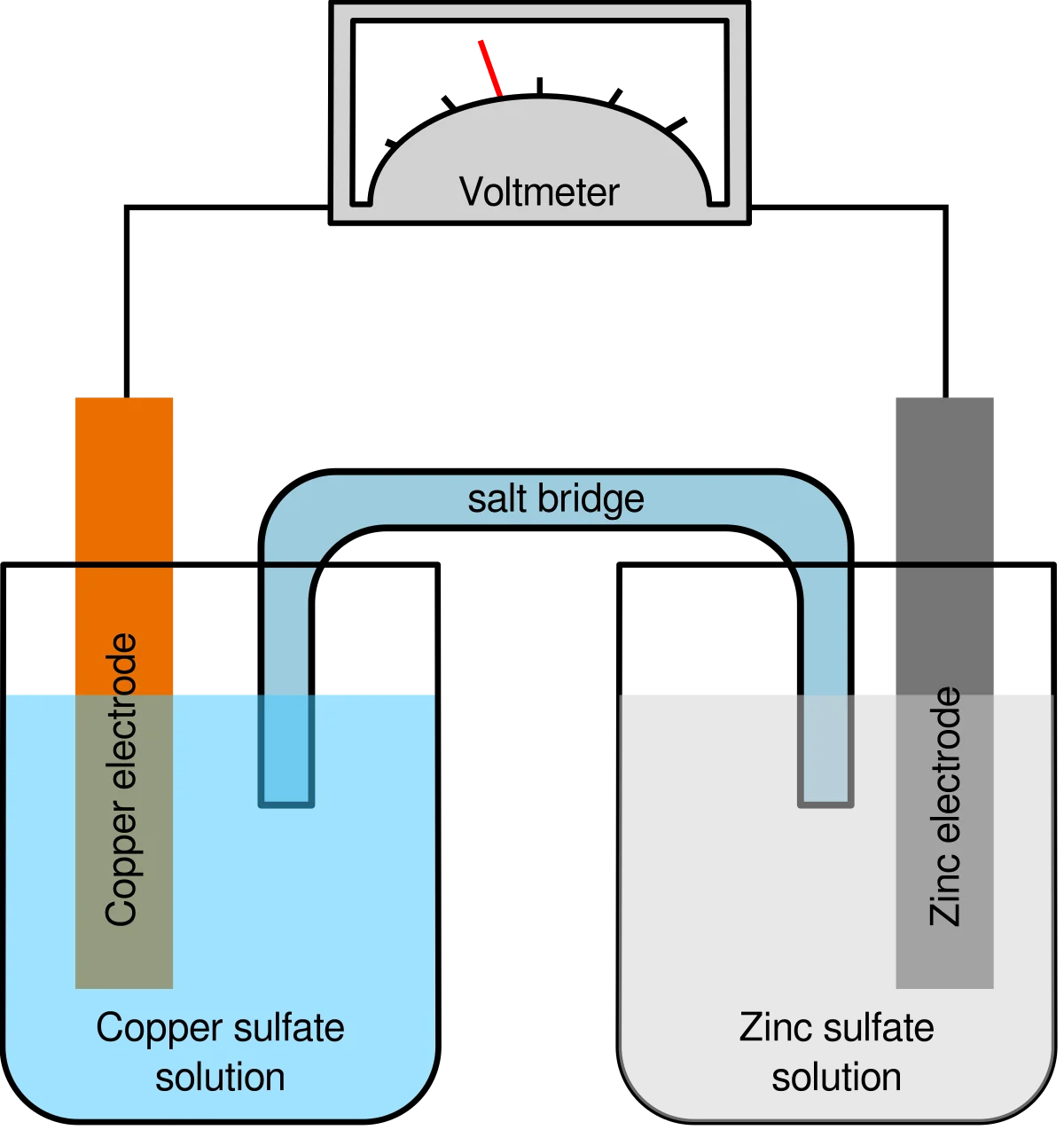
A galvanic cell with copper and zinc half-cells. The salt bridge connects the two solutions internally, while the external wire carries electrons from the zinc anode to the copper cathode through the voltmeter. Credit: Wikimedia Commons, CC BY-SA 3.0
The Daniell cell uses zinc and copper. Here is what happens:
At the anode (zinc side): Zinc atoms lose electrons and dissolve into solution as Zn2+ ions. The zinc electrode gradually shrinks.
Zn(s) -> Zn2+(aq) + 2e-
At the cathode (copper side): Cu2+ ions in solution gain electrons and plate out as solid copper on the electrode. The copper electrode gradually grows.
Cu2+(aq) + 2e- -> Cu(s)
Overall: Zn(s) + Cu2+(aq) -> Zn2+(aq) + Cu(s)
The reaction is spontaneous because copper has a higher reduction potential than zinc. Copper ions “want” electrons more than zinc ions do, so electrons flow from zinc to copper through the wire.
Why Separation Matters
If you simply dropped zinc into a copper sulfate solution, electrons would transfer directly at the metal surface. You would see the reaction happen, but you could not capture any electrical energy. By separating the half-cells and connecting them with a wire, you force every electron to travel through the external circuit. That electron flow is electric current, and it can do work.
Key Features of Galvanic Cells
Feature
Detail
Reaction type
Spontaneous (occurs on its own)
Energy conversion
Chemical -> Electrical
E°cell
Positive
ΔG
Negative
Anode
Oxidation occurs; electrode may shrink
Cathode
Reduction occurs; electrode may grow
Electron flow
Anode -> cathode (through external wire)
Everyday example
AA batteries, car batteries (while discharging)
In a galvanic cell, what happens to the mass of the anode electrode over time? What about the cathode?
Click to reveal answer
The anode loses mass; the cathode gains mass. At the anode, metal atoms are oxidized and dissolve into solution as cations. At the cathode, cations from solution are reduced and deposit as solid metal. The anode shrinks while the cathode grows.
Why must the two half-cells in a galvanic cell be physically separated?
Click to reveal answer
To force electrons through the external circuit. If both electrodes were in the same solution, electrons would transfer directly at the metal surface (as in the zinc-in-copper-sulfate beaker experiment). Separation ensures electrons must travel through the wire, producing usable electric current.
Every electrochemical cell has four essential parts: two electrodes, the electrolyte solutions they sit in, a salt bridge connecting the solutions internally, and a wire connecting the electrodes externally. Remove any one of these, and the cell stops working.
Electrodes - Where the Action Happens
The anode is the electrode where oxidation occurs. In a galvanic cell, the anode is labeled as the negative terminal because electrons are generated there and pushed out through the wire.
The cathode is the electrode where reduction occurs. In a galvanic cell, the cathode is the positive terminal because it attracts the electrons flowing through the wire.
Electrodes can be active or inert:
Active electrodes participate in the reaction. In the Daniell cell, the zinc anode dissolves and the copper cathode grows. The electrode material is a reactant or product.
Inert electrodes (platinum or graphite) do not react. They simply provide a surface for electron transfer and a conduction path. Inert electrodes are used when the reacting species are ions in solution or gases.
Electrolyte Solutions
Each half-cell contains an aqueous solution with dissolved ions. The anode compartment contains ions of the anode metal (e.g., ZnSO4 for a zinc anode). The cathode compartment contains ions of the cathode metal (e.g., CuSO4 for a copper cathode).
These ions are the chemical species that gain or lose electrons during the reaction.
The Salt Bridge - The Peacekeeper
As the reaction proceeds, a charge imbalance develops. The anode compartment gains positive ions (metal dissolves), and the cathode compartment loses positive ions (they plate out as metal). Without correction, this charge buildup would immediately stop the reaction - the anode side would become too positive to release more cations, and the cathode side would become too negative to accept more.
The salt bridge fixes this. It is typically a U-tube filled with a concentrated solution of an inert salt like KCl or KNO3 (or a gel saturated with these salts).
What flows through the salt bridge:
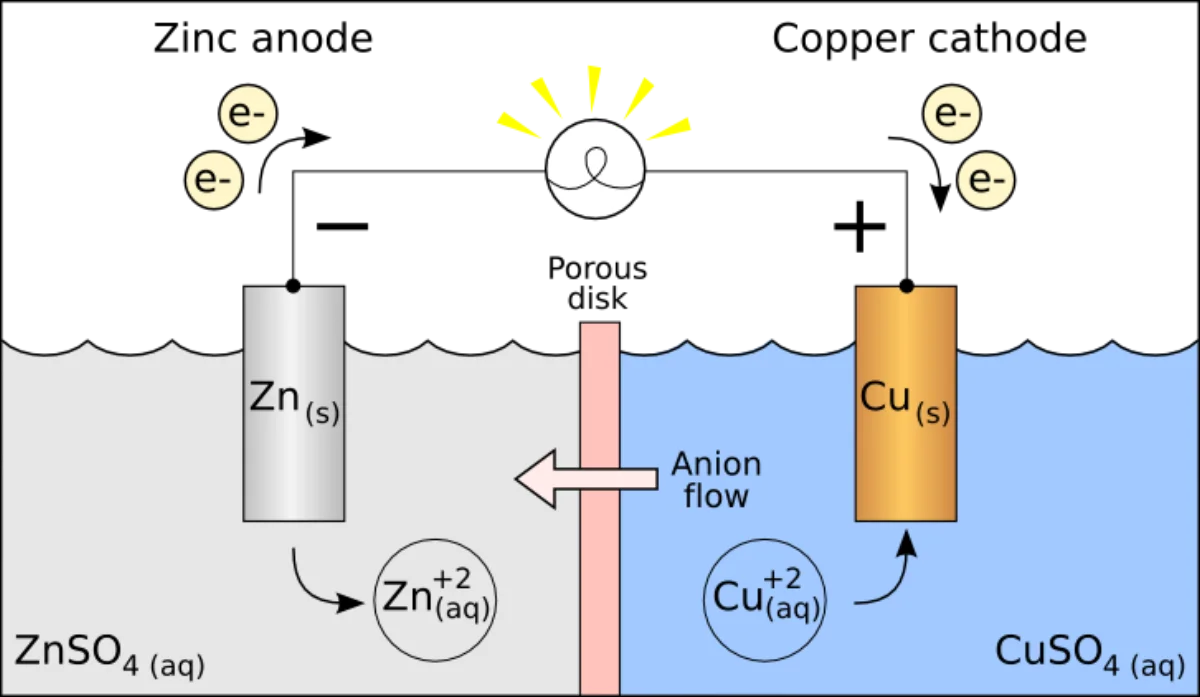
Anions (like Cl- or NO3-) migrate toward the anode to balance the excess positive charge from dissolved metal ions
Cations (like K+ or Na+) migrate toward the cathode to replace the positive charge lost as metal ions plate out
The salt bridge completes the internal circuit. Without it, the cell potential drops to zero almost instantly.
The External Circuit
A conductive wire connects the two electrodes externally. Electrons flow through this wire from anode to cathode. Any device placed in this circuit (lightbulb, motor, phone) is powered by this electron flow.
Putting It All Together
All the components of a galvanic cell in action. The zinc anode (left) oxidizes, releasing Zn2+ into solution. Electrons flow through the external circuit to the copper cathode (right), where Cu2+ ions are reduced and plate out as solid copper. Anions flow through the porous disk to maintain charge neutrality. Credit: Wikimedia Commons, CC BY-SA 3.0
What would happen to a galvanic cell if the salt bridge were removed?
Click to reveal answer
The cell would stop producing current almost immediately. Without the salt bridge, charge builds up in each half-cell (excess positive at the anode, excess negative at the cathode). This charge buildup opposes further electron flow, and the voltage drops to zero. The salt bridge maintains electrical neutrality by allowing ion migration between compartments.
In a galvanic cell, which direction do anions in the salt bridge migrate - toward the anode or the cathode?
Click to reveal answer
Toward the anode. As the anode metal oxidizes, it releases cations into solution, creating excess positive charge. Anions from the salt bridge (e.g., Cl-) migrate toward the anode to neutralize this buildup. Meanwhile, cations from the salt bridge (e.g., K+) migrate toward the cathode to replace the positive ions being reduced out of solution.
Drawing a full galvanic cell diagram every time would be exhausting. Cell notation is a shorthand that captures the same information in a single line of text. The MCAT uses this notation in passages, so you need to read it fluently.
The Rules
Cell notation always reads left to right, anode to cathode - the same direction electrons flow through the external circuit.
Symbol
Meaning
Single line |
Phase boundary (solid/solution or solution/gas interface)
Double line ||
Salt bridge separating the two half-cells
Commas ,
Separate species in the same phase
(s), (l), (aq), (g)
Phase labels
The Daniell Cell in Cell Notation
Zn(s) | Zn2+(1 M) || Cu2+(1 M) | Cu(s)
Reading from left to right:
Zn(s) - solid zinc anode (the electrode)
| - phase boundary between the solid electrode and the solution
Zn2+(1 M) - zinc ion solution in the anode compartment
|| - salt bridge
Cu2+(1 M) - copper ion solution in the cathode compartment
| - phase boundary between solution and solid electrode
Cu(s) - solid copper cathode
Examples with Different Setups
A cell with an inert electrode and a gas:
Pt(s) | H2(g) | H+(aq) || Ag+(aq) | Ag(s)
Here, the anode is a platinum electrode where H2 gas is oxidized to H+ ions. The platinum does not react - it just provides a surface.
A cell where both species are in solution (requires inert electrode):
A comma separates species in the same phase. Fe2+ and Fe3+ are both in the anode solution. Multiple species in the cathode solution are also comma-separated.
Common Mistakes to Avoid
Do not reverse the order. Anode is always on the left, cathode on the right.
Do not confuse | and ||. A single line is a phase boundary within a half-cell. The double line is the salt bridge between half-cells.
Do not forget phase labels. The MCAT expects you to know that electrodes are typically (s), solutions are (aq), and some half-reactions involve (g).
Write the cell notation for a galvanic cell with an iron anode (Fe/Fe2+) and a silver cathode (Ag+/Ag), both at 1 M concentrations.
Click to reveal answer
Fe(s) | Fe2+(1 M) || Ag+(1 M) | Ag(s). Iron is oxidized at the anode (left side). Silver ions are reduced at the cathode (right side). The single lines separate phases (solid electrode from aqueous solution), and the double line represents the salt bridge.
In the cell notation Pt(s) | H2(g) | H+(aq) || Cu2+(aq) | Cu(s), what is the role of platinum?
Click to reveal answer
Platinum serves as an inert electrode. It does not participate in the reaction. H2 gas is oxidized to H+ at the platinum surface, which simply provides a conductive surface for electron transfer. Inert electrodes like Pt or graphite are used when the reactants are gases or dissolved ions rather than solid metals.
The standard reduction potential table is the single most important tool in electrochemistry. It ranks every half-reaction by how strongly that species “wants” electrons. Learn to read it, and you can predict which reactions are spontaneous, identify the anode and cathode, and calculate cell voltages - all from one table.
What the Table Shows
Each entry in the table is a half-reaction written as a reduction (electrons on the left side):
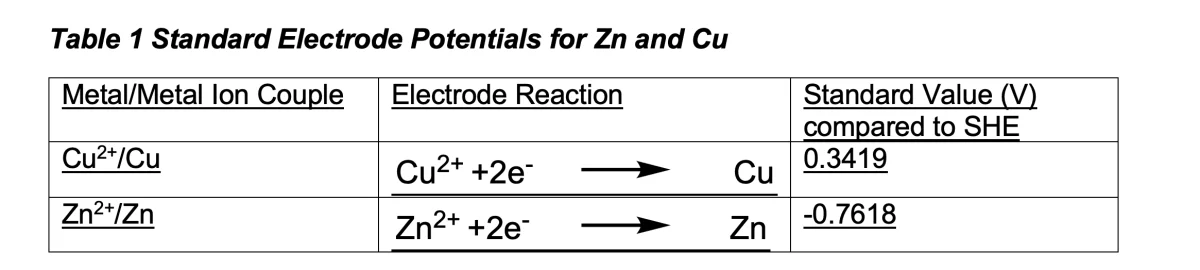
Cu2+(aq) + 2e- -> Cu(s) E° = +0.34 V
Zn2+(aq) + 2e- -> Zn(s) E° = -0.76 V
The E° value (standard reduction potential) tells you how strongly that species pulls electrons toward itself under standard conditions (25°C, 1 M solutions, 1 atm for gases).
The Reference Point - SHE
All reduction potentials are measured relative to the standard hydrogen electrode (SHE), which is assigned E° = 0.00 V by definition:
2H+(aq) + 2e- -> H2(g) E° = 0.00 V
A species with a positive E° is reduced more easily than H+. A species with a negative E° is reduced less easily than H+.
Reading the Table
Standard electrode potentials for the Cu/Zn system compared to the standard hydrogen electrode (SHE). Copper's positive value means it is reduced more easily than H2; zinc's negative value means it is reduced less easily. Credit: Wikimedia Commons, CC BY-SA 4.0
Key half-reactions to know for the MCAT:
Half-Reaction
E° (V)
Notes
F2 + 2e- -> 2F-
+2.87
Strongest common oxidizing agent
Au3+ + 3e- -> Au
+1.50
Gold resists oxidation
Ag+ + e- -> Ag
+0.80
Cu2+ + 2e- -> Cu
+0.34
2H+ + 2e- -> H2
0.00
Reference (SHE)
Ni2+ + 2e- -> Ni
-0.26
Fe2+ + 2e- -> Fe
-0.44
Zn2+ + 2e- -> Zn
-0.76
Na+ + e- -> Na
-2.71
Li+ + e- -> Li
-3.04
Strongest common reducing agent
Predicting Spontaneous Reactions
A spontaneous reaction occurs when the species with the higher (more positive) E° is reduced and the species with the lower (more negative) E° is oxidized.
Example: Will zinc reduce copper ions spontaneously?
Cu2+ + 2e- -> Cu E° = +0.34 V (higher, so Cu2+ is reduced)
Zn2+ + 2e- -> Zn E° = -0.76 V (lower, so Zn is oxidized)
Yes. Copper has the higher reduction potential, so it “wins” the electrons. Zinc gives them up. The reaction Zn + Cu2+ -> Zn2+ + Cu is spontaneous.
Will copper reduce zinc ions? No. That would require zinc to be reduced (+0.34 V species giving electrons to -0.76 V species), which is nonspontaneous.
Oxidizing and Reducing Agents
Strong oxidizing agents are species that are easily reduced (high E°). They take electrons from others. F2, MnO4-, Cr2O72- are strong oxidizing agents.
Strong reducing agents are species that are easily oxidized (low E°). They give electrons to others. Li, Na, Zn are strong reducing agents.
Flipping to Oxidation Potentials
The table lists reduction potentials. If you need the oxidation potential for a half-reaction, simply reverse the sign:
Reduction: Cu2+ + 2e- -> Cu E°red = +0.34 V
Oxidation: Cu -> Cu2+ + 2e- E°ox = -0.34 V
The MCAT almost always provides reduction potentials, but you should be comfortable flipping them mentally.
Given that E°(Ag+/Ag) = +0.80 V and E°(Fe2+/Fe) = -0.44 V, will iron spontaneously reduce silver ions?
Click to reveal answer
Yes. Silver has the higher reduction potential (+0.80 V), so Ag+ will be reduced to Ag. Iron has the lower reduction potential (-0.44 V), so Fe will be oxidized to Fe2+. The reaction Fe + 2Ag+ -> Fe2+ + 2Ag is spontaneous. E°cell = 0.80 - (-0.44) = +1.24 V (positive = spontaneous).
Why do you NOT multiply E° by a coefficient when balancing half-reactions?
Click to reveal answer
Because E° is an intensive property. It measures the intrinsic tendency of a species to gain or lose electrons, independent of the amount of substance. Doubling the half-reaction doubles the moles of electrons transferred but does not change the driving force (voltage) per electron. This is different from ΔG°, which IS extensive and does scale with moles.
Calculating the standard cell potential is the most common quantitative task in MCAT electrochemistry. The formula is straightforward, and every calculation follows the same pattern.
The Master Equation
Important: Both E°cathode and E°anode are the standard reduction potentials from the table. You do not need to reverse any signs before plugging in. The subtraction does the work.
Step-by-Step Process
Identify the cathode and anode. The species with the higher (more positive) E° is reduced at the cathode. The species with the lower E° is oxidized at the anode.
Negative E°cell means this direction is nonspontaneous. You would need to supply at least 1.10 V of external energy to force this reaction (making it an electrolytic cell).
Critical Rule: Do NOT Multiply E° by Coefficients
When balancing a cell reaction, you may need to multiply one half-reaction to equalize electrons. Never multiply the E° value.
Example: Building a cell from Al and Cu:
Cu2+ + 2e- -> Cu E° = +0.34 V
Al3+ + 3e- -> Al E° = -1.66 V
To balance electrons, you multiply the copper half-reaction by 3 and the aluminum half-reaction by 2:
3Cu2+ + 6e- -> 3Cu E° is still +0.34 V (not 3 x 0.34)
2Al3+ + 6e- -> 2Al E° is still -1.66 V (not 2 x -1.66)
E°cell = (+0.34) - (-1.66) = +2.00 V
Calculate E°cell for a cell with Ni (E° = -0.26 V) and Ag (E° = +0.80 V). Which metal is the anode?
Click to reveal answer
E°cell = +1.06 V. Nickel is the anode. Silver has the higher reduction potential (+0.80 V), so it is reduced at the cathode. Nickel has the lower reduction potential (-0.26 V), so it is oxidized at the anode. E°cell = 0.80 - (-0.26) = +1.06 V.
If E°cell for a proposed reaction is -0.50 V, what does this tell you?
Click to reveal answer
The reaction is nonspontaneous as written. A negative E°cell means the reaction will not proceed in the forward direction without external energy. To make it happen, you would need to supply at least 0.50 V from an external power source (electrolytic cell). The reverse reaction, however, would be spontaneous with E°cell = +0.50 V.
Three quantities tell you the same story about a reaction - whether it is spontaneous, at equilibrium, or nonspontaneous. They are connected by equations you must know cold for the MCAT.
The Three Master Equations
The Triangle of Relationships
These three equations form a triangle. If you know any one of E°, ΔG°, or K, you can calculate the other two.
Known
Find E°
Find ΔG°
Find K
E°
-
ΔG° = -nFE°
lnK = nFE°/RT
ΔG°
E° = -ΔG°/(nF)
-
lnK = -ΔG°/RT
K
E° = (RT/nF)lnK
ΔG° = -RTlnK
-
The Sign Relationships
All three quantities agree on the direction of spontaneity, but with opposite sign conventions for E° versus ΔG°:
Reaction type
E°cell
ΔG°
K
Spontaneous
Positive (+)
Negative (-)
> 1
At equilibrium
0
0
= 1 (only if E° = 0)
Nonspontaneous
Negative (-)
Positive (+)
< 1
Why the Negative Sign in ΔG° = -nFE°?
The negative sign ensures consistency: E° and ΔG° carry opposite signs for the same reaction direction. A spontaneous galvanic cell has a positive E°cell (electron flow is favorable) but a negative ΔG° (free energy decreases). The negative sign in the equation makes this work out mathematically.
Worked Example
For the Daniell cell (Zn-Cu), E°cell = +1.10 V and n = 2 (two electrons transferred).
Negative ΔG° confirms the reaction is spontaneous.
Calculate K:
ΔG° = -RTlnK
-212,267 = -(8.314)(298)lnK
lnK = 212,267 / 2477.6 = 85.7
K=e85.7≈1.5×1037
This enormous K tells you the reaction essentially goes to completion - products are overwhelmingly favored.
Quick Reference: Faraday’s Constant
Faraday’s constant (F) = 96,485 C/mol. This is the total charge carried by one mole of electrons.
For quick MCAT estimation: F is approximately 105 C/mol. So ΔG°=−nFE° is approximately −n(105)(E°) joules.
A reaction has E°cell = +0.50 V and transfers 3 electrons. Calculate ΔG° in kJ.
Click to reveal answer
ΔG° = -144.7 kJ. ΔG° = -nFE° = -(3)(96,485)(0.50) = -144,728 J = -144.7 kJ. The negative sign confirms the reaction is spontaneous, consistent with the positive E°cell.
If K for a reaction is 10−8 at 25°C, is E°cell positive or negative?
Click to reveal answer
E°cell is negative. K < 1 means the reaction is nonspontaneous (reactants are favored). This corresponds to ΔG° > 0 and E°cell < 0. All three indicators agree: the reaction does not proceed forward spontaneously under standard conditions.
Standard cell potentials (E°) assume everything is at 1 M concentration, 1 atm pressure, and 25°C. Real cells almost never operate under those conditions. The Nernst equation tells you the actual cell voltage when concentrations deviate from standard.
The Nernst Equation
What the Equation Tells You
The Nernst equation is a GPS for electrochemistry. E° tells you where you would be under standard conditions. The correction term -(RT/nF)lnQ adjusts for where you actually are.
Key Predictions from the Nernst Equation
Condition
Q value
lnQ
Correction term
E compared to E°
More reactants than standard
Q < 1
Negative
Positive
E > E° (higher voltage)
Standard conditions
Q = 1
Zero
Zero
E = E°
More products than standard
Q > 1
Positive
Negative
E < E° (lower voltage)
At equilibrium
Q = K
-
-
E = 0
The critical insight: As Q increases (products build up), the cell voltage decreases. This makes intuitive sense - as the reaction approaches equilibrium, there is less driving force to push electrons.
What Happens at Equilibrium
At equilibrium, Q=K and E=0:
0=E°−nFRTlnK
Rearranging:
E°=nFRTlnK
This is the equation from the previous section that connects E° and K. The Nernst equation at equilibrium derives it naturally.
Worked Example
For the Daniell cell under non-standard conditions:
Zn(s) + Cu2+(aq) -> Zn2+(aq) + Cu(s)
Given: E° = +1.10 V, n = 2, [Zn2+] = 2.0 M, [Cu2+] = 0.010 M, T = 25°C.
Q = [Zn2+]/[Cu2+] = 0.0102.0 = 200
Using the simplified Nernst equation:
E = 1.10 - (20.0592)log(200)
E = 1.10 - (0.0296)(2.30)
E = 1.10 - 0.068 = +1.03 V
The cell voltage is lower than E° because products (Zn2+) are concentrated and reactants (Cu2+) are dilute. The reaction quotient is large (Q > 1), reducing the driving force.
How Concentration Changes Affect E
Understanding how concentration changes affect cell potential connects directly to Le Chatelier’s principle:
Increasing reactant concentration (e.g., more Cu2+) decreases Q, which makes the correction term less negative, increasing E
Increasing product concentration (e.g., more Zn2+) increases Q, making the correction term more negative, decreasing E
Diluting products decreases Q and increases E
A galvanic cell has E° = +0.46 V. If the product concentration is increased while reactant concentration stays the same, does E increase or decrease?
Click to reveal answer
E decreases. Increasing product concentration increases Q. In the Nernst equation, E = E° - (RT/nF)lnQ, a larger Q means a larger subtracted term, so E decreases. This is consistent with Le Chatelier's principle: adding products opposes the forward reaction.
At what point does a galvanic cell stop producing a voltage?
Click to reveal answer
At equilibrium, when Q = K and E = 0. The reaction has not stopped - forward and reverse reactions are occurring at equal rates - but there is no net electron flow. The cell potential drops to zero, and the battery is "dead." Note that E° is typically NOT zero; it is the standard potential. Only the actual potential E reaches zero at equilibrium.
What if you built a cell where both electrodes were made of the same metal, dipped into solutions of the same ion at different concentrations? E° would be zero - the same half-reaction on both sides cancels perfectly. Yet the cell still produces a voltage. How?
The Concept
A concentration cell uses identical electrodes and identical ions but at different concentrations in the two half-cells. The driving force comes entirely from the concentration difference, not from a difference in reduction potentials.
The system is trying to equalize concentrations - just like how gases diffuse from high to low concentration. Nature drives toward equilibrium, and the electron flow is the mechanism.
How It Works
Consider a copper concentration cell:
Anode (dilute side): Cu(s) | Cu2+(0.010 M)
Cathode (concentrated side): Cu2+(1.0 M) | Cu(s)
At the anode (dilute side): Copper metal oxidizes to add Cu2+ ions to the dilute solution, increasing its concentration.
Cu(s) -> Cu2+(aq) + 2e-
At the cathode (concentrated side): Cu2+ ions are reduced to solid copper, decreasing the concentration.
Cu2+(aq) + 2e- -> Cu(s)
Net effect: The dilute solution gets more concentrated, and the concentrated solution gets more dilute. The system drives toward equal concentrations on both sides.
Calculating the Voltage
Since E° = 0 (identical half-reactions), the Nernst equation gives:
E = 0 - (0.0592/n)log(Q)
For the copper concentration cell with [Cu2+]dilute = 0.010 M and [Cu2+]concentrated = 1.0 M:
E = -(20.0592)log(0.010) = -(0.0296)(-2) = +0.0592 V
The voltage is small but positive, confirming the reaction is spontaneous. As the concentrations equalize, Q approaches 1, log(Q) approaches 0, and E approaches 0.
Key Features of Concentration Cells
Feature
Value
E°
0 (identical half-reactions)
Source of voltage
Concentration difference only
Anode
Dilute side (metal oxidizes to increase ion concentration)
Cathode
Concentrated side (ions reduce to decrease concentration)
At equilibrium
Both concentrations equal, E = 0
In a Ag/Ag+ concentration cell, one half-cell has [Ag+] = 0.001 M and the other has [Ag+] = 1.0 M. Which side is the anode?
Click to reveal answer
The dilute side (0.001 M) is the anode. The system drives toward equalization. At the dilute side, Ag metal dissolves (oxidation) to increase [Ag+]. At the concentrated side, Ag+ plates out (reduction) to decrease [Ag+]. Dilute = anode, concentrated = cathode.
Why does a concentration cell eventually stop producing a voltage?
Click to reveal answer
Because the concentrations equalize. When both half-cells reach the same concentration, Q = 1, log(Q) = 0, and E = 0. There is no more driving force. The cell reaches equilibrium because the concentration gradient - the only source of energy - has been eliminated.
A galvanic cell converts chemical energy into electrical energy. An electrolytic cell does the reverse - it uses electrical energy to drive a nonspontaneous chemical reaction. If a galvanic cell is a ball rolling downhill, an electrolytic cell is pushing the ball back up.
The Basic Setup
An electrolytic cell requires an external power source (a battery or DC power supply) that forces electrons to flow in the “wrong” direction - against the thermodynamic preference of the reaction.
Key Differences from Galvanic Cells
Feature
Galvanic Cell
Electrolytic Cell
Reaction
Spontaneous
Nonspontaneous (forced)
E°cell
Positive
Negative (for the forced reaction)
ΔG
Negative
Positive
Energy flow
Chemical -> Electrical
Electrical -> Chemical
Power source
The reaction itself
External battery/power supply
Anode charge
Negative (-)
Positive (+)
Cathode charge
Positive (+)
Negative (-)
The Charge Sign Flip
This is the trickiest part for students. In both cell types, oxidation still occurs at the anode and reduction at the cathode (An Ox, Red Cat - always). But the charge signs on the electrodes are reversed:
In a galvanic cell, the anode is (-) because electrons are generated there and pushed away.
In an electrolytic cell, the anode is (+) because the external battery pulls electrons away from it. The battery’s positive terminal connects to the anode, making it positive.
Common Electrolysis Reactions
Electrolysis of water:
2H2O(l) -> 2H2(g) + O2(g)
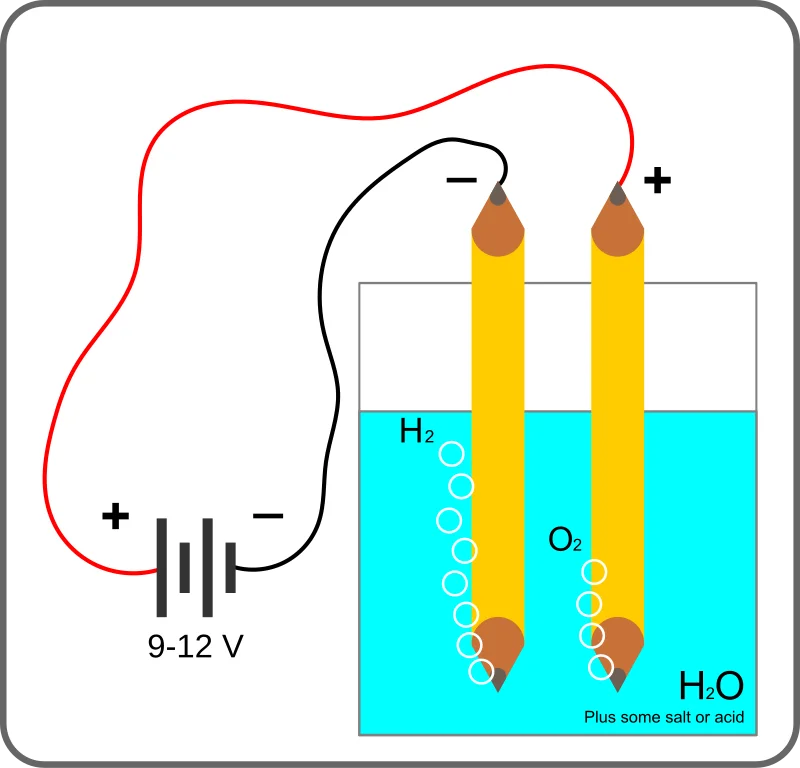
This is nonspontaneous (ΔG° = +474 kJ). An external voltage decomposes water into hydrogen gas at the cathode and oxygen gas at the anode.
Electrolysis of molten NaCl:
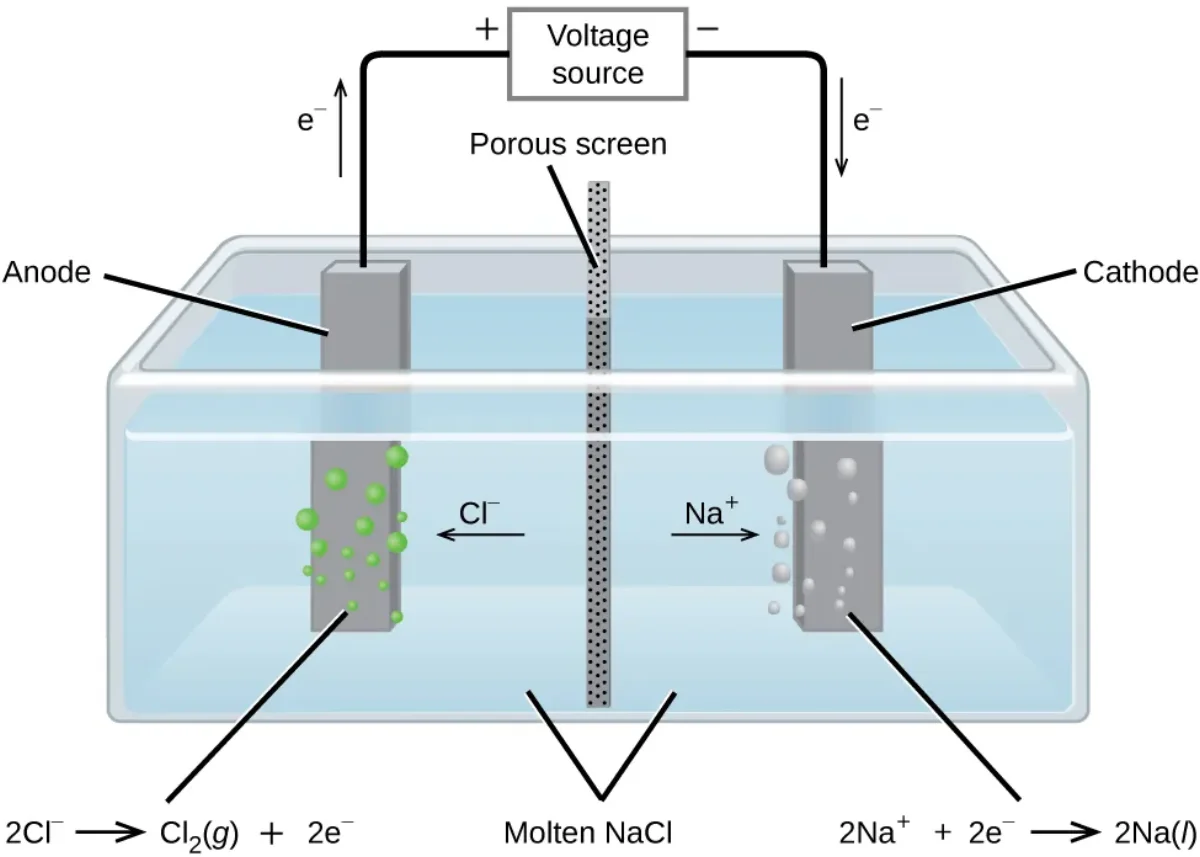
At the cathode: 2Na+(l) + 2e- -> 2Na(l) (sodium metal produced)
At the anode: 2Cl-(l) -> Cl2(g) + 2e- (chlorine gas produced)
Overall: 2NaCl(l) -> 2Na(l) + Cl2(g)
This is how sodium metal and chlorine gas are produced industrially.
Electrolysis of molten NaCl. The external voltage source forces the nonspontaneous decomposition of NaCl. Chloride ions are oxidized to Cl2 gas at the anode, and sodium ions are reduced to liquid sodium metal at the cathode. A porous screen separates the products. Credit: OpenStax Chemistry 2e, CC BY 4.0
Electroplating:
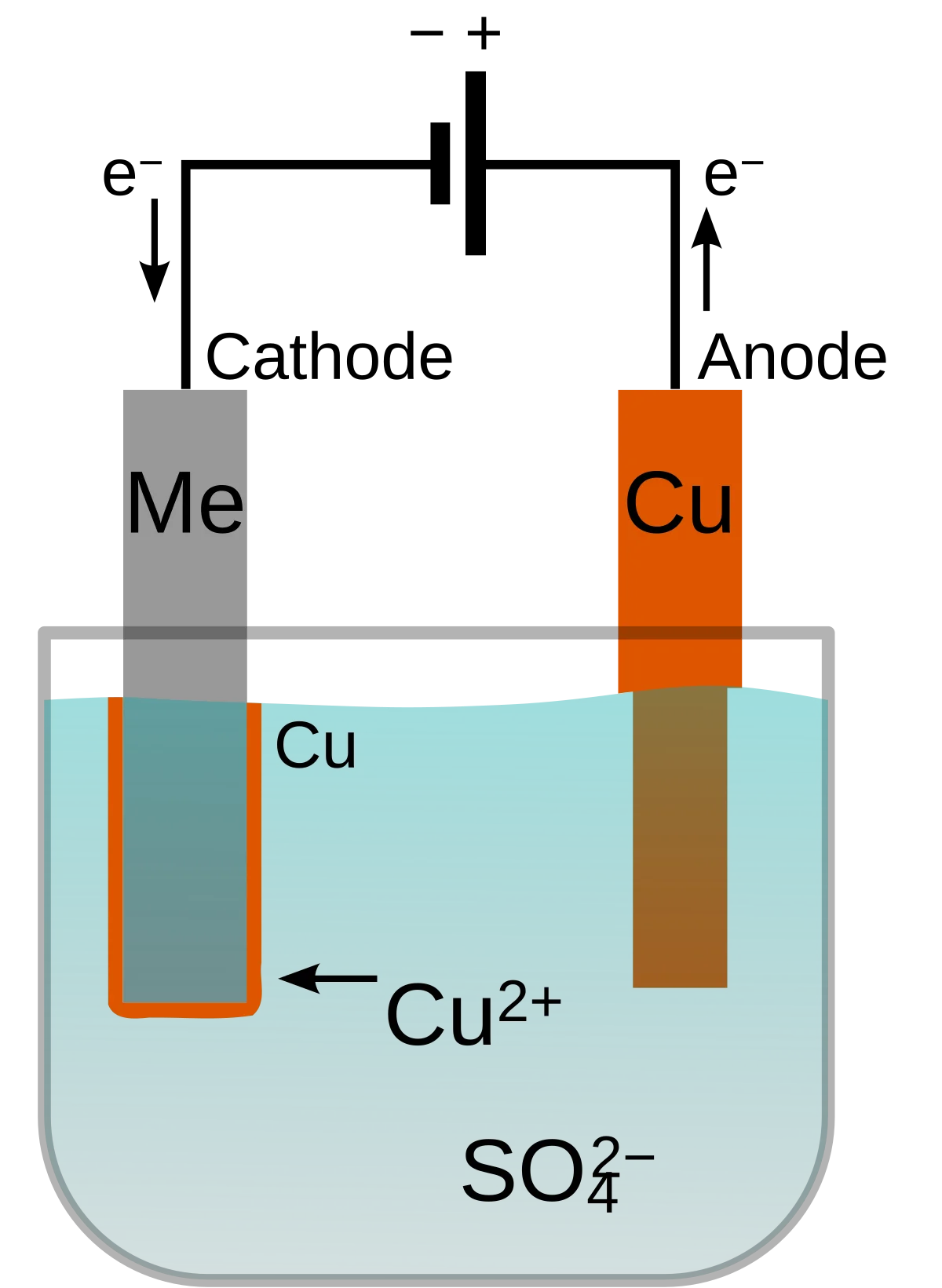
Electroplating deposits a thin layer of metal onto an object. The object to be plated is made the cathode (where reduction and metal deposition occur). The plating metal is dissolved in solution or used as a sacrificial anode.
For silver plating: Ag+(aq) + e- -> Ag(s) occurs at the cathode (the object being plated).
Copper electroplating. The copper anode dissolves (oxidation), releasing Cu2+ ions into the CuSO4 solution. These ions migrate to the cathode (the object being plated) where they are reduced and deposit as a thin layer of solid copper. Credit: Wikimedia Commons, CC BY-SA 4.0
Minimum Voltage Required
To drive an electrolytic reaction, the external voltage must exceed the magnitude of the (negative) E°cell for the nonspontaneous reaction. For the electrolysis of water, you need at least 1.23 V (and typically more due to overpotential - extra voltage needed to overcome kinetic barriers at the electrode surface).
In an electrolytic cell, is the anode positive or negative? Why?
Click to reveal answer
Positive. In an electrolytic cell, the external power source connects its positive terminal to the anode. This pulls electrons away from the anode, making it positive and forcing oxidation to occur there. This is opposite to a galvanic cell, where the anode is negative because electrons are spontaneously generated there.
During the electrolysis of molten NaCl, at which electrode is sodium metal produced - the anode or cathode?
Click to reveal answer
The cathode. Sodium ions (Na+) gain electrons (reduction) to form sodium metal. Reduction always occurs at the cathode, regardless of cell type. Meanwhile, chloride ions (Cl-) lose electrons (oxidation) at the anode to form chlorine gas.
If you run an electrolytic cell for a known time at a known current, exactly how much metal will plate out? Faraday’s laws give you a direct calculation chain from amps and seconds to grams of product.
The Key Relationships
Water electrolysis — a practical application of Faraday's laws. The external battery drives current through the solution. At the cathode, water is reduced to H₂ gas; at the anode, water is oxidized to O₂. Faraday's law predicts the mass of gas produced: q = It gives total charge, then moles of electrons = q/F. Credit: Wikimedia Commons, CC BY-SA 3.0
The Calculation Chain
Every Faraday’s law problem follows the same four-step chain:
Current and time -> Charge -> Moles of electrons -> Moles of substance -> Grams
q = It - Convert current (amps) and time (seconds) to charge (coulombs)
n(e-) = q/F - Convert charge to moles of electrons
Use stoichiometry - The half-reaction tells you the ratio of moles of electrons to moles of substance
m = n x M - Convert moles of substance to grams using molar mass
Worked Example
How many grams of copper are deposited when a 3.00 A current runs through a CuSO4 solution for 2.00 hours?
Half-reaction: Cu2+ + 2e- -> Cu (n = 2 electrons per copper atom)
Step 1: Convert time to seconds: 2.00 h x 3600 s/h = 7200 s
Step 2: Calculate charge: q = It = (3.00 A)(7200 s) = 21,600 C
Step 4: Moles of Cu: 0.2239 mol e- x (1 mol Cu / 2 mol e-) = 0.1120 mol Cu
Step 5: Grams of Cu: 0.1120 mol x 63.55 g/mol = 7.12 g Cu
Important Unit Relationships
Quantity
Symbol
Unit
Definition
Current
I
Ampere (A)
Coulombs per second (C/s)
Time
t
Seconds (s)
-
Charge
q
Coulombs (C)
I x t
Faraday’s constant
F
C/mol
96,485 C per mole of electrons
Moles of electrons
n
mol
q / F
Comparing Two Electrolytic Cells in Series
When two electrolytic cells are connected in series (same current flows through both), the same charge passes through each. The mass deposited at each cathode depends on the molar mass of the metal and the number of electrons in its half-reaction.
Example: Cells containing AgNO3 and CuSO4 are connected in series. The same current flows through both.
Silver: Ag+ + 1e- -> Ag (1 electron per atom, M = 107.9 g/mol)
Copper: Cu2+ + 2e- -> Cu (2 electrons per atom, M = 63.55 g/mol)
For the same charge: more silver is deposited because each silver atom requires only 1 electron, while each copper atom requires 2.
A current of 5.00 A flows through a solution of AgNO3 for 30.0 minutes. How many grams of silver are deposited? (Ag: 107.9 g/mol, the half-reaction is Ag+ + e- -> Ag)
Click to reveal answer
10.1 g Ag. t = 30 x 60 = 1800 s. q = It = 5.00 x 1800 = 9000 C. n(e-) = 969000,485 = 0.0933 mol. Since 1 mol e- deposits 1 mol Ag: mass = 0.0933 x 107.9 = 10.1 g.
Two electrolytic cells are connected in series. One contains Ag+ solution and the other contains Cu2+ solution. If 1.08 g of silver is deposited, how much copper is deposited?
Click to reveal answer
0.318 g Cu. Moles of Ag = 107.91.08 = 0.0100 mol. Since Ag+ + e- -> Ag, this required 0.0100 mol e-. The same charge flows through the Cu cell: Cu2+ + 2e- -> Cu, so 0.0100 mol e- produces 20.0100 = 0.00500 mol Cu. Mass = 0.00500 x 63.55 = 0.318 g Cu.
The MCAT loves asking you to compare galvanic and electrolytic cells. Some features stay the same between the two, and some flip. Knowing exactly which is which is worth easy points on test day.
What Stays the Same (Always True)
These facts are true in every electrochemical cell, no matter what type:
Rule
Applies to
Oxidation occurs at the anode
Both cell types
Reduction occurs at the cathode
Both cell types
Electrons flow from anode to cathode in the external circuit
Both cell types
Anions migrate toward the anode (internally)
Both cell types
Cations migrate toward the cathode (internally)
Both cell types
What Changes Between Cell Types
Feature
Galvanic Cell
Electrolytic Cell
Reaction spontaneity
Spontaneous
Nonspontaneous (forced)
E°cell sign
Positive (+)
Negative (-) for the forced reaction
ΔG sign
Negative (-)
Positive (+)
Energy conversion
Chemical -> Electrical
Electrical -> Chemical
External power source?
No (self-powered)
Yes (required)
Anode sign
Negative (-)
Positive (+)
Cathode sign
Positive (+)
Negative (-)
Salt bridge?
Yes (two separate containers)
Not always (can be single container)
Everyday example
Disposable batteries
Charging a battery, electroplating
Why the Electrode Signs Flip
In a galvanic cell, the anode spontaneously produces electrons. Electrons accumulate there, making it negative. The cathode consumes electrons, making it positive.
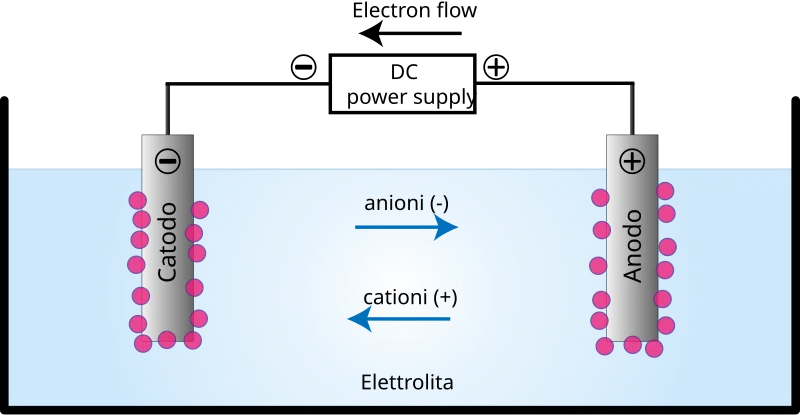
In an electrolytic cell, the external battery forces the process. The battery’s positive terminal connects to the anode, pulling electrons away from it (making the anode positive). The battery’s negative terminal pushes electrons toward the cathode (making the cathode negative).
An electrolytic cell during operation. Unlike a galvanic cell (which generates electricity spontaneously), an electrolytic cell requires an external power source to drive a non-spontaneous reaction. Notice that the anode is positive and the cathode is negative — the opposite of a galvanic cell — but electrons still flow from anode to cathode. Credit: Wikimedia Commons, CC BY-SA 3.0
The Rechargeable Battery - Both Types in One Device
A rechargeable battery beautifully demonstrates both cell types:
Discharging (using your phone): The battery operates as a galvanic cell. Spontaneous redox produces current. E > 0, ΔG < 0.
Charging (plugging in your phone): The charger forces the battery to operate as an electrolytic cell. External energy drives the reverse reaction. E < 0, ΔG > 0.
The anode and cathode actually swap when switching between charging and discharging, because the direction of the reaction reverses.
Quick Decision Flowchart
Is the reaction spontaneous? -> Galvanic cell (E° > 0, ΔG < 0)
Is external energy required? -> Electrolytic cell (E° < 0, ΔG > 0)
Name three features that are IDENTICAL in galvanic and electrolytic cells.
Click to reveal answer
1) Oxidation occurs at the anode. 2) Reduction occurs at the cathode. 3) Electrons flow from anode to cathode through the external circuit. These three rules never change regardless of cell type. What changes are the electrode signs, the spontaneity, and whether external power is needed.
A rechargeable battery is plugged into a charger. Is the battery currently operating as a galvanic or electrolytic cell? What is the sign of ΔG?
Click to reveal answer
Electrolytic cell. ΔG is positive. Charging a battery means forcing the reverse (nonspontaneous) reaction to occur, which requires external energy input. The charger acts as the power source driving the nonspontaneous reaction, making ΔG positive. When unplugged and in use, the battery switches back to a galvanic cell (spontaneous, ΔG negative).
Everything you have learned in this chapter plays out in two everyday phenomena: batteries that power your devices and corrosion that slowly destroys metal structures. Both are electrochemistry in action.
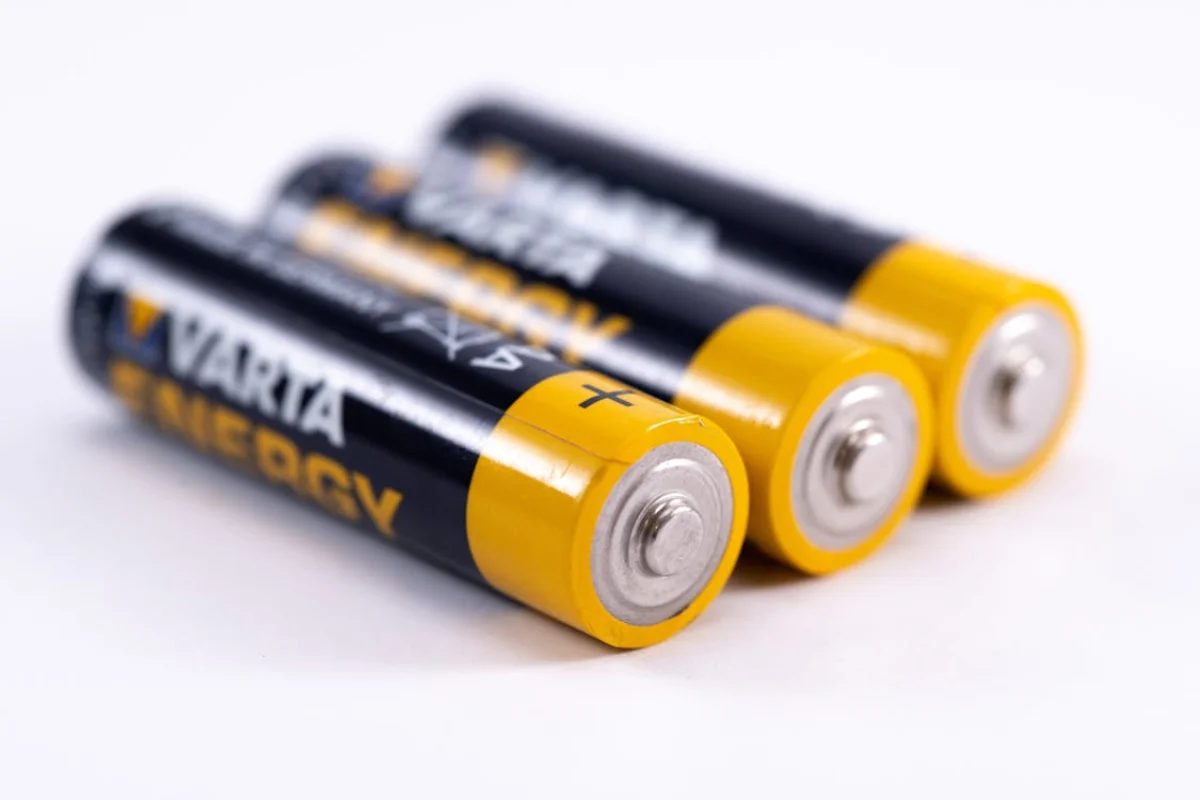
Alkaline AA batteries are primary (non-rechargeable) galvanic cells. Each produces about 1.5 V from a zinc anode and manganese dioxide cathode. Credit: Pexels, free to use
Types of Batteries
Batteries are classified by whether they can be recharged:
Type
Rechargeable?
Cell type during use
Examples
Primary
No
Galvanic only
Alkaline (AA, AAA), zinc-carbon
Secondary
Yes
Galvanic (discharge), electrolytic (charge)
Lead-acid, lithium-ion, NiCd, NiMH
Fuel cell
Continuous fuel
Galvanic
Hydrogen fuel cells
Lead-Acid Battery (Car Battery)
The lead-acid battery is the classic example of a secondary (rechargeable) battery.
A lead-acid car battery - the classic secondary (rechargeable) battery. Six cells connected in series produce the standard 12 V output. Credit: Pexels, free to use
Key features:
Both electrodes form PbSO4 during discharge
The sulfuric acid electrolyte is consumed (density decreases as the battery drains)
A single cell produces about 2 V; six cells in series give the standard 12 V car battery
Fully reversible when charged
Nickel-Cadmium (NiCd) Battery
Nickel-cadmium batteries are secondary cells that use nickel oxide hydroxide (NiOOH) as the cathode and cadmium metal (Cd) as the anode, with a KOH electrolyte. They are rechargeable and can deliver high current, but are largely being phased out because cadmium is toxic. The MCAT may reference them as a classic example of a rechargeable battery alongside lead-acid cells.
The key concept: NiCd batteries suffer from a “memory effect” where partial discharge cycles reduce their effective capacity. This is not something you need to know in detail, but it illustrates that real-world batteries do not behave as perfectly reversible electrochemical cells.
Lithium-Ion Battery (Phone/Laptop Battery)
Lithium-ion batteries dominate modern portable electronics because of their high energy density and rechargeability.
During discharge, lithium ions move from the graphite anode to the metal oxide cathode through the electrolyte. During charging, an external voltage forces them back.
The key concept for the MCAT: lithium-ion batteries are secondary cells that alternate between galvanic (discharging) and electrolytic (charging) modes.
Fuel Cells
A fuel cell is a galvanic cell that runs continuously as long as fuel (usually hydrogen) is supplied. Unlike a battery, the reactants are not stored inside the cell - they are fed in from an external source.
Hydrogen fuel cell:
Anode: 2H2(g) -> 4H+(aq) + 4e-
Cathode: O2(g) + 4H+(aq) + 4e- -> 2H2O(l)
Overall: 2H2(g) + O2(g) -> 2H2O(l)
The only product is water. This is why fuel cells are considered “clean” energy.
Corrosion - Unwanted Electrochemistry
Corrosion is the electrochemical destruction of a metal by reaction with substances in its environment. Rusting of iron is the most familiar example.
The Rusting Process
Real-world corrosion in action. The orange-brown rust is hydrated iron(III) oxide (Fe2O3 . nH2O) formed by the electrochemical oxidation of iron. The green patina suggests galvanic corrosion between dissimilar metals in contact. Credit: Wikimedia Commons, CC BY-SA 3.0
Rust formation: Fe2+ further oxidizes to Fe3+ and combines with oxygen and water to form hydrated iron(III) oxide (rust, Fe2O3 · nH2O)
Corrosion requires both water and oxygen. Iron immersed in pure water without dissolved oxygen does not rust. Iron in dry air does not rust. Both must be present.
Salt accelerates corrosion by increasing the conductivity of the electrolyte solution (dissolved ions carry charge more efficiently). This is why cars rust faster in coastal areas and where roads are salted in winter.
Preventing Corrosion
Method
How it works
Painting/coating
Physical barrier blocks water and oxygen
Galvanizing
Zinc coating on iron; zinc corrodes preferentially (sacrificial anode)
Cathodic protection
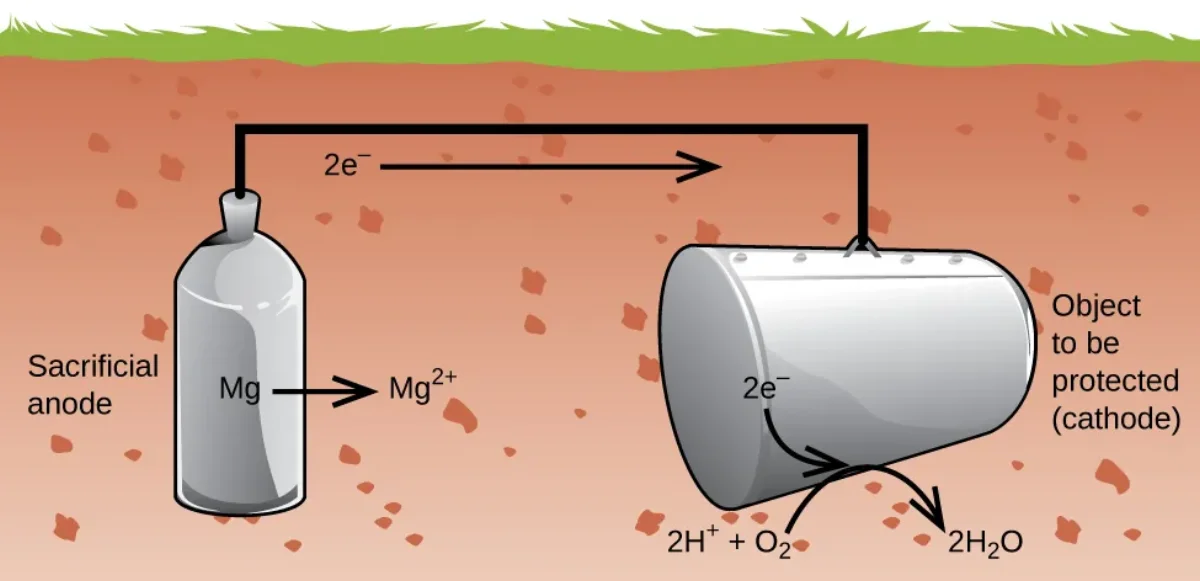
Attach a more active metal (e.g., Mg or Zn) that oxidizes instead of the iron
Stainless steel
Chromium alloy forms a passive oxide layer
Cathodic Protection - Sacrificial Anodes
Cathodic protection of an underground storage tank. The magnesium sacrificial anode (left) oxidizes preferentially (Mg to Mg2+), sending electrons to the tank. The tank becomes the cathode, where oxygen and water are reduced instead of the iron corroding. Credit: OpenStax Chemistry 2e, CC BY 4.0
Cathodic protection exploits the activity series. A more active metal (lower reduction potential) is attached to the iron structure. Because the active metal is more easily oxidized, it corrodes instead of the iron.
Example: Zinc blocks attached to a steel ship hull. Zinc (E° = -0.76 V) is oxidized preferentially over iron (E° = -0.44 V). The iron becomes the cathode in this galvanic couple and is protected from corrosion. The zinc blocks are periodically replaced.
Galvanic Corrosion
When two dissimilar metals are in electrical contact in the presence of an electrolyte, the more active metal corrodes faster than it would alone. This is galvanic corrosion.
Example: An iron nail wrapped in copper wire in salt water. Iron (E° = -0.44 V) is more active than copper (E° = +0.34 V), so iron becomes the anode and corrodes rapidly. The copper acts as the cathode and is protected.
This is why plumbers avoid connecting copper pipes directly to steel pipes without a dielectric union.
Why does galvanized (zinc-coated) iron resist rusting even when the zinc coating is scratched?
Click to reveal answer
Zinc acts as a sacrificial anode. Even when scratched, the exposed iron is in electrical contact with zinc. Since zinc (E° = -0.76 V) has a lower reduction potential than iron (E° = -0.44 V), zinc is preferentially oxidized. The iron becomes the cathode and is cathodically protected as long as zinc remains nearby.
What two conditions must be present for iron to rust?
Click to reveal answer
Water and oxygen must both be present. Water provides the electrolyte solution for ion transport. Oxygen is the oxidizing agent reduced at cathodic sites. Without either one, the electrochemical corrosion process cannot proceed. This is why iron submerged in oxygen-free water or kept in completely dry air does not rust.