
Galvanic Cells
Drop a strip of zinc metal into a beaker of blue copper sulfate solution. Within minutes, the solution fades and a reddish film of copper coats the zinc. Zinc atoms are handing electrons directly to copper ions - a spontaneous redox reaction. The problem? All the energy is wasted as heat. None of it does useful work.
A galvanic cell solves this by physically separating the two half-reactions. Instead of electrons jumping directly from zinc to copper in the same beaker, the zinc sits in one container and the copper sits in another. The only path for electrons is through an external wire - and on the way, those electrons can power a lightbulb, a motor, or your phone.
The Daniell Cell - The Classic Example
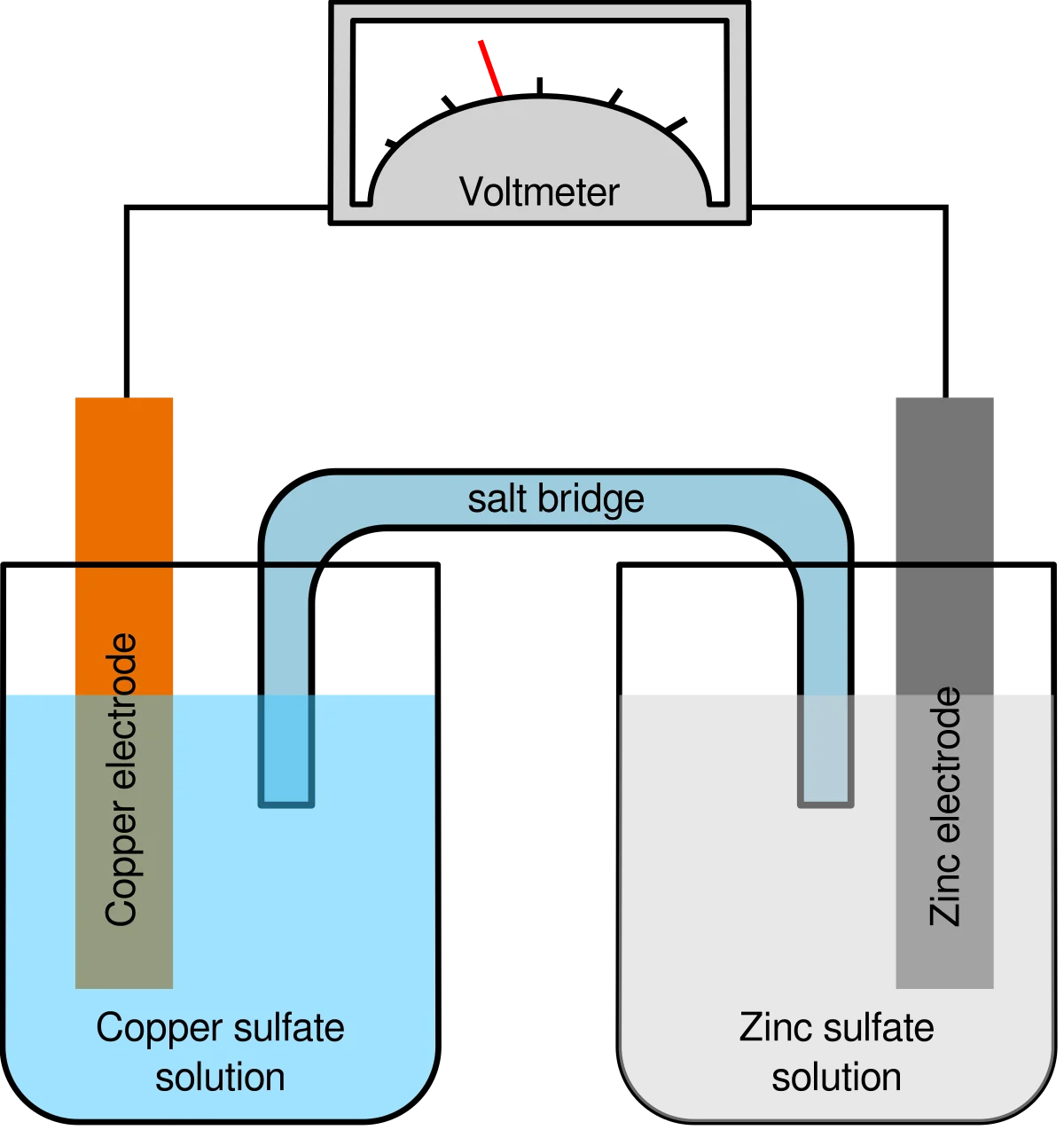
The Daniell cell uses zinc and copper. Here is what happens:
At the anode (zinc side): Zinc atoms lose electrons and dissolve into solution as Zn2+ ions. The zinc electrode gradually shrinks.
Zn(s) -> Zn2+(aq) + 2e-
At the cathode (copper side): Cu2+ ions in solution gain electrons and plate out as solid copper on the electrode. The copper electrode gradually grows.
Cu2+(aq) + 2e- -> Cu(s)
Overall: Zn(s) + Cu2+(aq) -> Zn2+(aq) + Cu(s)
The reaction is spontaneous because copper has a higher reduction potential than zinc. Copper ions “want” electrons more than zinc ions do, so electrons flow from zinc to copper through the wire.
Why Separation Matters
If you simply dropped zinc into a copper sulfate solution, electrons would transfer directly at the metal surface. You would see the reaction happen, but you could not capture any electrical energy. By separating the half-cells and connecting them with a wire, you force every electron to travel through the external circuit. That electron flow is electric current, and it can do work.
Key Features of Galvanic Cells
| Feature | Detail |
|---|---|
| Reaction type | Spontaneous (occurs on its own) |
| Energy conversion | Chemical -> Electrical |
| E°cell | Positive |
| ΔG | Negative |
| Anode | Oxidation occurs; electrode may shrink |
| Cathode | Reduction occurs; electrode may grow |
| Electron flow | Anode -> cathode (through external wire) |
| Everyday example | AA batteries, car batteries (while discharging) |