
Reduction Potentials
The standard reduction potential table is the single most important tool in electrochemistry. It ranks every half-reaction by how strongly that species “wants” electrons. Learn to read it, and you can predict which reactions are spontaneous, identify the anode and cathode, and calculate cell voltages - all from one table.
What the Table Shows
Each entry in the table is a half-reaction written as a reduction (electrons on the left side):
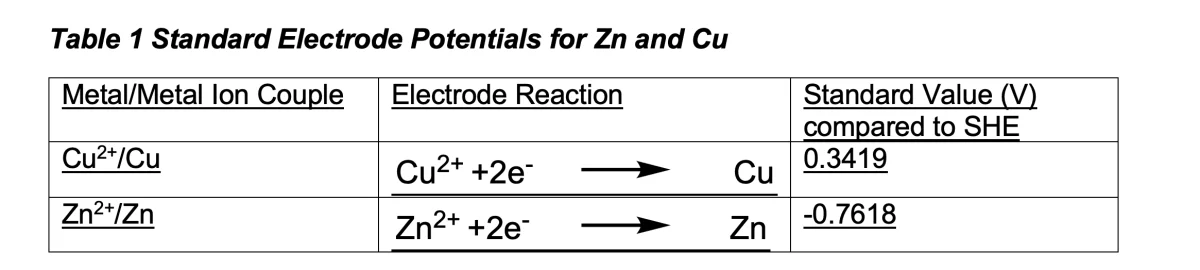
Cu2+(aq) + 2e- -> Cu(s) E° = +0.34 V
Zn2+(aq) + 2e- -> Zn(s) E° = -0.76 V
The E° value (standard reduction potential) tells you how strongly that species pulls electrons toward itself under standard conditions (25°C, 1 M solutions, 1 atm for gases).
The Reference Point - SHE
All reduction potentials are measured relative to the standard hydrogen electrode (SHE), which is assigned E° = 0.00 V by definition:
2H+(aq) + 2e- -> H2(g) E° = 0.00 V
A species with a positive E° is reduced more easily than H+. A species with a negative E° is reduced less easily than H+.
Reading the Table
Key half-reactions to know for the MCAT:
| Half-Reaction | E° (V) | Notes |
|---|---|---|
| F2 + 2e- -> 2F- | +2.87 | Strongest common oxidizing agent |
| Au3+ + 3e- -> Au | +1.50 | Gold resists oxidation |
| Ag+ + e- -> Ag | +0.80 | |
| Cu2+ + 2e- -> Cu | +0.34 | |
| 2H+ + 2e- -> H2 | 0.00 | Reference (SHE) |
| Ni2+ + 2e- -> Ni | -0.26 | |
| Fe2+ + 2e- -> Fe | -0.44 | |
| Zn2+ + 2e- -> Zn | -0.76 | |
| Na+ + e- -> Na | -2.71 | |
| Li+ + e- -> Li | -3.04 | Strongest common reducing agent |
Predicting Spontaneous Reactions
A spontaneous reaction occurs when the species with the higher (more positive) E° is reduced and the species with the lower (more negative) E° is oxidized.
Example: Will zinc reduce copper ions spontaneously?
- Cu2+ + 2e- -> Cu E° = +0.34 V (higher, so Cu2+ is reduced)
- Zn2+ + 2e- -> Zn E° = -0.76 V (lower, so Zn is oxidized)
Yes. Copper has the higher reduction potential, so it “wins” the electrons. Zinc gives them up. The reaction Zn + Cu2+ -> Zn2+ + Cu is spontaneous.
Will copper reduce zinc ions? No. That would require zinc to be reduced (+0.34 V species giving electrons to -0.76 V species), which is nonspontaneous.
Oxidizing and Reducing Agents
- Strong oxidizing agents are species that are easily reduced (high E°). They take electrons from others. F2, MnO4-, Cr2O72- are strong oxidizing agents.
- Strong reducing agents are species that are easily oxidized (low E°). They give electrons to others. Li, Na, Zn are strong reducing agents.
Flipping to Oxidation Potentials
The table lists reduction potentials. If you need the oxidation potential for a half-reaction, simply reverse the sign:
- Reduction: Cu2+ + 2e- -> Cu E°red = +0.34 V
- Oxidation: Cu -> Cu2+ + 2e- E°ox = -0.34 V
The MCAT almost always provides reduction potentials, but you should be comfortable flipping them mentally.