
Comparing Cells
The MCAT loves asking you to compare galvanic and electrolytic cells. Some features stay the same between the two, and some flip. Knowing exactly which is which is worth easy points on test day.
What Stays the Same (Always True)
These facts are true in every electrochemical cell, no matter what type:
| Rule | Applies to |
|---|---|
| Oxidation occurs at the anode | Both cell types |
| Reduction occurs at the cathode | Both cell types |
| Electrons flow from anode to cathode in the external circuit | Both cell types |
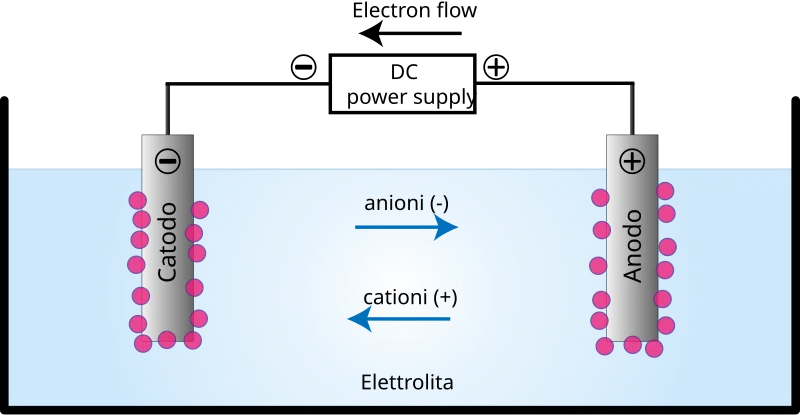
| Anions migrate toward the anode (internally) | Both cell types |
| Cations migrate toward the cathode (internally) | Both cell types |
What Changes Between Cell Types
| Feature | Galvanic Cell | Electrolytic Cell |
|---|---|---|
| Reaction spontaneity | Spontaneous | Nonspontaneous (forced) |
| E°cell sign | Positive (+) | Negative (-) for the forced reaction |
| ΔG sign | Negative (-) | Positive (+) |
| Energy conversion | Chemical -> Electrical | Electrical -> Chemical |
| External power source? | No (self-powered) | Yes (required) |
| Anode sign | Negative (-) | Positive (+) |
| Cathode sign | Positive (+) | Negative (-) |
| Salt bridge? | Yes (two separate containers) | Not always (can be single container) |
| Everyday example | Disposable batteries | Charging a battery, electroplating |
Why the Electrode Signs Flip
In a galvanic cell, the anode spontaneously produces electrons. Electrons accumulate there, making it negative. The cathode consumes electrons, making it positive.
In an electrolytic cell, the external battery forces the process. The battery’s positive terminal connects to the anode, pulling electrons away from it (making the anode positive). The battery’s negative terminal pushes electrons toward the cathode (making the cathode negative).
The Rechargeable Battery - Both Types in One Device
A rechargeable battery beautifully demonstrates both cell types:
- Discharging (using your phone): The battery operates as a galvanic cell. Spontaneous redox produces current. E > 0, ΔG < 0.
- Charging (plugging in your phone): The charger forces the battery to operate as an electrolytic cell. External energy drives the reverse reaction. E < 0, ΔG > 0.
The anode and cathode actually swap when switching between charging and discharging, because the direction of the reaction reverses.
Quick Decision Flowchart
- Is the reaction spontaneous? -> Galvanic cell (E° > 0, ΔG < 0)
- Is external energy required? -> Electrolytic cell (E° < 0, ΔG > 0)
- Where does oxidation occur? -> Always the anode
- Where does reduction occur? -> Always the cathode
- What is the sign of the anode?
- Galvanic: Negative (electrons generated)
- Electrolytic: Positive (external battery pulls electrons away)