
Cell Components
Every electrochemical cell has four essential parts: two electrodes, the electrolyte solutions they sit in, a salt bridge connecting the solutions internally, and a wire connecting the electrodes externally. Remove any one of these, and the cell stops working.
Electrodes - Where the Action Happens
The anode is the electrode where oxidation occurs. In a galvanic cell, the anode is labeled as the negative terminal because electrons are generated there and pushed out through the wire.
The cathode is the electrode where reduction occurs. In a galvanic cell, the cathode is the positive terminal because it attracts the electrons flowing through the wire.
Electrodes can be active or inert:
- Active electrodes participate in the reaction. In the Daniell cell, the zinc anode dissolves and the copper cathode grows. The electrode material is a reactant or product.
- Inert electrodes (platinum or graphite) do not react. They simply provide a surface for electron transfer and a conduction path. Inert electrodes are used when the reacting species are ions in solution or gases.
Electrolyte Solutions
Each half-cell contains an aqueous solution with dissolved ions. The anode compartment contains ions of the anode metal (e.g., ZnSO4 for a zinc anode). The cathode compartment contains ions of the cathode metal (e.g., CuSO4 for a copper cathode).
These ions are the chemical species that gain or lose electrons during the reaction.
The Salt Bridge - The Peacekeeper
As the reaction proceeds, a charge imbalance develops. The anode compartment gains positive ions (metal dissolves), and the cathode compartment loses positive ions (they plate out as metal). Without correction, this charge buildup would immediately stop the reaction - the anode side would become too positive to release more cations, and the cathode side would become too negative to accept more.
The salt bridge fixes this. It is typically a U-tube filled with a concentrated solution of an inert salt like KCl or KNO3 (or a gel saturated with these salts).
What flows through the salt bridge:
- Anions (like Cl- or NO3-) migrate toward the anode to balance the excess positive charge from dissolved metal ions
- Cations (like K+ or Na+) migrate toward the cathode to replace the positive charge lost as metal ions plate out
The salt bridge completes the internal circuit. Without it, the cell potential drops to zero almost instantly.
The External Circuit
A conductive wire connects the two electrodes externally. Electrons flow through this wire from anode to cathode. Any device placed in this circuit (lightbulb, motor, phone) is powered by this electron flow.
Putting It All Together
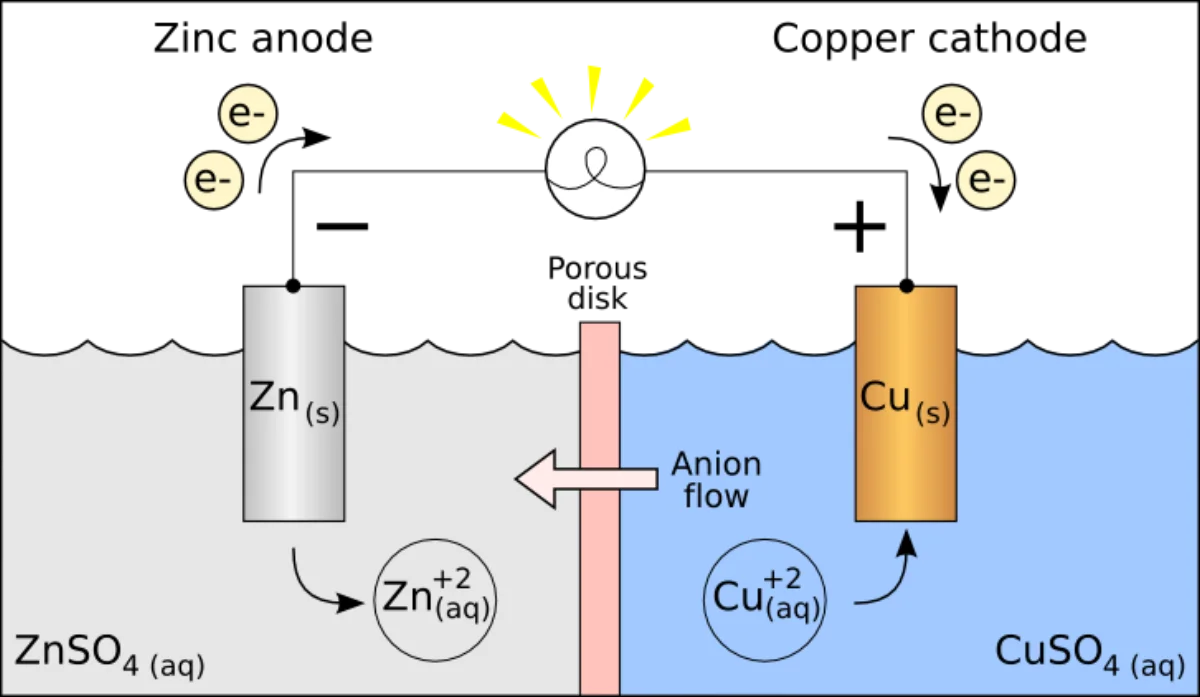
| Component | Function | What flows through it |
|---|---|---|
| Anode | Site of oxidation | Electrons leave |
| Cathode | Site of reduction | Electrons arrive |
| External wire | Connects electrodes | Electrons (anode -> cathode) |
| Salt bridge | Balances charge | Ions (anions toward anode, cations toward cathode) |
| Electrolyte | Contains reacting ions | Dissolved ions |