A galvanic cell converts chemical energy into electrical energy. An electrolytic cell does the reverse - it uses electrical energy to drive a nonspontaneous chemical reaction. If a galvanic cell is a ball rolling downhill, an electrolytic cell is pushing the ball back up.
The Basic Setup
An electrolytic cell requires an external power source (a battery or DC power supply) that forces electrons to flow in the “wrong” direction - against the thermodynamic preference of the reaction.
Key Differences from Galvanic Cells
Feature
Galvanic Cell
Electrolytic Cell
Reaction
Spontaneous
Nonspontaneous (forced)
E°cell
Positive
Negative (for the forced reaction)
ΔG
Negative
Positive
Energy flow
Chemical -> Electrical
Electrical -> Chemical
Power source
The reaction itself
External battery/power supply
Anode charge
Negative (-)
Positive (+)
Cathode charge
Positive (+)
Negative (-)
The Charge Sign Flip
This is the trickiest part for students. In both cell types, oxidation still occurs at the anode and reduction at the cathode (An Ox, Red Cat - always). But the charge signs on the electrodes are reversed:
In a galvanic cell, the anode is (-) because electrons are generated there and pushed away.
In an electrolytic cell, the anode is (+) because the external battery pulls electrons away from it. The battery’s positive terminal connects to the anode, making it positive.
Common Electrolysis Reactions
Electrolysis of water:
2H2O(l) -> 2H2(g) + O2(g)
This is nonspontaneous (ΔG° = +474 kJ). An external voltage decomposes water into hydrogen gas at the cathode and oxygen gas at the anode.
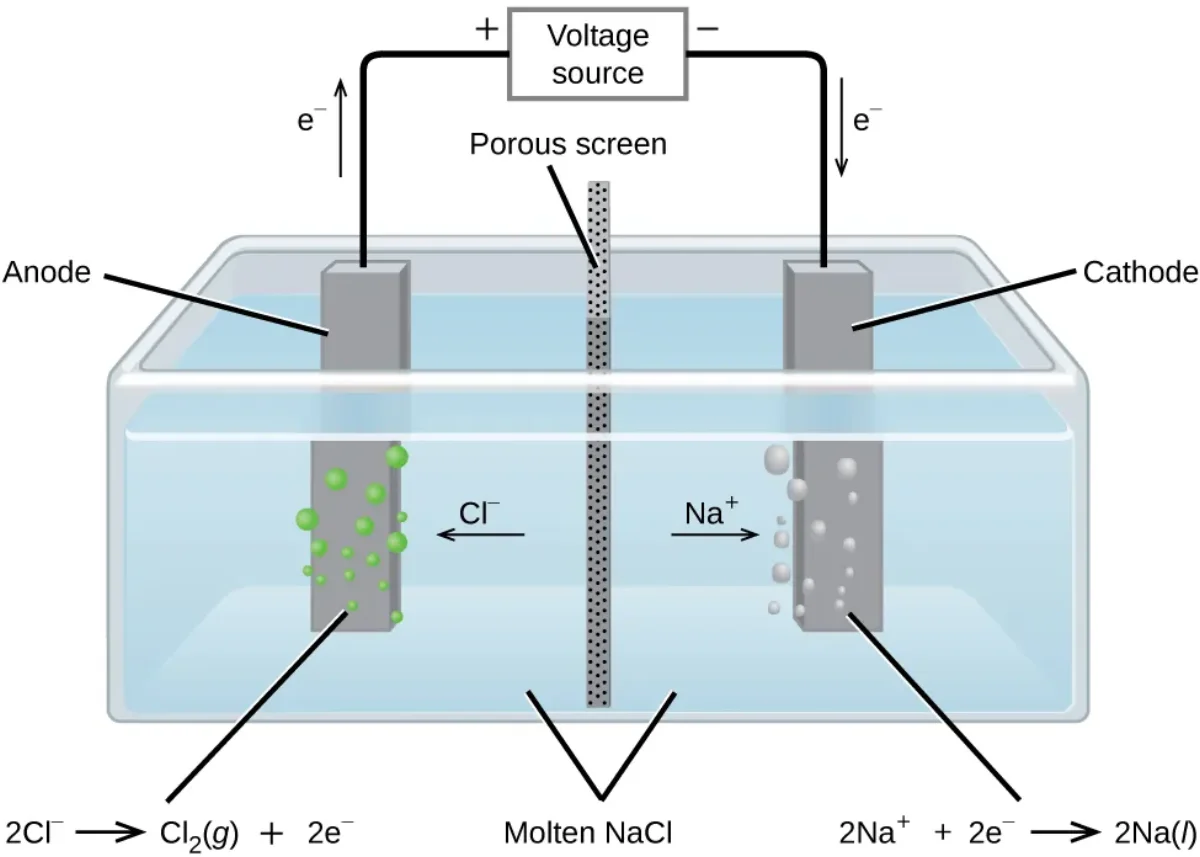
Electrolysis of molten NaCl:
At the cathode: 2Na+(l) + 2e- -> 2Na(l) (sodium metal produced)
At the anode: 2Cl-(l) -> Cl2(g) + 2e- (chlorine gas produced)
Overall: 2NaCl(l) -> 2Na(l) + Cl2(g)
This is how sodium metal and chlorine gas are produced industrially.
Electrolysis of molten NaCl. The external voltage source forces the nonspontaneous decomposition of NaCl. Chloride ions are oxidized to Cl2 gas at the anode, and sodium ions are reduced to liquid sodium metal at the cathode. A porous screen separates the products. Credit: OpenStax Chemistry 2e, CC BY 4.0
Electroplating:
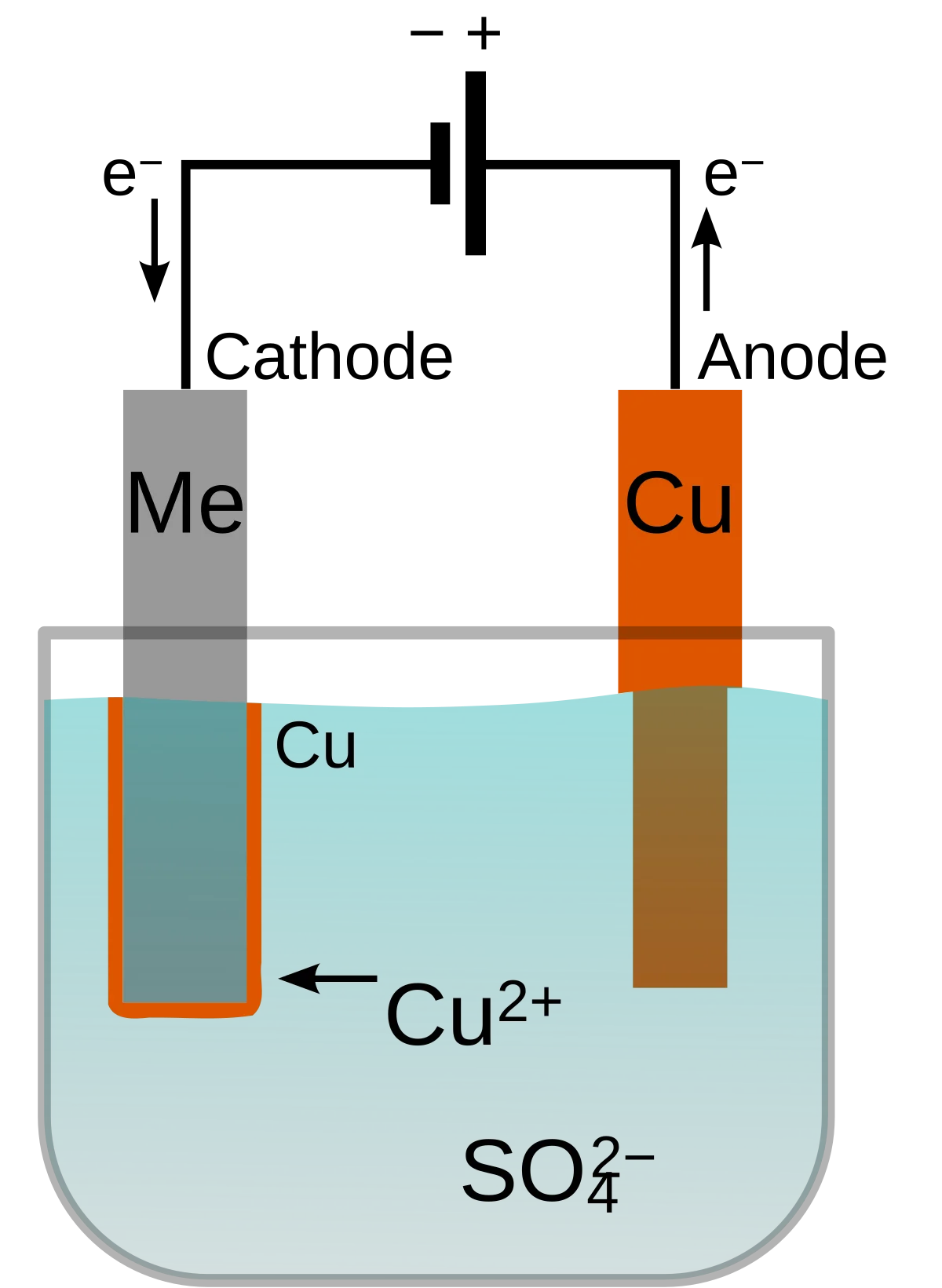
Electroplating deposits a thin layer of metal onto an object. The object to be plated is made the cathode (where reduction and metal deposition occur). The plating metal is dissolved in solution or used as a sacrificial anode.
For silver plating: Ag+(aq) + e- -> Ag(s) occurs at the cathode (the object being plated).
Copper electroplating. The copper anode dissolves (oxidation), releasing Cu2+ ions into the CuSO4 solution. These ions migrate to the cathode (the object being plated) where they are reduced and deposit as a thin layer of solid copper. Credit: Wikimedia Commons, CC BY-SA 4.0
Minimum Voltage Required
To drive an electrolytic reaction, the external voltage must exceed the magnitude of the (negative) E°cell for the nonspontaneous reaction. For the electrolysis of water, you need at least 1.23 V (and typically more due to overpotential - extra voltage needed to overcome kinetic barriers at the electrode surface).
In an electrolytic cell, is the anode positive or negative? Why?
Click to reveal answer
Positive. In an electrolytic cell, the external power source connects its positive terminal to the anode. This pulls electrons away from the anode, making it positive and forcing oxidation to occur there. This is opposite to a galvanic cell, where the anode is negative because electrons are spontaneously generated there.
During the electrolysis of molten NaCl, at which electrode is sodium metal produced - the anode or cathode?
Click to reveal answer
The cathode. Sodium ions (Na+) gain electrons (reduction) to form sodium metal. Reduction always occurs at the cathode, regardless of cell type. Meanwhile, chloride ions (Cl-) lose electrons (oxidation) at the anode to form chlorine gas.