
Batteries & Corrosion
Everything you have learned in this chapter plays out in two everyday phenomena: batteries that power your devices and corrosion that slowly destroys metal structures. Both are electrochemistry in action.
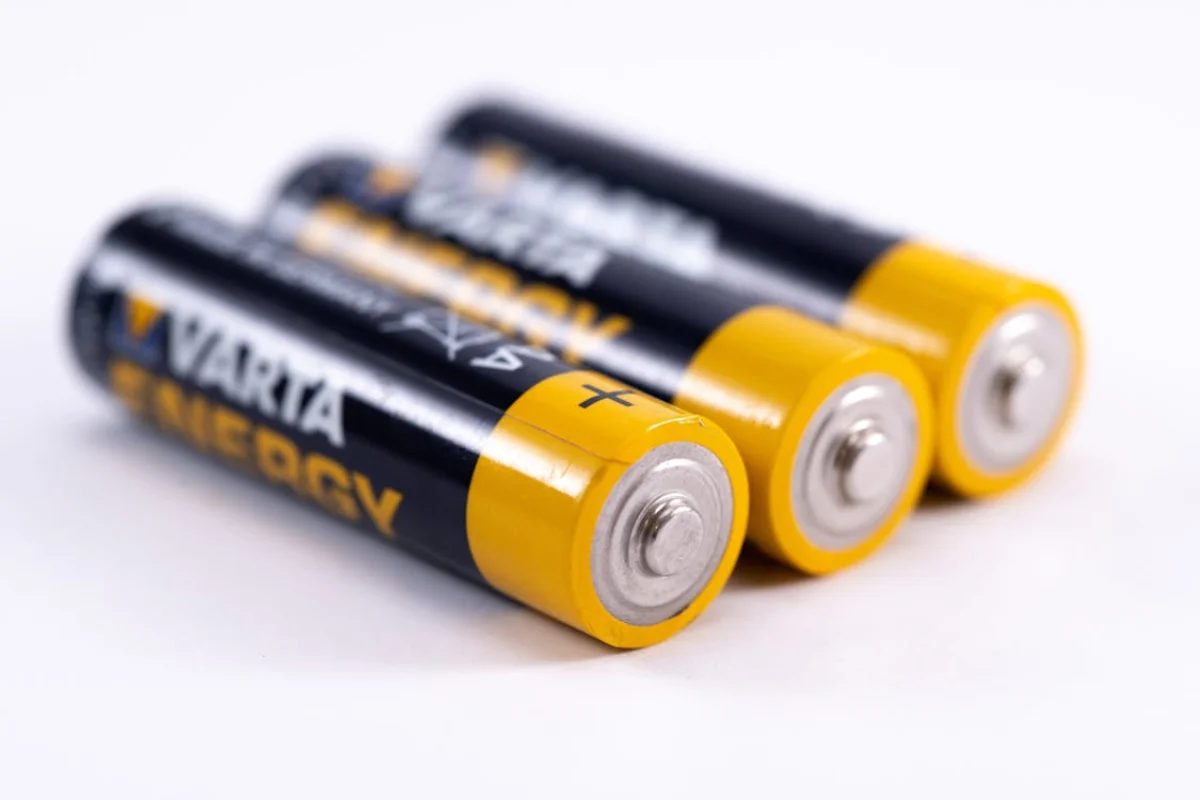
Types of Batteries
Batteries are classified by whether they can be recharged:
| Type | Rechargeable? | Cell type during use | Examples |
|---|---|---|---|
| Primary | No | Galvanic only | Alkaline (AA, AAA), zinc-carbon |
| Secondary | Yes | Galvanic (discharge), electrolytic (charge) | Lead-acid, lithium-ion, NiCd, NiMH |
| Fuel cell | Continuous fuel | Galvanic | Hydrogen fuel cells |
Lead-Acid Battery (Car Battery)
The lead-acid battery is the classic example of a secondary (rechargeable) battery.
Anode (oxidation): Pb(s) + SO42-(aq) -> PbSO4(s) + 2e-
Cathode (reduction): PbO2(s) + SO42-(aq) + 4H+(aq) + 2e- -> PbSO4(s) + 2H2O(l)
Overall: Pb(s) + PbO2(s) + 2H2SO4(aq) -> 2PbSO4(s) + 2H2O(l)
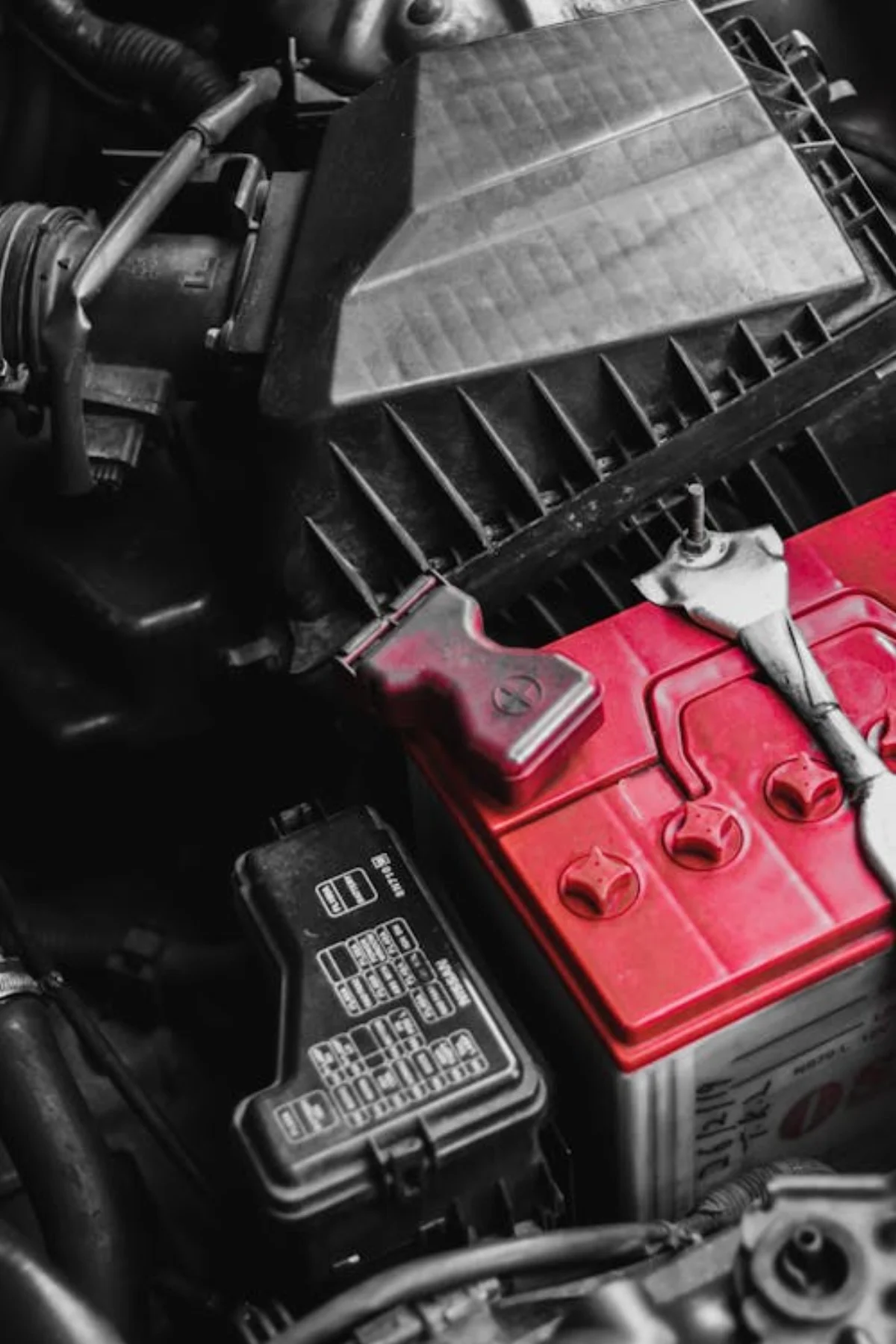
Key features:
- Both electrodes form PbSO4 during discharge
- The sulfuric acid electrolyte is consumed (density decreases as the battery drains)
- A single cell produces about 2 V; six cells in series give the standard 12 V car battery
- Fully reversible when charged
Nickel-Cadmium (NiCd) Battery
Nickel-cadmium batteries are secondary cells that use nickel oxide hydroxide (NiOOH) as the cathode and cadmium metal (Cd) as the anode, with a KOH electrolyte. They are rechargeable and can deliver high current, but are largely being phased out because cadmium is toxic. The MCAT may reference them as a classic example of a rechargeable battery alongside lead-acid cells.
The key concept: NiCd batteries suffer from a “memory effect” where partial discharge cycles reduce their effective capacity. This is not something you need to know in detail, but it illustrates that real-world batteries do not behave as perfectly reversible electrochemical cells.
Lithium-Ion Battery (Phone/Laptop Battery)
Lithium-ion batteries dominate modern portable electronics because of their high energy density and rechargeability.
During discharge, lithium ions move from the graphite anode to the metal oxide cathode through the electrolyte. During charging, an external voltage forces them back.
The key concept for the MCAT: lithium-ion batteries are secondary cells that alternate between galvanic (discharging) and electrolytic (charging) modes.
Fuel Cells
A fuel cell is a galvanic cell that runs continuously as long as fuel (usually hydrogen) is supplied. Unlike a battery, the reactants are not stored inside the cell - they are fed in from an external source.
Hydrogen fuel cell:
Anode: 2H2(g) -> 4H+(aq) + 4e-
Cathode: O2(g) + 4H+(aq) + 4e- -> 2H2O(l)
Overall: 2H2(g) + O2(g) -> 2H2O(l)
The only product is water. This is why fuel cells are considered “clean” energy.
Corrosion - Unwanted Electrochemistry
Corrosion is the electrochemical destruction of a metal by reaction with substances in its environment. Rusting of iron is the most familiar example.
The Rusting Process
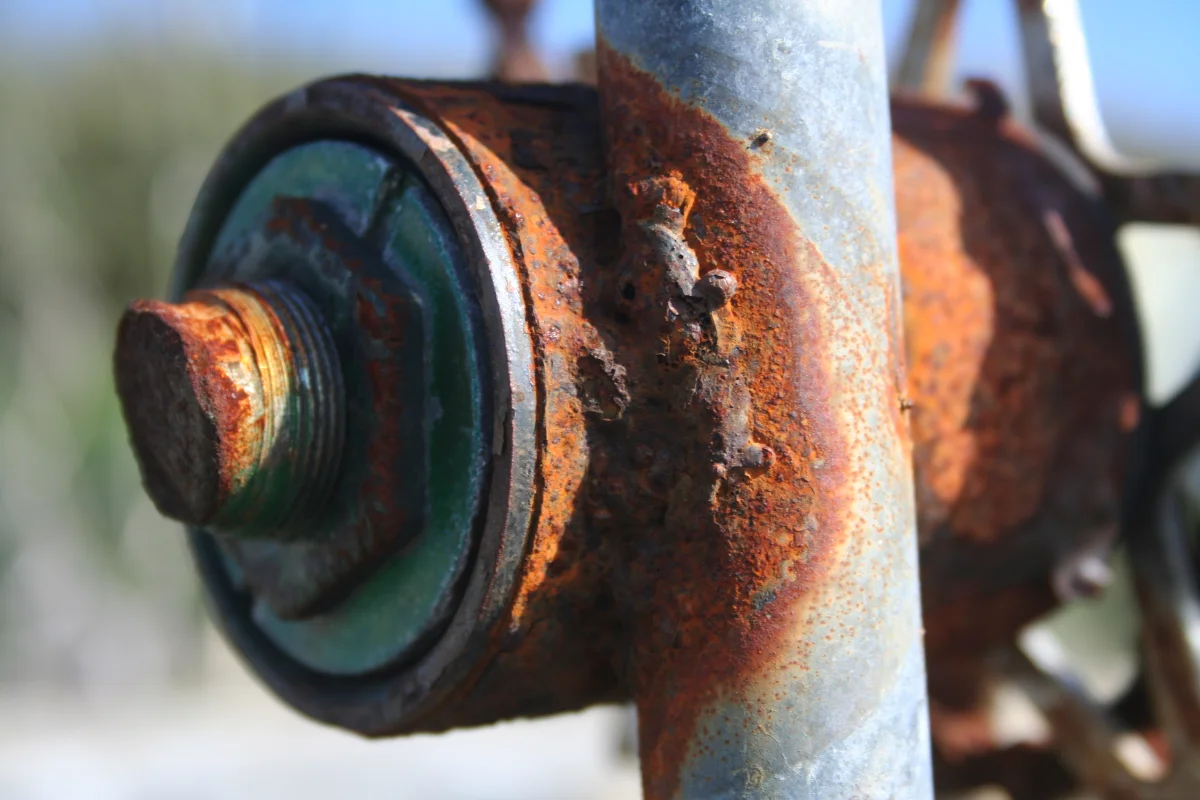
Iron corrosion happens in stages:
- Anodic region: Fe(s) -> Fe2+(aq) + 2e- (iron dissolves)
- Cathodic region: O2(g) + 2H2O(l) + 4e- -> 4OH-(aq) (oxygen is reduced)
- Rust formation: Fe2+ further oxidizes to Fe3+ and combines with oxygen and water to form hydrated iron(III) oxide (rust, Fe2O3 · nH2O)
Corrosion requires both water and oxygen. Iron immersed in pure water without dissolved oxygen does not rust. Iron in dry air does not rust. Both must be present.
Salt accelerates corrosion by increasing the conductivity of the electrolyte solution (dissolved ions carry charge more efficiently). This is why cars rust faster in coastal areas and where roads are salted in winter.
Preventing Corrosion
| Method | How it works |
|---|---|
| Painting/coating | Physical barrier blocks water and oxygen |
| Galvanizing | Zinc coating on iron; zinc corrodes preferentially (sacrificial anode) |
| Cathodic protection | Attach a more active metal (e.g., Mg or Zn) that oxidizes instead of the iron |
| Stainless steel | Chromium alloy forms a passive oxide layer |
Cathodic Protection - Sacrificial Anodes
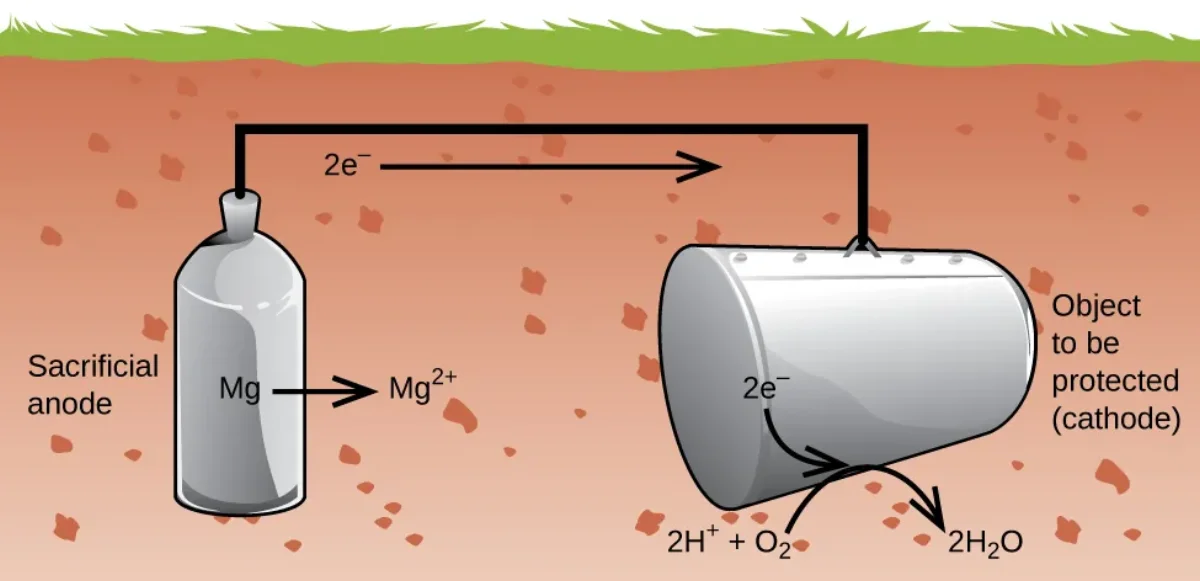
Cathodic protection exploits the activity series. A more active metal (lower reduction potential) is attached to the iron structure. Because the active metal is more easily oxidized, it corrodes instead of the iron.
Example: Zinc blocks attached to a steel ship hull. Zinc (E° = -0.76 V) is oxidized preferentially over iron (E° = -0.44 V). The iron becomes the cathode in this galvanic couple and is protected from corrosion. The zinc blocks are periodically replaced.
Galvanic Corrosion
When two dissimilar metals are in electrical contact in the presence of an electrolyte, the more active metal corrodes faster than it would alone. This is galvanic corrosion.
Example: An iron nail wrapped in copper wire in salt water. Iron (E° = -0.44 V) is more active than copper (E° = +0.34 V), so iron becomes the anode and corrodes rapidly. The copper acts as the cathode and is protected.
This is why plumbers avoid connecting copper pipes directly to steel pipes without a dielectric union.