
Combustion as Redox
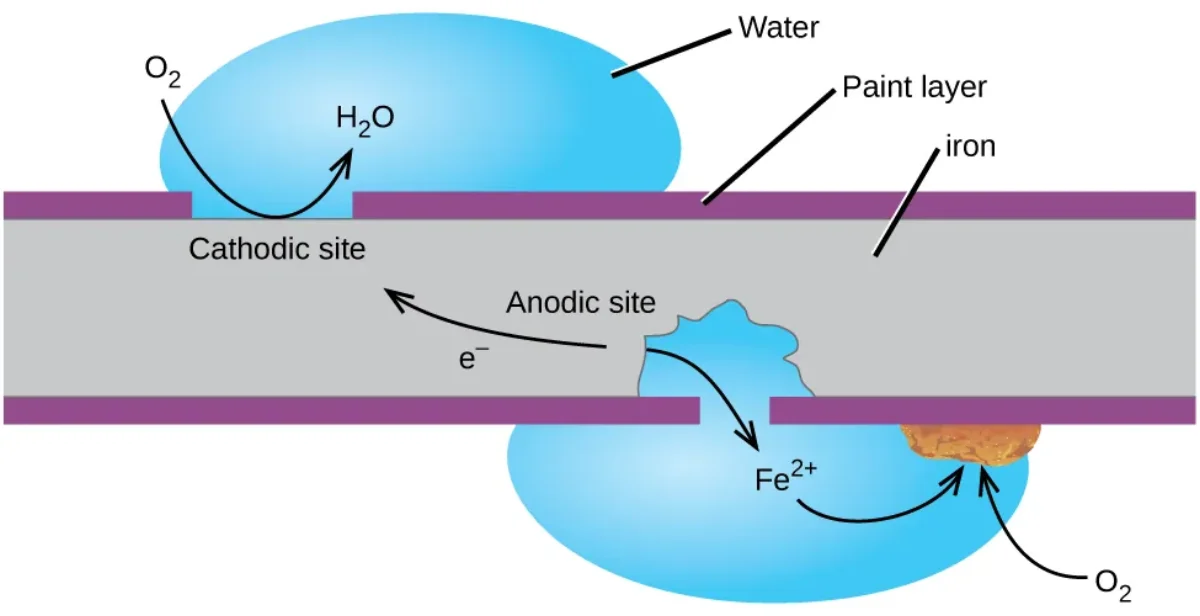
Combustion is the most dramatic redox reaction you encounter in everyday life. Strike a match, start a car engine, or light a Bunsen burner, and you are watching rapid oxidation by molecular oxygen. Combustion reactions are exothermic (they release energy as heat and light), and they are fundamentally the same electron-transfer process as rusting - just much faster.
Complete Combustion of Hydrocarbons
When a hydrocarbon (CxHy) burns completely in excess oxygen:
CxHy + O2 —> CO2 + H2O (unbalanced)
Redox analysis:
| Atom | Before | After | Change |
|---|---|---|---|
| C (in hydrocarbon) | Variable (often 0 or negative) | +4 (in CO2) | Oxidized |
| H (in hydrocarbon) | +1 | +1 (in H2O) | No change in typical hydrocarbons |
| O (in O2) | 0 | -2 (in CO2 and H2O) | Reduced |
Carbon is oxidized; oxygen is reduced. The hydrocarbon is the reducing agent (fuel). Oxygen is the oxidizing agent.
Balanced Example: Methane Combustion
CH4 + 2O2 —> CO2 + 2H2O
- Carbon goes from -4 (in CH4) to +4 (in CO2): oxidized, losing 8 electrons per carbon
- Oxygen goes from 0 (in O2) to -2 (in CO2 and H2O): reduced, gaining 2 electrons per oxygen
- Total electrons: C loses 8, and 4 O atoms each gain 2 = 8 total. Balanced.
This reaction releases 890 kJ/mol - the energy that heats your stove.
Incomplete Combustion
When oxygen supply is limited, combustion is incomplete:
2CH4 + 3O2 —> 2CO + 4H2O (limited O2)
Carbon is only partially oxidized to +2 (in CO) instead of +4 (in CO2). Carbon monoxide (CO) is the dangerous product of incomplete combustion - it binds to hemoglobin with 200 times greater affinity than O2, blocking oxygen transport.
| Combustion Type | Products | Carbon Oxidation State | Energy Released |
|---|---|---|---|
| Complete | CO2 + H2O | +4 (fully oxidized) | Maximum |
| Incomplete | CO + H2O | +2 (partially oxidized) | Less than maximum |
| Very incomplete | C (soot) + H2O | 0 (barely oxidized) | Much less |
Combustion of Other Organic Molecules
Combustion is not limited to hydrocarbons. Any organic molecule (alcohols, sugars, fats) can undergo combustion:
Ethanol: C2H5OH + 3O2 —> 2CO2 + 3H2O
Glucose: C6H12O6 + 6O2 —> 6CO2 + 6H2O
Notice that the glucose combustion equation is identical to the overall equation for aerobic cellular respiration. The products and total energy released are the same. The difference is that combustion releases all the energy at once as heat, while cellular respiration releases it in controlled steps, capturing much of it as ATP.
Combustion Analysis: Working Backwards
In combustion analysis, you burn a sample of unknown composition and measure the masses of CO2 and H2O produced:
- All carbon in the sample ends up as CO2
- All hydrogen in the sample ends up as H2O
- Any remaining mass is oxygen (or another element, if specified)
To find the empirical formula:
- grams CO2 —> moles CO2 —> moles C
- grams H2O —> moles H2O —> moles H (multiply by 2, since each H2O has 2 H)
- Remaining mass = moles O
- Find the simplest whole-number ratio
This technique connects combustion (redox) to stoichiometry - a cross-topic link the MCAT loves.
Summary: Why Combustion Is Redox
| Feature | Combustion Detail |
|---|---|
| Oxidizing agent | O2 (reduced from 0 to -2) |
| Reducing agent | Fuel (carbon oxidized, typically from low state to +4) |
| Energy | Highly exothermic (large negative delta-H) |
| Spontaneity | Spontaneous but requires activation energy (spark/flame) |
| Biological parallel | Cellular respiration = controlled combustion of glucose |