Before you can identify a redox reaction, you need a bookkeeping system that tracks electrons. That system is the oxidation state (also called the oxidation number). Think of it as a hypothetical charge each atom would carry if every bond in the molecule were completely ionic - all shared electrons assigned to the more electronegative atom.
Oxidation states are not real charges (except for monatomic ions). They are an accounting tool. But they are incredibly powerful: by comparing oxidation states before and after a reaction, you can instantly see which atoms lost electrons and which gained them.
The Rules (Apply in This Order)
The rules below are listed in priority order. When two rules conflict, the higher-priority rule wins.
Priority
Rule
Example
1
Free elements = 0. Any atom in its elemental form has an oxidation state of zero.
Fe(s) = 0, O2 = 0, P4 = 0
2
Monatomic ions = their charge.
Na+ = +1, Cl- = -1, Fe3+ = +3
3
Fluorine = -1 always. Fluorine is the most electronegative element and always wins the electron tug-of-war.
In OF2, F = -1 (oxygen is forced to +2)
4
Oxygen = -2 (usually). Exception: -1 in peroxides (H2O2, Na2O2), -21 in superoxides (KO2), and +2 when bonded to fluorine.
In H2O, O = -2. In H2O2, O = -1
5
Hydrogen = +1 (usually). Exception: -1 in metal hydrides (NaH, CaH2).
In HCl, H = +1. In NaH, H = -1
6
Group 1 metals = +1 in compounds.
Na in NaCl = +1
7
Group 2 metals = +2 in compounds.
Ca in CaCl2 = +2
8
The sum of all oxidation states = the overall charge. For a neutral compound, the sum is zero. For a polyatomic ion, the sum equals the ion’s charge.
In SO4^2-, S + 4(-2) = -2, so S = +6
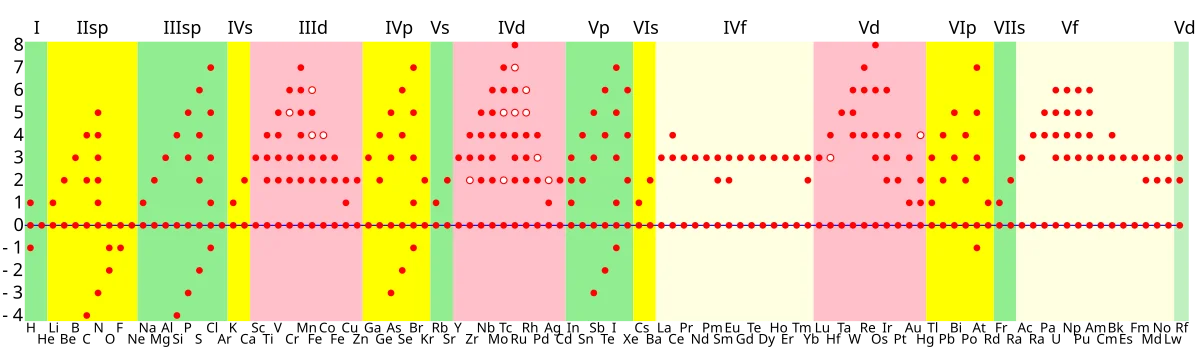
Oxidation states across the periodic table. Main group elements typically have predictable oxidation states based on their group number, while transition metals can adopt multiple oxidation states due to the availability of d electrons. Credit: Wikimedia Commons, CC BY-SA 4.0
Worked Example: Finding the Oxidation State of Sulfur in K2SO4
Step 1. Start with atoms that have fixed oxidation states. Potassium is Group 1, so K = +1. Oxygen follows Rule 4, so O = -2.
Step 2. Use the sum rule (Rule 8). K2SO4 is a neutral compound, so the sum must equal zero:
2(+1) + S + 4(-2) = 0
Step 3. Solve for S:
+2 + S - 8 = 0 —> S = +6
Sulfur has an oxidation state of +6 in potassium sulfate.
Worked Example: Finding the Oxidation State of Nitrogen in NO3-
The nitrate ion has a charge of -1. Using the sum rule:
N + 3(-2) = -1
N - 6 = -1 —> N = +5
Common Pitfalls on the MCAT
Peroxides vs. regular oxides. If you see H2O2 or Na2O2, oxygen is -1, not -2. The MCAT loves to test this exception.
Metal hydrides. In NaH or CaH2, hydrogen is -1 because the metal is more electropositive. If you see H bonded to a Group 1 or Group 2 metal, flip hydrogen’s sign.
Transition metals. Transition metals have variable oxidation states. You cannot memorize them all - instead, use the other atoms in the compound to solve for the metal’s oxidation state algebraically.
Practice: Assign Oxidation States
Try these before flipping the flashcard:
Compound
Find the oxidation state of…
MnO4-
Mn
Cr2O7^2-
Cr
H3PO4
P
Na2O2
O
What is the oxidation state of Mn in MnO4-?
Click to reveal answer
Mn = +7. Oxygen is -2. The ion has a -1 charge: Mn + 4(-2) = -1, so Mn = +7. Permanganate (MnO4-) is one of the strongest common oxidizing agents precisely because Mn is at such a high oxidation state - it desperately wants to gain electrons and be reduced.
In Na2O2 (sodium peroxide), what is the oxidation state of oxygen? Why is it different from the usual -2?
Click to reveal answer
Oxygen = -1. Na is Group 1, so Na = +1. For the compound to be neutral: 2(+1) + 2(O) = 0, so O = -1. This is a peroxide - it contains the O2^2- ion, where an O-O single bond exists. The MCAT specifically tests whether you know that oxygen is -1 in peroxides, not the usual -2.
Now that you can assign oxidation states, identifying redox reactions is straightforward: compare oxidation states before and after the reaction. If any atom’s oxidation state changed, it is a redox reaction. If no oxidation states changed, it is not.
How to Spot a Redox Reaction
Step 1. Assign oxidation states to every atom on both sides of the equation.
Step 2. Compare. Any atom whose oxidation state increased was oxidized (lost electrons). Any atom whose oxidation state decreased was reduced (gained electrons).
Step 3. If at least one atom was oxidized and at least one was reduced, it is a redox reaction.
Worked Example: Is This a Redox Reaction?
Reaction: 2Na + Cl2 —> 2NaCl
Atom
Before
After
Change
Na
0 (free element)
+1 (in NaCl)
Increased by 1 —> oxidized
Cl
0 (free element)
-1 (in NaCl)
Decreased by 1 —> reduced
Yes - this is a redox reaction. Sodium lost one electron per atom (oxidized). Chlorine gained one electron per atom (reduced).
Worked Example: Not a Redox Reaction
Reaction: NaOH + HCl —> NaCl + H2O
Atom
Before
After
Change
Na
+1
+1
No change
O
-2
-2
No change
H
+1
+1
No change
Cl
-1
-1
No change
No atom changed oxidation state. This is an acid-base neutralization, not a redox reaction.
Key Patterns That Signal Redox
Not every MCAT question will give you time to assign all oxidation states. Here are fast shortcuts to recognize redox reactions:
Pattern
Why It is Redox
A free element appears as a reactant or product
Free elements have oxidation state 0; if they become part of a compound, their state must change
A metal displaces another metal from solution
One metal is oxidized while the other is reduced
Combustion (substance + O2)
Carbon and hydrogen are oxidized; oxygen is reduced
A substance reacts with a strong oxidizing agent (KMnO4, K2Cr2O7, H2O2)
The oxidizing agent is reduced; the other substance is oxidized
Charge changes in ionic species
Fe2+ becoming Fe3+ is oxidation; Cu2+ becoming Cu is reduction
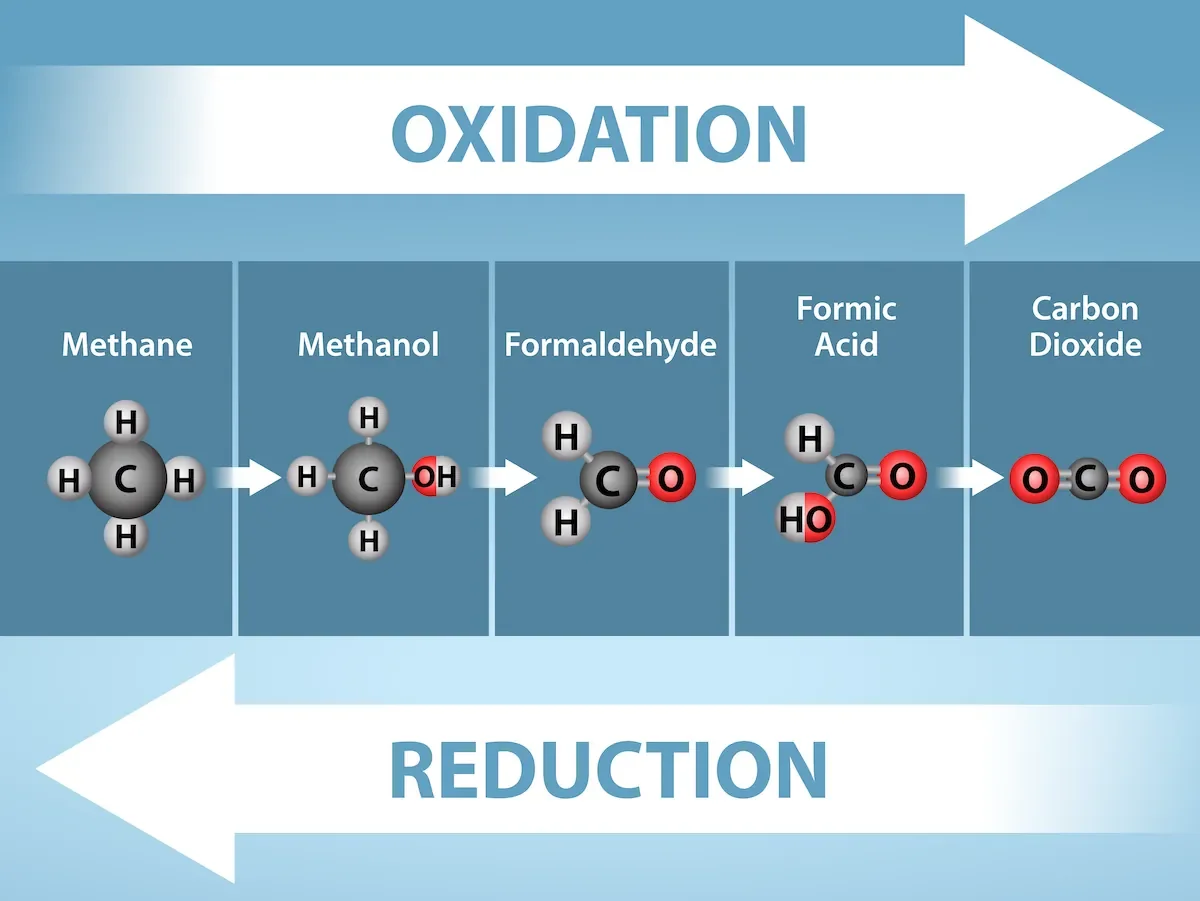
The oxidation spectrum of carbon: from fully reduced (CH4) to fully oxidized (CO2). Each step to the right adds bonds to oxygen and removes bonds to hydrogen - the hallmark of oxidation in organic molecules. Credit: OpenStax Biology 2e, CC BY 4.0
The Three Definitions of Oxidation and Reduction
The MCAT can present redox from three different angles:
Definition
Oxidation
Reduction
Electron transfer
Loses electrons
Gains electrons
Oxidation state
Oxidation state increases
Oxidation state decreases
Oxygen/hydrogen (older definition)
Gains oxygen or loses hydrogen
Loses oxygen or gains hydrogen
The electron transfer and oxidation state definitions are the ones you will use most. The oxygen/hydrogen definition is older but occasionally appears in MCAT passages about metabolic reactions, where “dehydrogenation” (loss of hydrogen) is described as oxidation.
In the reaction Fe2O3 + 3CO --> 2Fe + 3CO2, identify which species is oxidized and which is reduced.
Click to reveal answer
Carbon is oxidized (from +2 in CO to +4 in CO2). Iron is reduced (from +3 in Fe2O3 to 0 in Fe). This is the smelting of iron ore - carbon monoxide donates electrons to iron oxide, reducing the iron to its metallic form. CO is the reducing agent; Fe2O3 is the oxidizing agent.
Is the following reaction a redox reaction? AgNO3(aq) + NaCl(aq) --> AgCl(s) + NaNO3(aq)
Click to reveal answer
No. Check oxidation states: Ag stays +1, N stays +5, O stays -2, Cl stays -1, Na stays +1. No atom changed oxidation state. This is a double displacement (metathesis) reaction, not a redox reaction. AgCl precipitates because it is insoluble, but no electrons were transferred.
The terminology of redox agents confuses almost every student the first time they see it. The oxidizing agent is the substance that gets reduced. The reducing agent is the substance that gets oxidized. It sounds backwards until you realize the names describe what the substance does to the OTHER species, not what happens to itself.
Quick Reference
Term
What it DOES to others
What happens to IT
Electron role
Oxidizing agent
Oxidizes the other species
Gets reduced (gains electrons)
Electron acceptor
Reducing agent
Reduces the other species
Gets oxidized (loses electrons)
Electron donor
Identifying the Agents in a Reaction
Reaction: Zn(s) + Cu2+(aq) —> Zn2+(aq) + Cu(s)
Zinc goes from 0 to +2 (loses 2 electrons, is oxidized). Since zinc is oxidized, it is the reducing agent - it donates electrons to Cu2+.
Cu2+ goes from +2 to 0 (gains 2 electrons, is reduced). Since Cu2+ is reduced, it is the oxidizing agent - it accepts electrons from Zn.
Strength of Oxidizing and Reducing Agents
The strength of an oxidizing agent depends on how strongly it attracts electrons. The strength of a reducing agent depends on how easily it gives up electrons.
Strong oxidizing agents have a high tendency to gain electrons. They typically have:
High electronegativity (F2, O2, Cl2)
Metals in very high oxidation states (Mn in MnO4- is +7, Cr in Cr2O7^2- is +6)
Electron-poor species hungry for electrons
Strong reducing agents have a high tendency to lose electrons. They typically are:
Hydride donors (NaBH4, LiAlH4) that deliver H- with its extra electron
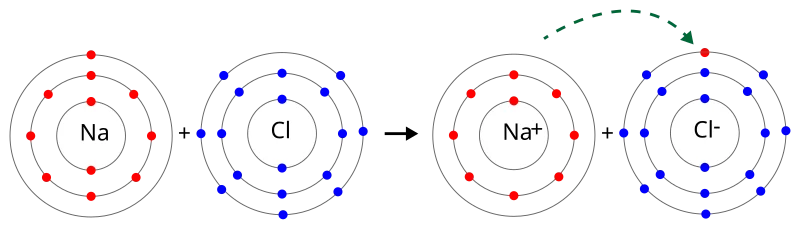
Electron transfer in NaCl formation. Sodium is the reducing agent (it loses an electron and is oxidized from 0 to +1), while chlorine is the oxidizing agent (it gains an electron and is reduced from 0 to −1). Remember: the reducing agent is oxidized, and the oxidizing agent is reduced. Credit: Wikimedia Commons, CC BY-SA 4.0
Conjugate Redox Pairs
Just as acids and bases form conjugate pairs, oxidizing and reducing agents form conjugate redox pairs. When a reducing agent loses electrons, it becomes an oxidizing agent (and vice versa).
Reducing agent
Loses electrons —>
Oxidizing agent
Zn
—> Zn2+ + 2e-
Zn2+
Fe
—> Fe2+ + 2e-
Fe2+
Na
—> Na+ + e-
Na+
A strong reducing agent (like Na) has a weak conjugate oxidizing agent (Na+ has little desire to regain its electron). A strong oxidizing agent (like F2) has a weak conjugate reducing agent (F- has little desire to give up its extra electron).
This mirrors the acid-base conjugate relationship: strong acid = weak conjugate base.
In the reaction 2Fe3+(aq) + Sn2+(aq) --> 2Fe2+(aq) + Sn4+(aq), identify the oxidizing agent and the reducing agent.
Click to reveal answer
Fe3+ is the oxidizing agent (it is reduced from +3 to +2, gaining electrons). Sn2+ is the reducing agent (it is oxidized from +2 to +4, losing electrons). Each Fe3+ gains one electron; Sn2+ loses two electrons total, which is why we need 2 Fe3+ ions.
Why is lithium metal one of the strongest reducing agents in chemistry?
Click to reveal answer
Lithium has an extremely low ionization energy and the most negative standard reduction potential (-3.04 V). It gives up its single valence electron more readily than any other metal. Once it loses that electron, Li+ has a noble gas configuration (like helium) and is very stable, so there is a strong thermodynamic driving force for lithium to be oxidized. This makes it the most powerful reducing agent on the standard reduction potential table.
Balancing redox reactions requires more than just matching atoms - you also need to balance the electrons transferred. The half-reaction method is the systematic way to do this, and it works every time. In acidic solution, you use H2O to balance oxygen atoms and H+ to balance hydrogen atoms.
The Half-Reaction Method in Acidic Solution
Step 1: Split into half-reactions. Identify which species is oxidized and which is reduced. Write each as a separate half-reaction.
Step 2: Balance atoms other than O and H. Make sure the element being oxidized or reduced has the same number of atoms on both sides.
Step 3: Balance oxygen by adding H2O. For every O atom you need, add one H2O to the opposite side.
Step 4: Balance hydrogen by adding H+. For every H atom you need, add one H+ to the opposite side. (This is why the method works in acidic solution - H+ is available.)
Step 5: Balance charge by adding electrons. Add e- to the more positive side of each half-reaction so the total charge is equal on both sides.
Step 6: Equalize electrons. Multiply each half-reaction by the appropriate integer so both half-reactions transfer the same number of electrons.
Step 7: Add the half-reactions. Cancel electrons (they should cancel completely) and cancel any H2O or H+ that appear on both sides.
Step 8: Verify. Check that atoms balance AND charge balances.
When balancing a redox reaction in acidic solution, what do you add to balance oxygen atoms? What do you add to balance hydrogen atoms?
Click to reveal answer
Add H2O to balance oxygen atoms. Add H+ to balance hydrogen atoms. For each oxygen atom needed, add one H2O to the opposite side. Each H2O introduces 2 H atoms, so you then add H+ to balance those. Electrons are added last to balance charge.
In the reaction Cr2O7^2- + 14H+ + 6e- --> 2Cr3+ + 7H2O, how many electrons does each chromium atom gain? What was its starting oxidation state?
Click to reveal answer
Each Cr gains 3 electrons, going from +6 to +3. In Cr2O7^2-, each Cr is +6 (since 2Cr + 7(-2) = -2, so Cr = +6). In the product Cr3+, each Cr is +3. That is a decrease of 3 per Cr atom. With 2 Cr atoms, the total is 6 electrons gained, matching the 6e- shown in the balanced half-reaction.
Balancing redox reactions in basic solution uses the exact same half-reaction method as acidic solution, with one extra step at the end. You first balance the equation as if it were in acid (using H+ and H2O), and then convert all the H+ ions into water by adding OH- to both sides.
The Extra Step for Basic Solution
After you have a balanced equation in acidic solution (following all the steps from the previous section):
Add OH- to BOTH sides of the equation - one OH- for every H+ that appears. On the side where H+ exists, the H+ and OH- combine to form H2O. On the other side, you simply add the same number of OH- ions.
Then simplify: cancel any H2O molecules that appear on both sides.
The problem will always tell you which medium the reaction occurs in. Look for these clues:
Clue in the problem
Method
”In acidic solution” or pH < 7
Use H+ and H2O directly
”In basic solution” or pH > 7 or NaOH present
Balance in acid first, then convert H+ to H2O with OH-
No medium specified
Usually assume acidic unless the problem specifies otherwise
What is the key difference between balancing a redox reaction in acidic solution versus basic solution?
Click to reveal answer
In basic solution, you add one extra step at the end: add OH- to both sides to neutralize all H+ ions into water. The core method (split, balance atoms, balance O with H2O, balance H with H+, balance charge with e-) is identical. The only change is that in basic solution, H+ cannot exist in significant concentrations, so you convert every H+ to H2O by adding OH-.
After balancing a redox equation in acid, you have 4H+ on the left side. To convert to basic solution, what do you add and where?
Click to reveal answer
Add 4 OH- to BOTH sides. On the left, 4H+ + 4OH- combine to form 4H2O. On the right, the 4OH- remain as is. Then simplify by canceling any H2O that appears on both sides. The result is an equation with OH- and H2O but no H+.
A half-reaction shows just one side of a redox process - either the oxidation or the reduction, but not both. You have already used half-reactions to balance redox equations. Now let’s understand them more deeply, because half-reactions are the language of electrochemistry (Chapter 12) and the foundation for standard reduction potentials.
Writing Half-Reactions
Every redox reaction can be split into two half-reactions:
Oxidation half-reaction: Shows the species losing electrons. Electrons appear on the product side (right).
Zn(s) —> Zn2+(aq) + 2e-
Reduction half-reaction: Shows the species gaining electrons. Electrons appear on the reactant side (left).
Cu2+(aq) + 2e- —> Cu(s)
The overall reaction is the sum of the two halves, with electrons canceling:
Zn(s) + Cu2+(aq) —> Zn2+(aq) + Cu(s)
Spectator Ions
When you split a reaction into half-reactions, spectator ions disappear. They do not participate in the electron transfer and are not included in either half-reaction.
Full molecular equation: Zn(s) + CuSO4(aq) —> ZnSO4(aq) + Cu(s)
Net ionic equation: Zn(s) + Cu2+(aq) —> Zn2+(aq) + Cu(s)
Spectator ion: SO4^2- (sulfate appears on both sides, unchanged)
The sulfate ion watches the electron transfer without participating - just like a spectator at a game.
The Standard Reduction Potential Table
Every half-reaction has a measurable tendency to occur, quantified as the standard reduction potential (E). The table lists half-reactions as reductions by convention.
Half-reaction (as written: reduction)
E (V)
F2 + 2e- —> 2F-
+2.87
Au3+ + 3e- —> Au
+1.50
Ag+ + e- —> Ag
+0.80
Cu2+ + 2e- —> Cu
+0.34
2H+ + 2e- —> H2
0.00 (reference)
Ni2+ + 2e- —> Ni
-0.26
Fe2+ + 2e- —> Fe
-0.45
Zn2+ + 2e- —> Zn
-0.76
Al3+ + 3e- —> Al
-1.66
Mg2+ + 2e- —> Mg
-2.37
Na+ + e- —> Na
-2.71
Li+ + e- —> Li
-3.04
Key rules for using this table:
A more positive E means a stronger tendency to be reduced (stronger oxidizing agent)
A more negative E means a stronger tendency to be oxidized (stronger reducing agent)
The hydrogen electrode (2H+ + 2e- —> H2) is defined as exactly 0.00 V - it is the reference point
To get the oxidation potential, flip the sign: if Cu2+ + 2e- —> Cu has E = +0.34 V, then Cu —> Cu2+ + 2e- has E = -0.34 V
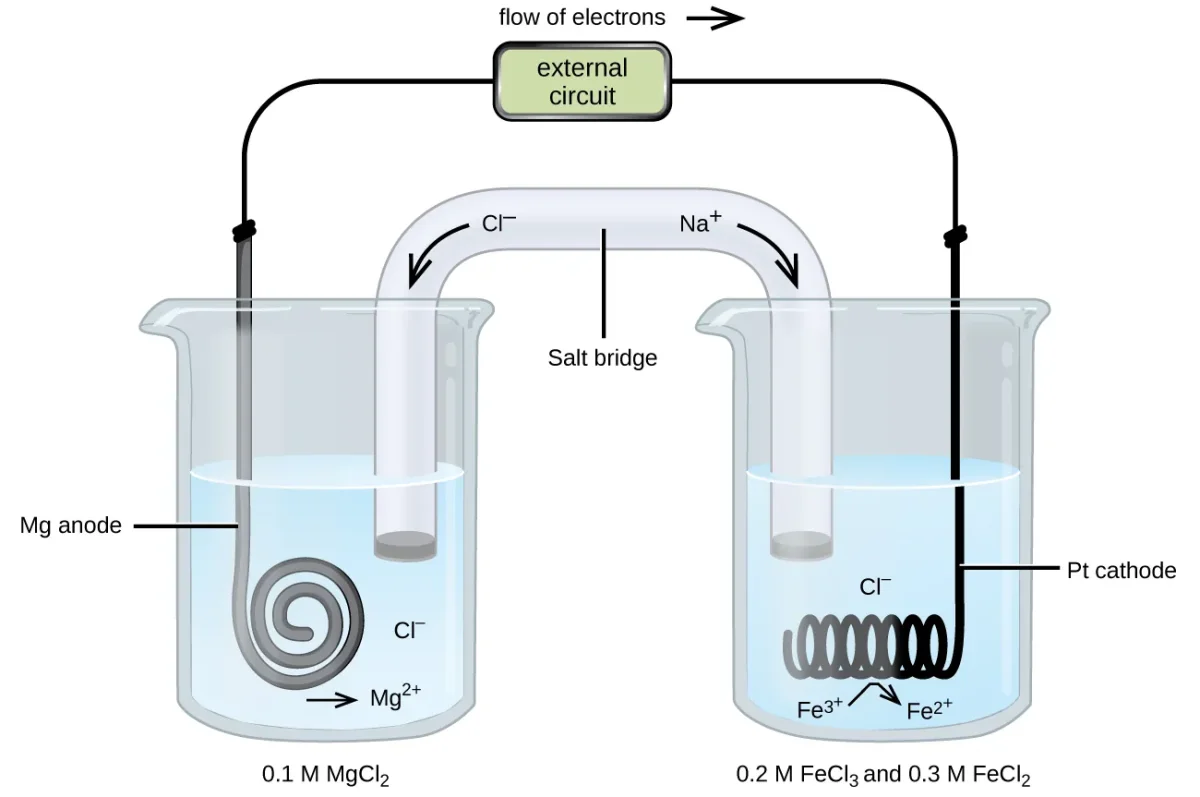
A galvanic cell separates the two half-reactions into different compartments. The oxidation half-reaction occurs at the anode (left), the reduction half-reaction at the cathode (right), and the salt bridge maintains electrical neutrality. This is the physical manifestation of half-reactions in action. Credit: OpenStax Chemistry 2e, CC BY 4.0
Predicting Spontaneity from Half-Reactions
A redox reaction is spontaneous when the species with the higher (more positive) reduction potential is actually being reduced, and the species with the lower (more negative) reduction potential is being oxidized.
Rule: If E(cell) = E(cathode) - E(anode) > 0, the reaction is spontaneous.
This will be covered in full detail in Chapter 12 (Electrochemistry), but the foundation is here: the reduction potential table tells you which direction electrons naturally want to flow.
Why does the standard reduction potential table list all half-reactions as reductions, even though some species are more likely to be oxidized?
Click to reveal answer
It is a convention to allow easy comparison. By writing everything as a reduction, you can directly compare E values: the more positive the value, the stronger the oxidizing agent (the more that species wants to be reduced). If a species actually gets oxidized in a reaction, you simply reverse the half-reaction and flip the sign of E. Having one consistent format prevents confusion from mixing oxidation and reduction potentials.
Given that E for Ag+/Ag = +0.80 V and E for Zn2+/Zn = -0.76 V, will zinc metal spontaneously reduce silver ions?
Click to reveal answer
Yes. Ag+ has the higher reduction potential (+0.80 V), so it wants to be reduced (gain electrons). Zn has the lower reduction potential (-0.76 V), so it wants to be oxidized (lose electrons). E(cell) = +0.80 - (-0.76) = +1.56 V, which is positive, confirming the reaction is spontaneous: Zn(s) + 2Ag+(aq) --> Zn2+(aq) + 2Ag(s).
The activity series is a ranking of metals (and hydrogen) by how easily they are oxidized - that is, how readily they give up electrons. It is the practical version of the standard reduction potential table, and it lets you predict at a glance whether one metal can displace another from solution.
The Activity Series (Most Active to Least Active)
Metal
Reactivity
Reaction with Water/Acid
Li, K, Ba, Ca, Na
Most active
React vigorously with cold water
Mg, Al, Zn, Fe
Active
React with steam or dilute acids
Ni, Sn, Pb
Moderately active
React with acids (slowly)
H2
Reference line
— divides metals that dissolve in acid from those that do not —
Cu, Ag, Pt, Au
Least active (noble metals)
Do not react with most acids
The Displacement Rule
A metal higher on the activity series can displace a metal lower on the series from its salt solution. A metal lower on the series cannot displace a metal above it.
Will zinc displace copper from CuSO4?
Zn is above Cu in the activity series —> Yes. Zinc is more active (more willing to be oxidized).
Zn(s) + CuSO4(aq) —> ZnSO4(aq) + Cu(s)
Will copper displace zinc from ZnSO4?
Cu is below Zn in the activity series —> No. Copper is less active. This reaction does not occur spontaneously.
A displacement reaction in action: when a more active metal is placed in a solution containing ions of a less active metal, the more active metal dissolves while the less active metal deposits as a solid. Credit: OpenStax Chemistry 2e, CC BY 4.0
Hydrogen’s Position in the Activity Series
Hydrogen sits in the middle of the activity series. This has a practical consequence:
Metals above H2 (like Zn, Fe, Mg) dissolve in dilute acids like HCl or H2SO4, producing H2 gas:
Zn(s) + 2HCl(aq) —> ZnCl2(aq) + H2(g)
Metals below H2 (like Cu, Ag, Au) do NOT dissolve in most dilute acids. They are more “noble” than hydrogen - they refuse to be oxidized by H+.
Why Noble Metals Resist Corrosion
Copper, silver, platinum, and gold are called “noble metals” because they have positive reduction potentials. They would rather stay in their metallic form than be oxidized. This is why:
Gold jewelry does not tarnish
Platinum is used in electrodes (it will not react with the solution)
Copper pennies do not dissolve in water (though they do develop a green patina over decades from slow oxidation in air)
Practical Applications
Application
Activity Series Principle
Galvanized steel
Zinc coating protects iron. Zn is more active than Fe, so Zn is oxidized first (sacrificial anode), protecting the iron underneath
Ship hull protection
Zinc blocks attached to steel hulls corrode preferentially, preventing the hull from rusting
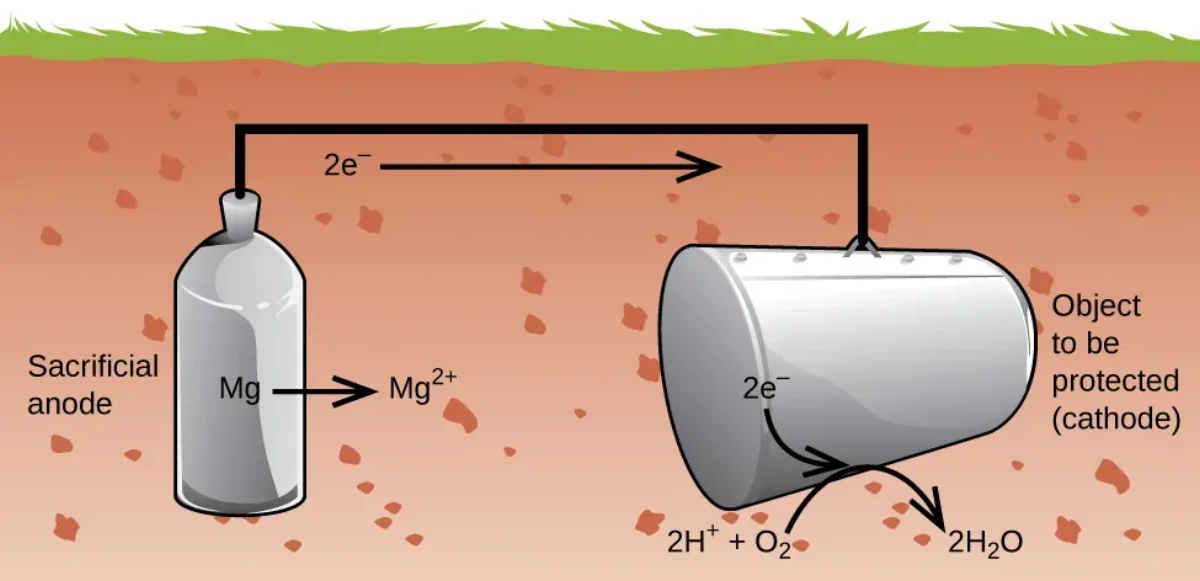
Cathodic protection in action: a sacrificial magnesium anode (more active metal) is buried near a steel storage tank. Magnesium is oxidized preferentially, sending electrons to the steel and preventing it from corroding. When the magnesium is consumed, it is simply replaced. Credit: OpenStax Chemistry 2e, CC BY 4.0
| Thermite reaction | Al displaces Fe from Fe2O3 because Al is more active than Fe: 2Al + Fe2O3 --> Al2O3 + 2Fe |
| Extracting metals from ore | More active metals (like C/coke) reduce less active metal oxides in a furnace |
A student places a strip of iron metal into a solution of copper(II) sulfate. What will they observe, and why?
Click to reveal answer
Reddish-brown copper metal will deposit on the iron strip, and the solution will change from blue to pale green. Iron is above copper in the activity series, so Fe is oxidized to Fe2+ (green in solution) while Cu2+ is reduced to Cu metal (reddish solid). The blue color fades as Cu2+ is removed from solution. Reaction: Fe(s) + CuSO4(aq) --> FeSO4(aq) + Cu(s).
Will silver metal dissolve in dilute hydrochloric acid? Explain using the activity series.
Click to reveal answer
No. Silver (Ag) is below hydrogen in the activity series, meaning silver is less reactive than hydrogen. H+ ions in HCl are not strong enough oxidizing agents to oxidize Ag to Ag+. Only metals above hydrogen in the activity series (like Zn, Fe, Mg) dissolve in dilute HCl. Silver requires a stronger oxidizing acid like concentrated HNO3.
In most redox reactions, one substance is oxidized while a completely different substance is reduced. But in a disproportionation reaction, the same element is both oxidized AND reduced. One atom of that element goes up in oxidation state while another atom of the same element goes down. It is like one person simultaneously winning and losing a bet with themselves.
The Classic Example: Hydrogen Peroxide Decomposition
2H2O2 —> 2H2O + O2
Let’s track the oxygen:
Species
Oxidation state of O
H2O2 (reactant)
-1 (peroxide)
H2O (product)
-2
O2 (product)
0
Oxygen starts at -1 in hydrogen peroxide. In the products, some oxygen atoms went to -2 (reduced, gained electrons) and others went to 0 (oxidized, lost electrons). The same element, oxygen, is both oxidized and reduced.
The same element appears in the reactants with one oxidation state
That element appears in the products with two different oxidation states - one higher and one lower than the starting state
The element simultaneously underwent oxidation AND reduction
Another Example: Copper(I) Disproportionation
2Cu+(aq) —> Cu(s) + Cu2+(aq)
Cu+ starts at oxidation state +1. In the products:
Cu(s) has oxidation state 0 (reduced: +1 —> 0)
Cu2+ has oxidation state +2 (oxidized: +1 —> +2)
This reaction occurs spontaneously because Cu+ is unstable in aqueous solution. It is thermodynamically favorable for Cu+ ions to split into metallic copper and Cu2+ ions.
Halogens and Disproportionation
Halogens commonly undergo disproportionation in basic solution:
Cl2(g) + 2OH-(aq) —> ClO-(aq) + Cl-(aq) + H2O(l)
Chlorine starts at 0. In the products:
Cl- has oxidation state -1 (reduced)
ClO- has Cl at oxidation state +1 (oxidized)
This is how household bleach (NaClO) is manufactured - by bubbling chlorine gas into sodium hydroxide solution.
The Opposite: Comproportionation
The reverse of disproportionation is comproportionation (also called synproportionation), where two different oxidation states of the same element combine to form a single intermediate oxidation state.
S(-2) and S(+6) combine to form S(0). Two different oxidation states converge to one intermediate state.
In the reaction 2Cu+(aq) --> Cu(s) + Cu2+(aq), why is this classified as a disproportionation reaction rather than a simple redox reaction?
Click to reveal answer
Because the same element (copper) is both oxidized and reduced. Cu+ at oxidation state +1 simultaneously goes to 0 (reduced to Cu metal) and +2 (oxidized to Cu2+). In a regular redox reaction, one substance is oxidized while a different substance is reduced. In disproportionation, the same element plays both roles.
Can an element in its maximum oxidation state undergo disproportionation? Why or why not?
Click to reveal answer
No. Disproportionation requires the element to simultaneously increase AND decrease its oxidation state. If the element is already at its maximum, it cannot be further oxidized. It can only be reduced. Similarly, an element at its minimum oxidation state can only be oxidized, not reduced. Only intermediate oxidation states can disproportionate.
An oxidizing agent causes another substance to be oxidized by accepting electrons from it. Strong oxidizing agents are electron-hungry species - they pull electrons away from other molecules aggressively. Knowing the common oxidizing agents and their visual signatures helps you quickly identify redox reactions in MCAT passages.
The Big List of Common Oxidizing Agents
Oxidizing Agent
Formula
Oxidation State of Key Atom
Reduced Product
Visual Cue
Permanganate ion
MnO4-
Mn = +7
Mn2+ (acidic) or MnO2 (neutral/basic)
Deep purple —> colorless (acidic) or brown solid (basic)
Dichromate ion
Cr2O7^2-
Cr = +6
Cr3+
Orange —> green
Fluorine
F2
F = 0
F-
Strongest elemental oxidizing agent
Chlorine
Cl2
Cl = 0
Cl-
Pale yellow-green gas
Bromine
Br2
Br = 0
Br-
Reddish-brown liquid
Hydrogen peroxide
H2O2
O = -1
H2O
Can also act as a reducing agent
Concentrated nitric acid
HNO3
N = +5
NO2 or NO
Brown gas (NO2) evolved
Concentrated sulfuric acid
H2SO4 (hot, concentrated)
S = +6
SO2
Pungent gas
Oxygen
O2
O = 0
O2- or OH-
Universal oxidizing agent in combustion
Permanganate (MnO4-)
Potassium permanganate (KMnO4) is one of the most commonly tested oxidizing agents on the MCAT:
In acidic solution: MnO4- is reduced to Mn2+ (colorless). The deep purple color disappears.
In neutral or basic solution: MnO4- is reduced to MnO2 (brown solid precipitate).
Why it is strong: Mn is at +7, its maximum oxidation state. It has a powerful drive to gain electrons and drop to a lower oxidation state.
MCAT passages about redox titrations frequently use KMnO4 as the titrant because it acts as its own indicator - the endpoint is marked by the first permanent appearance of purple color (when all the reducing agent has been consumed and the next drop of MnO4- has nothing left to oxidize).
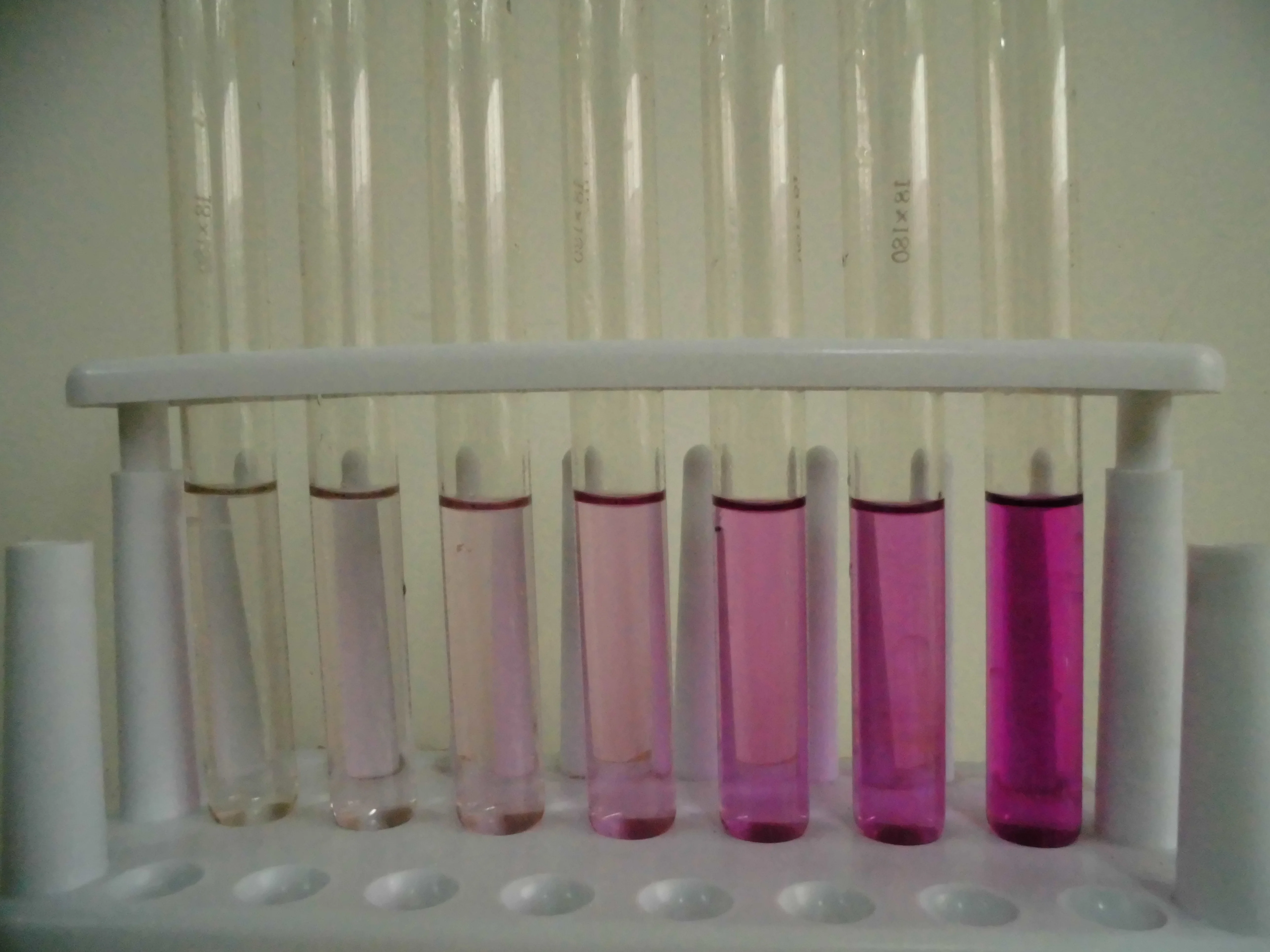
Potassium permanganate (KMnO₄) solutions displaying the characteristic deep purple color of Mn⁷⁺. In acidic solution, permanganate is reduced to the nearly colorless Mn²⁺ ion — this dramatic color change makes KMnO₄ a visual indicator for redox titrations. Credit: Wikimedia Commons, CC BY-SA 4.0
Dichromate (Cr2O7^2-)
Potassium dichromate (K2Cr2O7) is another classic oxidizing agent:
In acidic solution: Cr2O7^2- is reduced to Cr3+. The color changes from orange to green.
Why it is strong: Cr is at +6, a very high oxidation state.
Halogens as Oxidizing Agents
The halogens (F2, Cl2, Br2, I2) are all oxidizing agents, with strength decreasing down the group:
F2 > Cl2 > Br2 > I2
This trend follows electronegativity: fluorine is the most electronegative element, so F2 is the strongest oxidizing agent. A higher halogen can oxidize a lower halide:
Cl2(aq) + 2Br-(aq) —> 2Cl-(aq) + Br2(aq)
Chlorine oxidizes bromide because Cl2 is a stronger oxidizing agent than Br2. But the reverse (Br2 oxidizing Cl-) does not occur.
Hydrogen Peroxide: A Special Case
H2O2 can act as either an oxidizing agent or a reducing agent depending on the reaction partner:
As oxidizing agent: H2O2 + 2e- —> 2OH- (oxygen goes from -1 to -2)
As reducing agent: H2O2 —> O2 + 2H+ + 2e- (oxygen goes from -1 to 0)
When paired with a stronger oxidizing agent (like MnO4-), H2O2 acts as a reducing agent. When paired with a weaker species (like Fe2+), it acts as an oxidizing agent. The oxygen in H2O2 is at -1, an intermediate state, so it can go in either direction.
KMnO4 is added to an acidic solution of Fe2+. What color change would you observe, and what are the products?
Click to reveal answer
The deep purple MnO4- decolorizes as it is reduced to colorless Mn2+. Fe2+ is oxidized to Fe3+ (pale yellow). The reaction: MnO4- + 8H+ + 5Fe2+ --> Mn2+ + 4H2O + 5Fe3+. The purple color disappears until all Fe2+ is consumed. The first drop that stays purple marks the endpoint.
Chlorine gas is bubbled through a solution of potassium bromide. What happens and why?
Click to reveal answer
The solution turns reddish-brown as Br2 is produced. Cl2 is a stronger oxidizing agent than Br2 (higher reduction potential), so Cl2 oxidizes Br- to Br2: Cl2 + 2KBr --> 2KCl + Br2. The reverse reaction (Br2 + 2KCl) would not occur because Br2 is not strong enough to oxidize Cl-.
A reducing agent causes another substance to be reduced by donating electrons to it. Strong reducing agents are electron-rich species that readily give up electrons. They are the chemical opposite of oxidizing agents, and knowing the major ones helps you predict reaction outcomes on the MCAT.
The Big List of Common Reducing Agents
Reducing Agent
Why It Donates Electrons
Common Context
Alkali metals (Li, Na, K)
Extremely low ionization energy; one valence electron easily lost
Li is the strongest reducing agent on the standard table (E = -3.04 V)
Alkaline earth metals (Mg, Ca, Ba)
Low ionization energy; two valence electrons
Mg ribbon burns in air (vigorous oxidation by O2)
Zinc (Zn)
Active metal above H2 in activity series
Used in galvanization, Daniel cell anodes
Iron (Fe)
Active metal above H2
Corrodes (rusts) by losing electrons to O2
Aluminum (Al)
Very active despite protective oxide layer
Thermite reaction: 2Al + Fe2O3 —> Al2O3 + 2Fe
Carbon (C) / Carbon monoxide (CO)
C goes from 0 to +4; CO goes from +2 to +4
Smelting: reducing metal ores in a furnace
Hydrogen gas (H2)
H goes from 0 to +1
Hydrogenation of alkenes, industrial metal reduction
NaBH4 (sodium borohydride)
Delivers H- (hydride with 2 electrons)
Organic chemistry: reduces aldehydes and ketones to alcohols
LiAlH4 (lithium aluminum hydride)
Stronger hydride donor than NaBH4
Organic chemistry: reduces carboxylic acids, esters, and amides
NADH (biological)
Donates 2e- + H+
Cellular respiration: delivers electrons to ETC
FADH2 (biological)
Donates 2e- + 2H+
Cellular respiration: delivers electrons to ETC
Active Metals as Reducing Agents
The most common reducing agents in general chemistry are the active metals. Their placement in the activity series directly reflects their reducing power:
Metal
E (V)
Reducing Strength
Li
-3.04
Strongest
K
-2.93
Very strong
Ca
-2.87
Very strong
Na
-2.71
Very strong
Mg
-2.37
Strong
Al
-1.66
Strong
Zn
-0.76
Moderate
Fe
-0.45
Moderate
The more negative the reduction potential, the less the metal wants to be in its reduced (metallic) form, and the more readily it donates electrons. Lithium metal is so reactive that it must be stored under mineral oil to prevent it from reacting with moisture in the air.
Hydride Reagents in Organic Chemistry
You will encounter NaBH4 and LiAlH4 extensively in organic chemistry:
NaBH4 (mild reducing agent):
Delivers H- (hydride) to carbonyl carbons
Reduces aldehydes and ketones to alcohols
Does NOT reduce carboxylic acids or esters (too mild)
LiAlH4 (strong reducing agent):
More powerful hydride donor
Reduces aldehydes, ketones, carboxylic acids, esters, and amides
Must be used in anhydrous conditions (reacts violently with water)
Both reagents work by delivering a hydride ion (H:-), which is hydrogen with two electrons - a powerful reducing species.
Carbon and Carbon Monoxide as Reducing Agents
In metallurgy, carbon (as coke) and carbon monoxide are used to extract metals from their ores:
Fe2O3(s) + 3CO(g) —> 2Fe(l) + 3CO2(g)
Carbon is oxidized from +2 (in CO) to +4 (in CO2), while iron is reduced from +3 to 0. This is the basis of iron smelting in a blast furnace - an industrial application of the activity series.
Why is lithium the strongest reducing agent, even though it is not the largest alkali metal?
Click to reveal answer
Lithium has the most negative standard reduction potential (-3.04 V) because of its exceptionally high hydration energy. Although larger alkali metals (Cs, Rb) have lower ionization energies, lithium's tiny Li+ ion is so strongly stabilized by hydration (water molecules cluster tightly around the small ion) that the overall energetics favor oxidation more than for any other metal. The combination of reasonable ionization energy and extraordinary hydration energy makes Li the best reducing agent in aqueous solution.
In organic chemistry, what is the key difference between NaBH4 and LiAlH4 as reducing agents?
Click to reveal answer
LiAlH4 is a much stronger reducing agent than NaBH4. NaBH4 can reduce aldehydes and ketones to alcohols but cannot reduce carboxylic acids or esters. LiAlH4 reduces all of these. The difference is in reducing power: AlH4- is a better hydride donor than BH4-. On the MCAT, if a passage mentions a carbonyl being reduced and asks which reagent was used, check the substrate - if it is a carboxylic acid or ester, LiAlH4 is required.
Every concept you have learned about redox so far - oxidation states, electron transfer, oxidizing agents, reducing agents - plays out inside your cells every second. Cellular respiration is fundamentally a series of coupled redox reactions: glucose is oxidized to CO2, and oxygen is reduced to H2O. The energy released along the way is captured in ATP.
The biological twist is that cells do not transfer electrons directly from glucose to oxygen in one explosive step. Instead, they use electron carrier molecules - molecular “taxis” that pick up electrons from metabolic intermediates and deliver them to the electron transport chain.
NAD+/NADH: The Primary Electron Carrier
NAD+ (nicotinamide adenine dinucleotide) is the oxidized form. NADH is the reduced form.
The reaction:
NAD+ + 2e- + H+ —> NADH
NAD+ accepts two electrons and one proton from a substrate
The substrate is oxidized (loses electrons); NAD+ is reduced to NADH
NAD+ is the oxidizing agent; the substrate is the reducing agent
Where NADH is produced:
Glycolysis (cytoplasm): 2 NADH per glucose
Pyruvate dehydrogenase (mitochondrial matrix): 2 NADH per glucose
Krebs cycle (mitochondrial matrix): 6 NADH per glucose
Where NADH is consumed:
Electron transport chain: NADH donates its electrons to Complex I, regenerating NAD+
Each NADH contributes to the production of approximately 2.5 ATP (via oxidative phosphorylation)
FAD/FADH2: The Secondary Electron Carrier
FAD (flavin adenine dinucleotide) is the oxidized form. FADH2 is the reduced form.
The reaction:
FAD + 2e- + 2H+ —> FADH2
FAD accepts two electrons and two protons
FAD is reduced to FADH2
Where FADH2 is produced:
Krebs cycle: succinate —> fumarate step (succinate dehydrogenase, which is also Complex II of the ETC)
Beta-oxidation of fatty acids
Where FADH2 is consumed:
Electron transport chain: FADH2 donates electrons to Complex II
Each FADH2 contributes to approximately 1.5 ATP
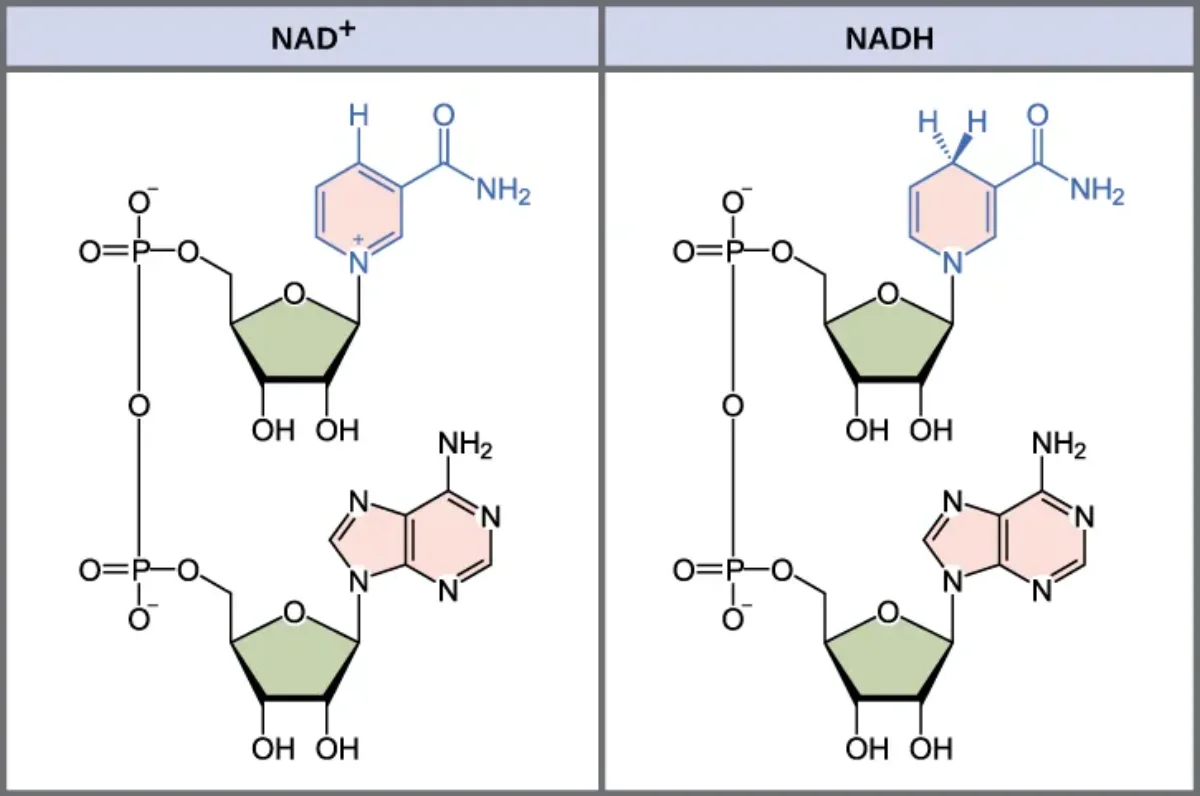
The structures of NAD+ (oxidized) and NADH (reduced). The nicotinamide ring accepts two electrons and one proton, converting the positively charged NAD+ into the neutral NADH. This single electron-carrying step is repeated dozens of times during the oxidation of one glucose molecule. Credit: OpenStax Biology 2e, CC BY 4.0
Why Two Different Carriers?
NAD+/NADH and FAD/FADH2 operate at different reduction potentials:
Carrier
E’ (V)
Electrons Delivered To
NADH
-0.32 V
Complex I (higher energy entry)
FADH2
-0.22 V
Complex II (lower energy entry)
NADH has a more negative reduction potential, meaning it carries higher-energy electrons. These electrons enter the ETC at Complex I and pass through more proton pumps, generating more ATP. FADH2’s electrons have slightly less energy and enter at Complex II, bypassing one proton pump, which is why FADH2 produces fewer ATP.
Redox in Other Metabolic Pathways
Pathway
Redox Event
Carrier Involved
Glycolysis
Glyceraldehyde-3-phosphate oxidized
NAD+ —> NADH
Krebs cycle
Multiple substrates oxidized
NAD+ —> NADH, FAD —> FADH2
Beta-oxidation
Fatty acyl-CoA oxidized
NAD+ —> NADH, FAD —> FADH2
Pentose phosphate pathway
Glucose-6-phosphate oxidized
NADP+ —> NADPH
Photosynthesis (light reactions)
H2O oxidized
NADP+ —> NADPH
Fermentation
Pyruvate or acetaldehyde reduced
NADH —> NAD+ (regenerated)
NADPH: The Biosynthetic Reducing Agent
NADPH (the phosphorylated version of NADH) is used for anabolic (building) reactions rather than energy production:
Fatty acid synthesis requires NADPH as the electron donor
Produced mainly by the pentose phosphate pathway
Also produced by the malic enzyme and isocitrate dehydrogenase (cytoplasmic)
Key distinction: NADH feeds into energy production (catabolic). NADPH feeds into biosynthesis (anabolic). They are chemically similar but functionally distinct.
In the reaction catalyzed by lactate dehydrogenase (pyruvate + NADH --> lactate + NAD+), which species is oxidized and which is reduced?
Click to reveal answer
NADH is oxidized (to NAD+), and pyruvate is reduced (to lactate). NADH donates its electrons, so it is the reducing agent and gets oxidized. Pyruvate accepts those electrons (the carbonyl is reduced to a hydroxyl), so pyruvate is the oxidizing agent and gets reduced. This reaction regenerates NAD+ for glycolysis during anaerobic conditions.
Why does NADH produce more ATP than FADH2 in the electron transport chain?
Click to reveal answer
NADH donates electrons to Complex I, while FADH2 donates to Complex II, bypassing the first proton pump. NADH's electrons have a more negative reduction potential (-0.32 V vs. -0.22 V for FADH2), so they carry more energy and pass through three proton-pumping complexes (I, III, IV). FADH2 skips Complex I and only passes through two (III, IV). Fewer protons pumped means less ATP from the proton gradient: approximately 2.5 ATP per NADH vs. 1.5 ATP per FADH2.
Combustion is the most dramatic redox reaction you encounter in everyday life. Strike a match, start a car engine, or light a Bunsen burner, and you are watching rapid oxidation by molecular oxygen. Combustion reactions are exothermic (they release energy as heat and light), and they are fundamentally the same electron-transfer process as rusting - just much faster.
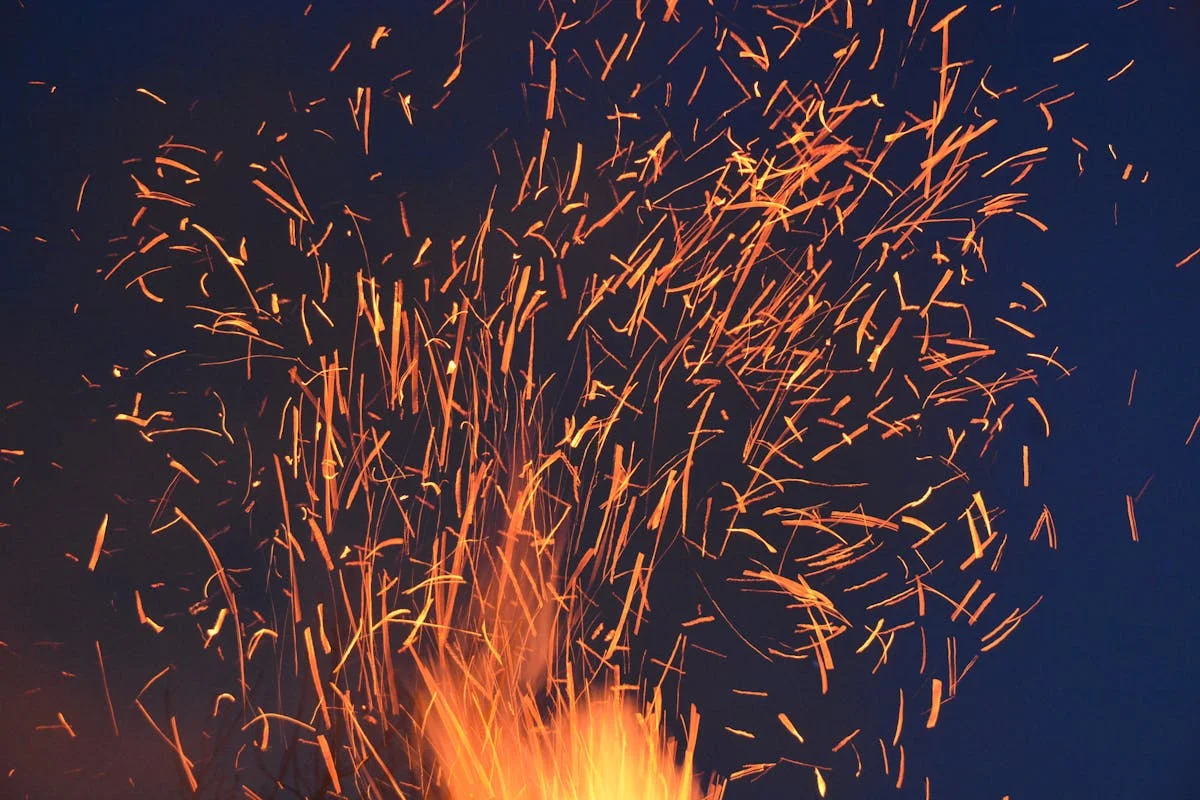
Combustion is the most visible redox reaction in everyday life - a rapid, exothermic oxidation of fuel by molecular oxygen, releasing energy as heat and light. Credit: Pexels, free to use
Complete Combustion of Hydrocarbons
When a hydrocarbon (CxHy) burns completely in excess oxygen:
CxHy + O2 —> CO2 + H2O (unbalanced)
Redox analysis:
Atom
Before
After
Change
C (in hydrocarbon)
Variable (often 0 or negative)
+4 (in CO2)
Oxidized
H (in hydrocarbon)
+1
+1 (in H2O)
No change in typical hydrocarbons
O (in O2)
0
-2 (in CO2 and H2O)
Reduced
Carbon is oxidized; oxygen is reduced. The hydrocarbon is the reducing agent (fuel). Oxygen is the oxidizing agent.
Balanced Example: Methane Combustion
CH4 + 2O2 —> CO2 + 2H2O
Carbon goes from -4 (in CH4) to +4 (in CO2): oxidized, losing 8 electrons per carbon
Oxygen goes from 0 (in O2) to -2 (in CO2 and H2O): reduced, gaining 2 electrons per oxygen
Total electrons: C loses 8, and 4 O atoms each gain 2 = 8 total. Balanced.
This reaction releases 890 kJ/mol - the energy that heats your stove.
Incomplete Combustion
When oxygen supply is limited, combustion is incomplete:
2CH4 + 3O2 —> 2CO + 4H2O (limited O2)
Carbon is only partially oxidized to +2 (in CO) instead of +4 (in CO2). Carbon monoxide (CO) is the dangerous product of incomplete combustion - it binds to hemoglobin with 200 times greater affinity than O2, blocking oxygen transport.
Combustion Type
Products
Carbon Oxidation State
Energy Released
Complete
CO2 + H2O
+4 (fully oxidized)
Maximum
Incomplete
CO + H2O
+2 (partially oxidized)
Less than maximum
Very incomplete
C (soot) + H2O
0 (barely oxidized)
Much less
Combustion of Other Organic Molecules
Combustion is not limited to hydrocarbons. Any organic molecule (alcohols, sugars, fats) can undergo combustion:
Ethanol: C2H5OH + 3O2 —> 2CO2 + 3H2O
Glucose: C6H12O6 + 6O2 —> 6CO2 + 6H2O
Notice that the glucose combustion equation is identical to the overall equation for aerobic cellular respiration. The products and total energy released are the same. The difference is that combustion releases all the energy at once as heat, while cellular respiration releases it in controlled steps, capturing much of it as ATP.
Combustion Analysis: Working Backwards
In combustion analysis, you burn a sample of unknown composition and measure the masses of CO2 and H2O produced:
All carbon in the sample ends up as CO2
All hydrogen in the sample ends up as H2O
Any remaining mass is oxygen (or another element, if specified)
To find the empirical formula:
grams CO2 —> moles CO2 —> moles C
grams H2O —> moles H2O —> moles H (multiply by 2, since each H2O has 2 H)
Remaining mass = moles O
Find the simplest whole-number ratio
This technique connects combustion (redox) to stoichiometry - a cross-topic link the MCAT loves.
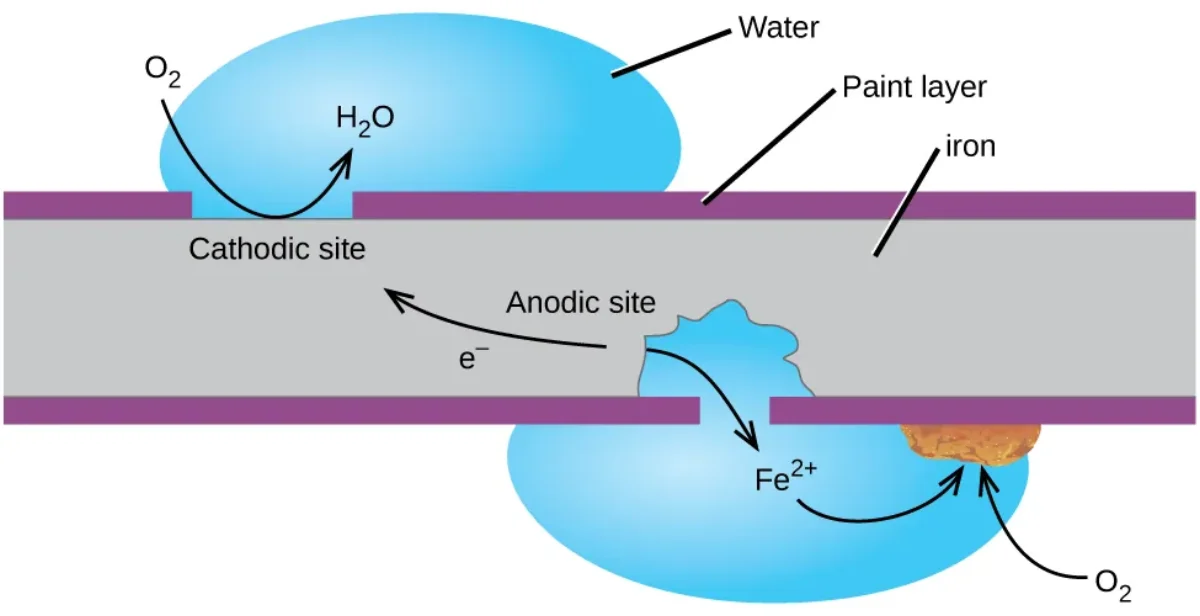
Iron corrosion (rusting) is slow-motion combustion - the same fundamental redox process as burning, just at a much slower rate. Anodic regions lose electrons (Fe is oxidized to Fe2+), while cathodic regions gain electrons (O2 is reduced). Both processes are oxidation by oxygen. Credit: OpenStax Chemistry 2e, CC BY 4.0
Summary: Why Combustion Is Redox
Feature
Combustion Detail
Oxidizing agent
O2 (reduced from 0 to -2)
Reducing agent
Fuel (carbon oxidized, typically from low state to +4)
Energy
Highly exothermic (large negative delta-H)
Spontaneity
Spontaneous but requires activation energy (spark/flame)
Biological parallel
Cellular respiration = controlled combustion of glucose
Why is carbon monoxide (CO) dangerous, and how does incomplete combustion produce it?
Click to reveal answer
CO is produced when there is insufficient O2 for complete combustion, leaving carbon only partially oxidized (at +2 instead of +4). CO is dangerous because it binds to hemoglobin at the same site as O2 but with approximately 200 times greater affinity. Once CO occupies the binding site, O2 cannot displace it, effectively blocking oxygen transport. Additionally, CO binding shifts the O2-hemoglobin dissociation curve to the left (increased affinity), making the remaining bound O2 harder to release to tissues.
The combustion of glucose and cellular respiration have the same overall equation: C6H12O6 + 6O2 --> 6CO2 + 6H2O. If the products are the same, why do cells use the multi-step pathway instead of direct combustion?
Click to reveal answer
Cells use a multi-step pathway to capture energy gradually as ATP, rather than releasing it all at once as heat. Direct combustion would release 2870 kJ/mol as heat, which would denature proteins and kill the cell. By breaking glucose oxidation into many small steps (glycolysis, Krebs cycle, ETC), cells capture approximately 30-32 ATP per glucose. Each step releases a manageable amount of energy. The total delta-H is the same (state function), but the pathway determines how much energy is captured as useful work versus wasted as heat.