
Half-Reactions
A half-reaction shows just one side of a redox process - either the oxidation or the reduction, but not both. You have already used half-reactions to balance redox equations. Now let’s understand them more deeply, because half-reactions are the language of electrochemistry (Chapter 12) and the foundation for standard reduction potentials.
Writing Half-Reactions
Every redox reaction can be split into two half-reactions:
Oxidation half-reaction: Shows the species losing electrons. Electrons appear on the product side (right).
Zn(s) —> Zn2+(aq) + 2e-
Reduction half-reaction: Shows the species gaining electrons. Electrons appear on the reactant side (left).
Cu2+(aq) + 2e- —> Cu(s)
The overall reaction is the sum of the two halves, with electrons canceling:
Zn(s) + Cu2+(aq) —> Zn2+(aq) + Cu(s)
Spectator Ions
When you split a reaction into half-reactions, spectator ions disappear. They do not participate in the electron transfer and are not included in either half-reaction.
Full molecular equation: Zn(s) + CuSO4(aq) —> ZnSO4(aq) + Cu(s)
Net ionic equation: Zn(s) + Cu2+(aq) —> Zn2+(aq) + Cu(s)
Spectator ion: SO4^2- (sulfate appears on both sides, unchanged)
The sulfate ion watches the electron transfer without participating - just like a spectator at a game.
The Standard Reduction Potential Table
Every half-reaction has a measurable tendency to occur, quantified as the standard reduction potential (E). The table lists half-reactions as reductions by convention.
| Half-reaction (as written: reduction) | E (V) |
|---|---|
| F2 + 2e- —> 2F- | +2.87 |
| Au3+ + 3e- —> Au | +1.50 |
| Ag+ + e- —> Ag | +0.80 |
| Cu2+ + 2e- —> Cu | +0.34 |
| 2H+ + 2e- —> H2 | 0.00 (reference) |
| Ni2+ + 2e- —> Ni | -0.26 |
| Fe2+ + 2e- —> Fe | -0.45 |
| Zn2+ + 2e- —> Zn | -0.76 |
| Al3+ + 3e- —> Al | -1.66 |
| Mg2+ + 2e- —> Mg | -2.37 |
| Na+ + e- —> Na | -2.71 |
| Li+ + e- —> Li | -3.04 |
Key rules for using this table:
- A more positive E means a stronger tendency to be reduced (stronger oxidizing agent)
- A more negative E means a stronger tendency to be oxidized (stronger reducing agent)
- The hydrogen electrode (2H+ + 2e- —> H2) is defined as exactly 0.00 V - it is the reference point
- To get the oxidation potential, flip the sign: if Cu2+ + 2e- —> Cu has E = +0.34 V, then Cu —> Cu2+ + 2e- has E = -0.34 V
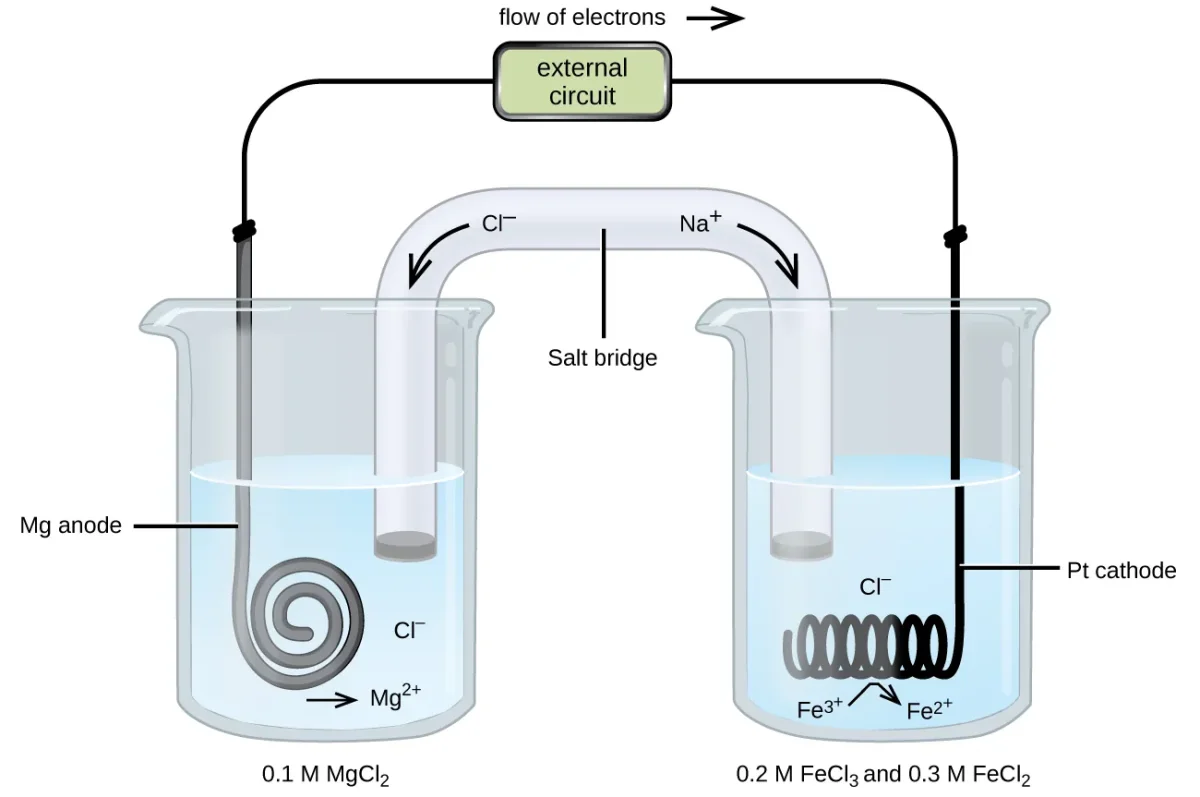
Predicting Spontaneity from Half-Reactions
A redox reaction is spontaneous when the species with the higher (more positive) reduction potential is actually being reduced, and the species with the lower (more negative) reduction potential is being oxidized.
Rule: If E(cell) = E(cathode) - E(anode) > 0, the reaction is spontaneous.
This will be covered in full detail in Chapter 12 (Electrochemistry), but the foundation is here: the reduction potential table tells you which direction electrons naturally want to flow.