
Common Oxidizing Agents
An oxidizing agent causes another substance to be oxidized by accepting electrons from it. Strong oxidizing agents are electron-hungry species - they pull electrons away from other molecules aggressively. Knowing the common oxidizing agents and their visual signatures helps you quickly identify redox reactions in MCAT passages.
The Big List of Common Oxidizing Agents
| Oxidizing Agent | Formula | Oxidation State of Key Atom | Reduced Product | Visual Cue |
|---|---|---|---|---|
| Permanganate ion | MnO4- | Mn = +7 | Mn2+ (acidic) or MnO2 (neutral/basic) | Deep purple —> colorless (acidic) or brown solid (basic) |
| Dichromate ion | Cr2O7^2- | Cr = +6 | Cr3+ | Orange —> green |
| Fluorine | F2 | F = 0 | F- | Strongest elemental oxidizing agent |
| Chlorine | Cl2 | Cl = 0 | Cl- | Pale yellow-green gas |
| Bromine | Br2 | Br = 0 | Br- | Reddish-brown liquid |
| Hydrogen peroxide | H2O2 | O = -1 | H2O | Can also act as a reducing agent |
| Concentrated nitric acid | HNO3 | N = +5 | NO2 or NO | Brown gas (NO2) evolved |
| Concentrated sulfuric acid | H2SO4 (hot, concentrated) | S = +6 | SO2 | Pungent gas |
| Oxygen | O2 | O = 0 | O2- or OH- | Universal oxidizing agent in combustion |
Permanganate (MnO4-)
Potassium permanganate (KMnO4) is one of the most commonly tested oxidizing agents on the MCAT:
- In acidic solution: MnO4- is reduced to Mn2+ (colorless). The deep purple color disappears.
- In neutral or basic solution: MnO4- is reduced to MnO2 (brown solid precipitate).
- Why it is strong: Mn is at +7, its maximum oxidation state. It has a powerful drive to gain electrons and drop to a lower oxidation state.
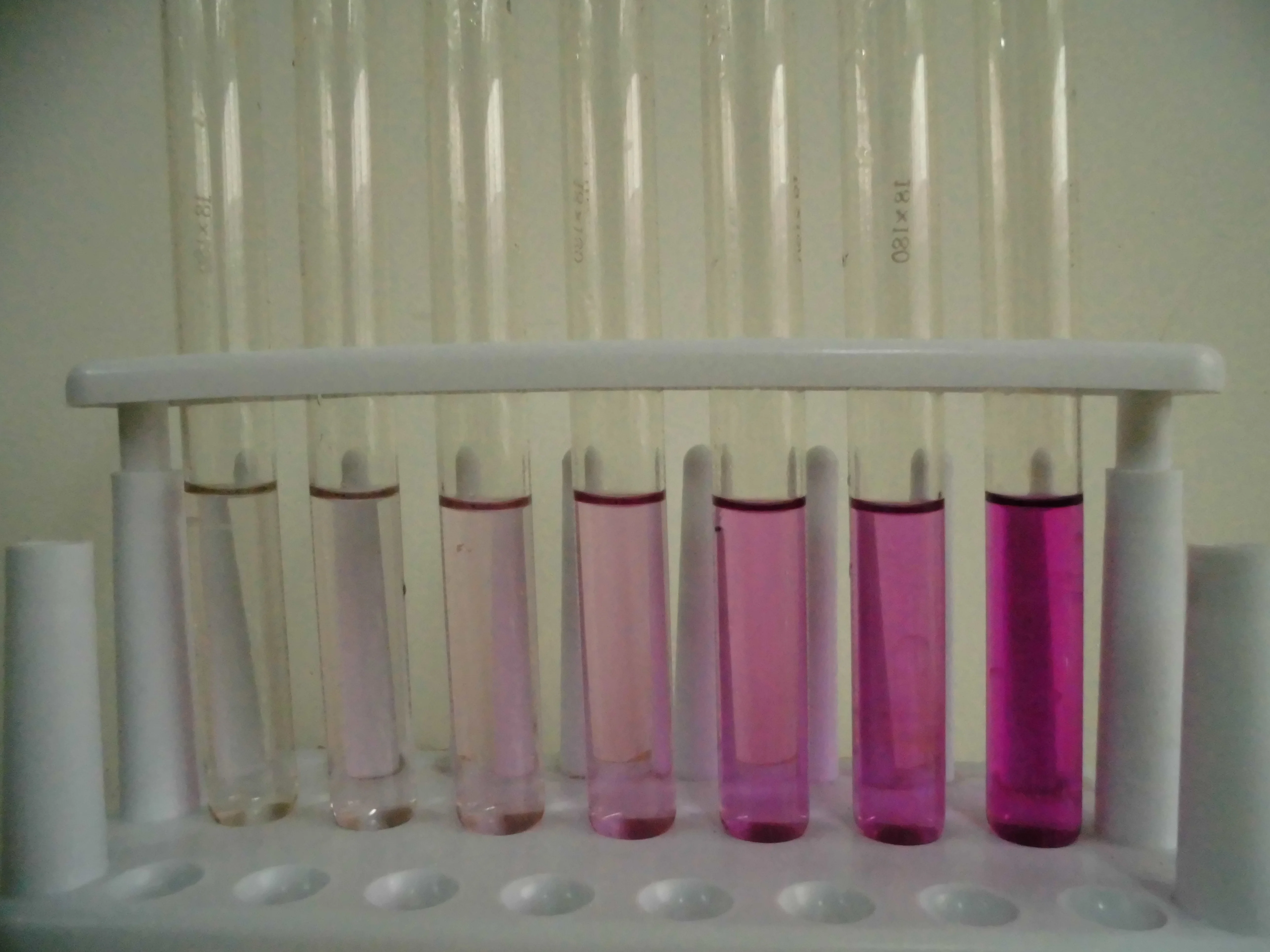
MCAT passages about redox titrations frequently use KMnO4 as the titrant because it acts as its own indicator - the endpoint is marked by the first permanent appearance of purple color (when all the reducing agent has been consumed and the next drop of MnO4- has nothing left to oxidize).
Dichromate (Cr2O7^2-)
Potassium dichromate (K2Cr2O7) is another classic oxidizing agent:
- In acidic solution: Cr2O7^2- is reduced to Cr3+. The color changes from orange to green.
- Why it is strong: Cr is at +6, a very high oxidation state.
Halogens as Oxidizing Agents
The halogens (F2, Cl2, Br2, I2) are all oxidizing agents, with strength decreasing down the group:
F2 > Cl2 > Br2 > I2
This trend follows electronegativity: fluorine is the most electronegative element, so F2 is the strongest oxidizing agent. A higher halogen can oxidize a lower halide:
Cl2(aq) + 2Br-(aq) —> 2Cl-(aq) + Br2(aq)
Chlorine oxidizes bromide because Cl2 is a stronger oxidizing agent than Br2. But the reverse (Br2 oxidizing Cl-) does not occur.
Hydrogen Peroxide: A Special Case
H2O2 can act as either an oxidizing agent or a reducing agent depending on the reaction partner:
- As oxidizing agent: H2O2 + 2e- —> 2OH- (oxygen goes from -1 to -2)
- As reducing agent: H2O2 —> O2 + 2H+ + 2e- (oxygen goes from -1 to 0)
When paired with a stronger oxidizing agent (like MnO4-), H2O2 acts as a reducing agent. When paired with a weaker species (like Fe2+), it acts as an oxidizing agent. The oxygen in H2O2 is at -1, an intermediate state, so it can go in either direction.