
Recognizing Oxidation and Reduction
Now that you can assign oxidation states, identifying redox reactions is straightforward: compare oxidation states before and after the reaction. If any atom’s oxidation state changed, it is a redox reaction. If no oxidation states changed, it is not.
How to Spot a Redox Reaction
Step 1. Assign oxidation states to every atom on both sides of the equation.
Step 2. Compare. Any atom whose oxidation state increased was oxidized (lost electrons). Any atom whose oxidation state decreased was reduced (gained electrons).
Step 3. If at least one atom was oxidized and at least one was reduced, it is a redox reaction.
Worked Example: Is This a Redox Reaction?
Reaction: 2Na + Cl2 —> 2NaCl
| Atom | Before | After | Change |
|---|---|---|---|
| Na | 0 (free element) | +1 (in NaCl) | Increased by 1 —> oxidized |
| Cl | 0 (free element) | -1 (in NaCl) | Decreased by 1 —> reduced |
Yes - this is a redox reaction. Sodium lost one electron per atom (oxidized). Chlorine gained one electron per atom (reduced).
Worked Example: Not a Redox Reaction
Reaction: NaOH + HCl —> NaCl + H2O
| Atom | Before | After | Change |
|---|---|---|---|
| Na | +1 | +1 | No change |
| O | -2 | -2 | No change |
| H | +1 | +1 | No change |
| Cl | -1 | -1 | No change |
No atom changed oxidation state. This is an acid-base neutralization, not a redox reaction.
Key Patterns That Signal Redox
Not every MCAT question will give you time to assign all oxidation states. Here are fast shortcuts to recognize redox reactions:
| Pattern | Why It is Redox |
|---|---|
| A free element appears as a reactant or product | Free elements have oxidation state 0; if they become part of a compound, their state must change |
| A metal displaces another metal from solution | One metal is oxidized while the other is reduced |
| Combustion (substance + O2) | Carbon and hydrogen are oxidized; oxygen is reduced |
| A substance reacts with a strong oxidizing agent (KMnO4, K2Cr2O7, H2O2) | The oxidizing agent is reduced; the other substance is oxidized |
| Charge changes in ionic species | Fe2+ becoming Fe3+ is oxidation; Cu2+ becoming Cu is reduction |
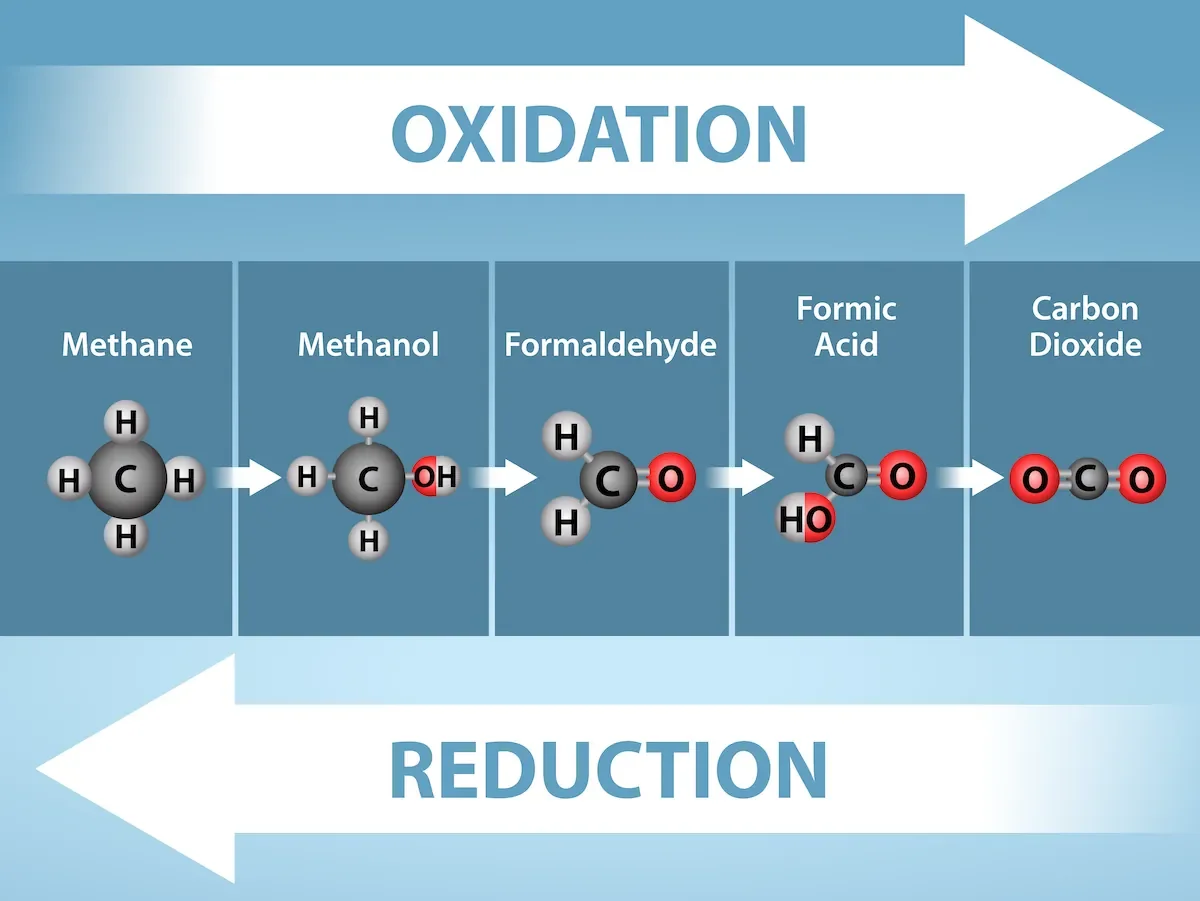
The Three Definitions of Oxidation and Reduction
The MCAT can present redox from three different angles:
| Definition | Oxidation | Reduction |
|---|---|---|
| Electron transfer | Loses electrons | Gains electrons |
| Oxidation state | Oxidation state increases | Oxidation state decreases |
| Oxygen/hydrogen (older definition) | Gains oxygen or loses hydrogen | Loses oxygen or gains hydrogen |
The electron transfer and oxidation state definitions are the ones you will use most. The oxygen/hydrogen definition is older but occasionally appears in MCAT passages about metabolic reactions, where “dehydrogenation” (loss of hydrogen) is described as oxidation.