
Redox in Biological Systems
Every concept you have learned about redox so far - oxidation states, electron transfer, oxidizing agents, reducing agents - plays out inside your cells every second. Cellular respiration is fundamentally a series of coupled redox reactions: glucose is oxidized to CO2, and oxygen is reduced to H2O. The energy released along the way is captured in ATP.
The biological twist is that cells do not transfer electrons directly from glucose to oxygen in one explosive step. Instead, they use electron carrier molecules - molecular “taxis” that pick up electrons from metabolic intermediates and deliver them to the electron transport chain.
NAD+/NADH: The Primary Electron Carrier
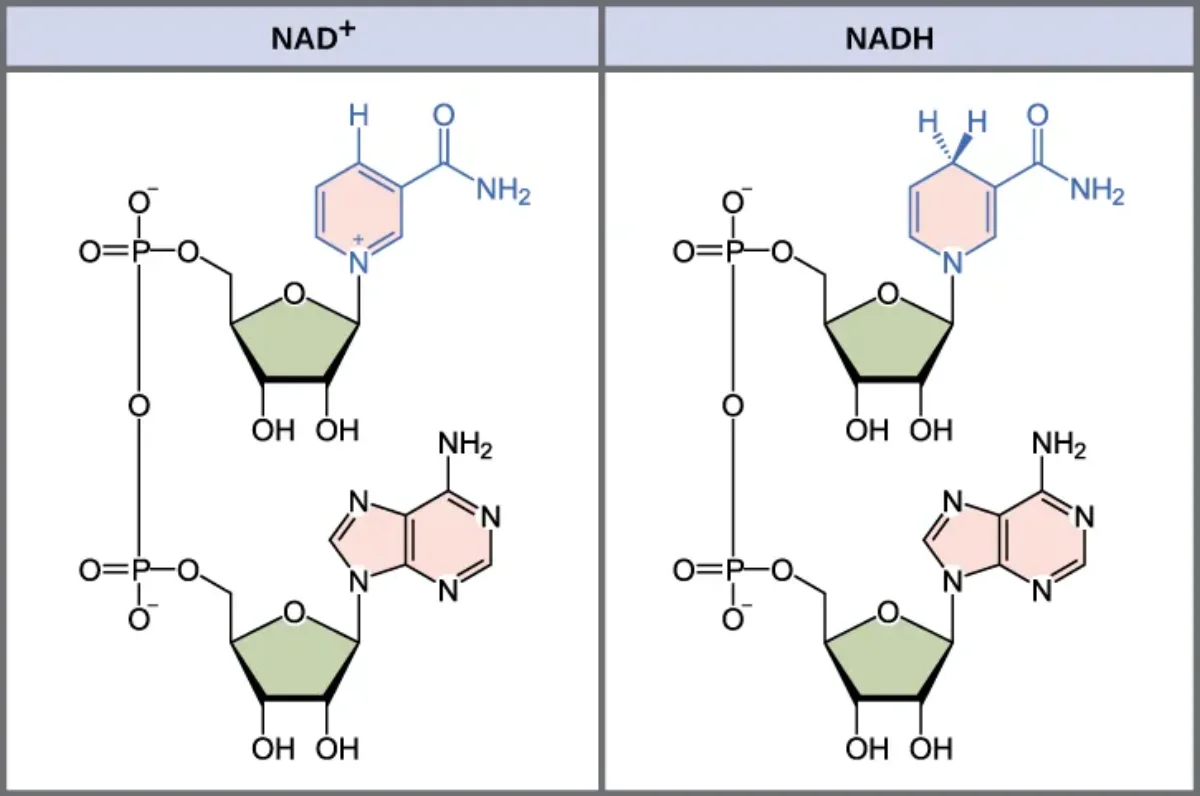
NAD+ (nicotinamide adenine dinucleotide) is the oxidized form. NADH is the reduced form.
The reaction:
NAD+ + 2e- + H+ —> NADH
- NAD+ accepts two electrons and one proton from a substrate
- The substrate is oxidized (loses electrons); NAD+ is reduced to NADH
- NAD+ is the oxidizing agent; the substrate is the reducing agent
Where NADH is produced:
- Glycolysis (cytoplasm): 2 NADH per glucose
- Pyruvate dehydrogenase (mitochondrial matrix): 2 NADH per glucose
- Krebs cycle (mitochondrial matrix): 6 NADH per glucose
Where NADH is consumed:
- Electron transport chain: NADH donates its electrons to Complex I, regenerating NAD+
- Each NADH contributes to the production of approximately 2.5 ATP (via oxidative phosphorylation)
FAD/FADH2: The Secondary Electron Carrier
FAD (flavin adenine dinucleotide) is the oxidized form. FADH2 is the reduced form.
The reaction:
FAD + 2e- + 2H+ —> FADH2
- FAD accepts two electrons and two protons
- FAD is reduced to FADH2
Where FADH2 is produced:
- Krebs cycle: succinate —> fumarate step (succinate dehydrogenase, which is also Complex II of the ETC)
- Beta-oxidation of fatty acids
Where FADH2 is consumed:
- Electron transport chain: FADH2 donates electrons to Complex II
- Each FADH2 contributes to approximately 1.5 ATP
Why Two Different Carriers?
NAD+/NADH and FAD/FADH2 operate at different reduction potentials:
| Carrier | E’ (V) | Electrons Delivered To |
|---|---|---|
| NADH | -0.32 V | Complex I (higher energy entry) |
| FADH2 | -0.22 V | Complex II (lower energy entry) |
NADH has a more negative reduction potential, meaning it carries higher-energy electrons. These electrons enter the ETC at Complex I and pass through more proton pumps, generating more ATP. FADH2’s electrons have slightly less energy and enter at Complex II, bypassing one proton pump, which is why FADH2 produces fewer ATP.
Redox in Other Metabolic Pathways
| Pathway | Redox Event | Carrier Involved |
|---|---|---|
| Glycolysis | Glyceraldehyde-3-phosphate oxidized | NAD+ —> NADH |
| Krebs cycle | Multiple substrates oxidized | NAD+ —> NADH, FAD —> FADH2 |
| Beta-oxidation | Fatty acyl-CoA oxidized | NAD+ —> NADH, FAD —> FADH2 |
| Pentose phosphate pathway | Glucose-6-phosphate oxidized | NADP+ —> NADPH |
| Photosynthesis (light reactions) | H2O oxidized | NADP+ —> NADPH |
| Fermentation | Pyruvate or acetaldehyde reduced | NADH —> NAD+ (regenerated) |
NADPH: The Biosynthetic Reducing Agent
NADPH (the phosphorylated version of NADH) is used for anabolic (building) reactions rather than energy production:
- Fatty acid synthesis requires NADPH as the electron donor
- Produced mainly by the pentose phosphate pathway
- Also produced by the malic enzyme and isocitrate dehydrogenase (cytoplasmic)
Key distinction: NADH feeds into energy production (catabolic). NADPH feeds into biosynthesis (anabolic). They are chemically similar but functionally distinct.