The activity series is a ranking of metals (and hydrogen) by how easily they are oxidized - that is, how readily they give up electrons. It is the practical version of the standard reduction potential table, and it lets you predict at a glance whether one metal can displace another from solution.
The Activity Series (Most Active to Least Active)
Metal
Reactivity
Reaction with Water/Acid
Li, K, Ba, Ca, Na
Most active
React vigorously with cold water
Mg, Al, Zn, Fe
Active
React with steam or dilute acids
Ni, Sn, Pb
Moderately active
React with acids (slowly)
H2
Reference line
— divides metals that dissolve in acid from those that do not —
Cu, Ag, Pt, Au
Least active (noble metals)
Do not react with most acids
The Displacement Rule
A metal higher on the activity series can displace a metal lower on the series from its salt solution. A metal lower on the series cannot displace a metal above it.
Will zinc displace copper from CuSO4?
Zn is above Cu in the activity series —> Yes. Zinc is more active (more willing to be oxidized).
Zn(s) + CuSO4(aq) —> ZnSO4(aq) + Cu(s)
Will copper displace zinc from ZnSO4?
Cu is below Zn in the activity series —> No. Copper is less active. This reaction does not occur spontaneously.
A displacement reaction in action: when a more active metal is placed in a solution containing ions of a less active metal, the more active metal dissolves while the less active metal deposits as a solid. Credit: OpenStax Chemistry 2e, CC BY 4.0
Hydrogen’s Position in the Activity Series
Hydrogen sits in the middle of the activity series. This has a practical consequence:
Metals above H2 (like Zn, Fe, Mg) dissolve in dilute acids like HCl or H2SO4, producing H2 gas:
Zn(s) + 2HCl(aq) —> ZnCl2(aq) + H2(g)
Metals below H2 (like Cu, Ag, Au) do NOT dissolve in most dilute acids. They are more “noble” than hydrogen - they refuse to be oxidized by H+.
Why Noble Metals Resist Corrosion
Copper, silver, platinum, and gold are called “noble metals” because they have positive reduction potentials. They would rather stay in their metallic form than be oxidized. This is why:
Gold jewelry does not tarnish
Platinum is used in electrodes (it will not react with the solution)
Copper pennies do not dissolve in water (though they do develop a green patina over decades from slow oxidation in air)
Practical Applications
Application
Activity Series Principle
Galvanized steel
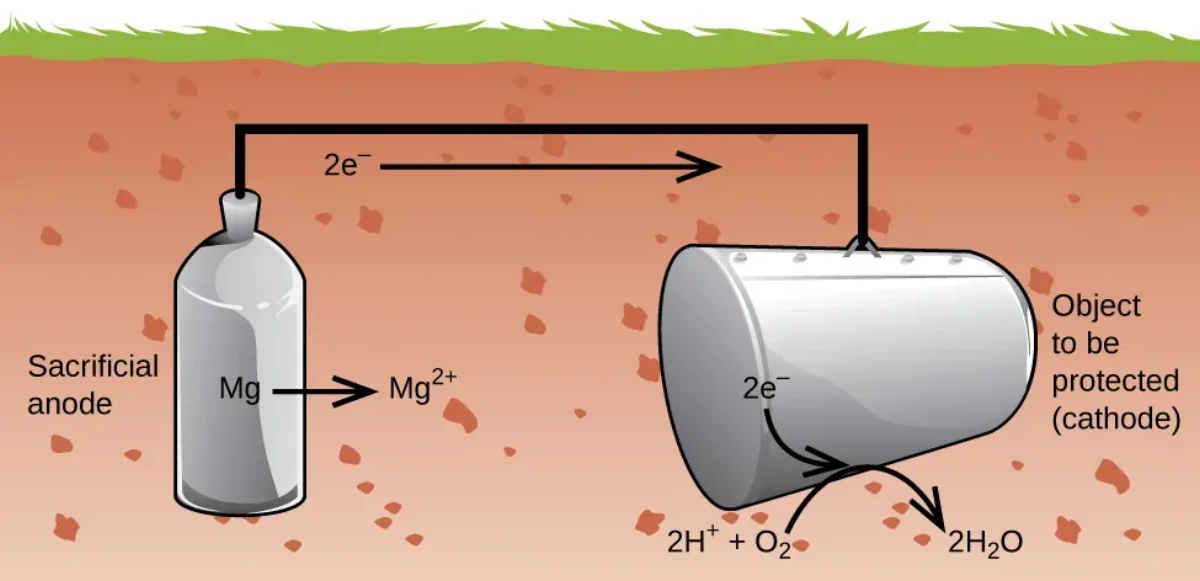
Zinc coating protects iron. Zn is more active than Fe, so Zn is oxidized first (sacrificial anode), protecting the iron underneath
Ship hull protection
Zinc blocks attached to steel hulls corrode preferentially, preventing the hull from rusting
Cathodic protection in action: a sacrificial magnesium anode (more active metal) is buried near a steel storage tank. Magnesium is oxidized preferentially, sending electrons to the steel and preventing it from corroding. When the magnesium is consumed, it is simply replaced. Credit: OpenStax Chemistry 2e, CC BY 4.0
| Thermite reaction | Al displaces Fe from Fe2O3 because Al is more active than Fe: 2Al + Fe2O3 --> Al2O3 + 2Fe |
| Extracting metals from ore | More active metals (like C/coke) reduce less active metal oxides in a furnace |
A student places a strip of iron metal into a solution of copper(II) sulfate. What will they observe, and why?
Click to reveal answer
Reddish-brown copper metal will deposit on the iron strip, and the solution will change from blue to pale green. Iron is above copper in the activity series, so Fe is oxidized to Fe2+ (green in solution) while Cu2+ is reduced to Cu metal (reddish solid). The blue color fades as Cu2+ is removed from solution. Reaction: Fe(s) + CuSO4(aq) --> FeSO4(aq) + Cu(s).
Will silver metal dissolve in dilute hydrochloric acid? Explain using the activity series.
Click to reveal answer
No. Silver (Ag) is below hydrogen in the activity series, meaning silver is less reactive than hydrogen. H+ ions in HCl are not strong enough oxidizing agents to oxidize Ag to Ag+. Only metals above hydrogen in the activity series (like Zn, Fe, Mg) dissolve in dilute HCl. Silver requires a stronger oxidizing acid like concentrated HNO3.