
Oxidation States
Before you can identify a redox reaction, you need a bookkeeping system that tracks electrons. That system is the oxidation state (also called the oxidation number). Think of it as a hypothetical charge each atom would carry if every bond in the molecule were completely ionic - all shared electrons assigned to the more electronegative atom.
Oxidation states are not real charges (except for monatomic ions). They are an accounting tool. But they are incredibly powerful: by comparing oxidation states before and after a reaction, you can instantly see which atoms lost electrons and which gained them.
The Rules (Apply in This Order)
The rules below are listed in priority order. When two rules conflict, the higher-priority rule wins.
| Priority | Rule | Example |
|---|---|---|
| 1 | Free elements = 0. Any atom in its elemental form has an oxidation state of zero. | Fe(s) = 0, O2 = 0, P4 = 0 |
| 2 | Monatomic ions = their charge. | Na+ = +1, Cl- = -1, Fe3+ = +3 |
| 3 | Fluorine = -1 always. Fluorine is the most electronegative element and always wins the electron tug-of-war. | In OF2, F = -1 (oxygen is forced to +2) |
| 4 | Oxygen = -2 (usually). Exception: -1 in peroxides (H2O2, Na2O2), - in superoxides (KO2), and +2 when bonded to fluorine. | In H2O, O = -2. In H2O2, O = -1 |
| 5 | Hydrogen = +1 (usually). Exception: -1 in metal hydrides (NaH, CaH2). | In HCl, H = +1. In NaH, H = -1 |
| 6 | Group 1 metals = +1 in compounds. | Na in NaCl = +1 |
| 7 | Group 2 metals = +2 in compounds. | Ca in CaCl2 = +2 |
| 8 | The sum of all oxidation states = the overall charge. For a neutral compound, the sum is zero. For a polyatomic ion, the sum equals the ion’s charge. | In SO4^2-, S + 4(-2) = -2, so S = +6 |
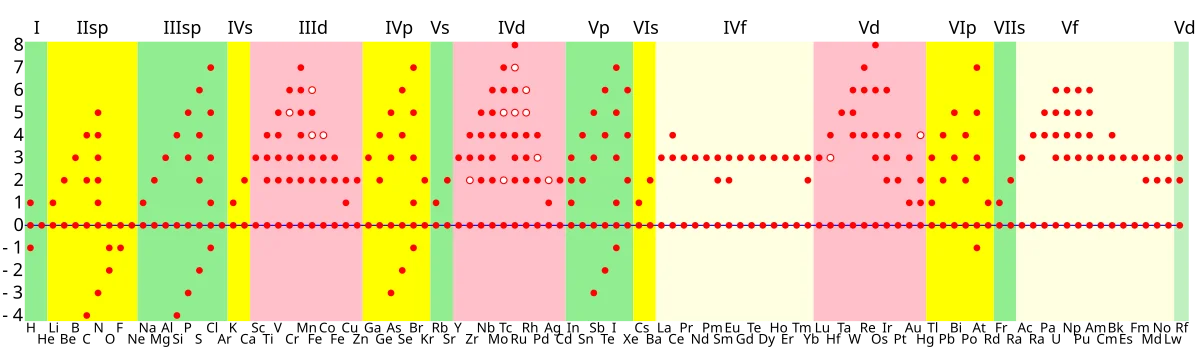
Worked Example: Finding the Oxidation State of Sulfur in K2SO4
Step 1. Start with atoms that have fixed oxidation states. Potassium is Group 1, so K = +1. Oxygen follows Rule 4, so O = -2.
Step 2. Use the sum rule (Rule 8). K2SO4 is a neutral compound, so the sum must equal zero:
2(+1) + S + 4(-2) = 0
Step 3. Solve for S:
+2 + S - 8 = 0 —> S = +6
Sulfur has an oxidation state of +6 in potassium sulfate.
Worked Example: Finding the Oxidation State of Nitrogen in NO3-
The nitrate ion has a charge of -1. Using the sum rule:
N + 3(-2) = -1
N - 6 = -1 —> N = +5
Common Pitfalls on the MCAT
Peroxides vs. regular oxides. If you see H2O2 or Na2O2, oxygen is -1, not -2. The MCAT loves to test this exception.
Metal hydrides. In NaH or CaH2, hydrogen is -1 because the metal is more electropositive. If you see H bonded to a Group 1 or Group 2 metal, flip hydrogen’s sign.
Transition metals. Transition metals have variable oxidation states. You cannot memorize them all - instead, use the other atoms in the compound to solve for the metal’s oxidation state algebraically.
Practice: Assign Oxidation States
Try these before flipping the flashcard:
| Compound | Find the oxidation state of… |
|---|---|
| MnO4- | Mn |
| Cr2O7^2- | Cr |
| H3PO4 | P |
| Na2O2 | O |