The terminology of redox agents confuses almost every student the first time they see it. The oxidizing agent is the substance that gets reduced. The reducing agent is the substance that gets oxidized. It sounds backwards until you realize the names describe what the substance does to the OTHER species, not what happens to itself.
Quick Reference
Term
What it DOES to others
What happens to IT
Electron role
Oxidizing agent
Oxidizes the other species
Gets reduced (gains electrons)
Electron acceptor
Reducing agent
Reduces the other species
Gets oxidized (loses electrons)
Electron donor
Identifying the Agents in a Reaction
Reaction: Zn(s) + Cu2+(aq) —> Zn2+(aq) + Cu(s)
Zinc goes from 0 to +2 (loses 2 electrons, is oxidized). Since zinc is oxidized, it is the reducing agent - it donates electrons to Cu2+.
Cu2+ goes from +2 to 0 (gains 2 electrons, is reduced). Since Cu2+ is reduced, it is the oxidizing agent - it accepts electrons from Zn.
Strength of Oxidizing and Reducing Agents
The strength of an oxidizing agent depends on how strongly it attracts electrons. The strength of a reducing agent depends on how easily it gives up electrons.
Strong oxidizing agents have a high tendency to gain electrons. They typically have:
High electronegativity (F2, O2, Cl2)
Metals in very high oxidation states (Mn in MnO4- is +7, Cr in Cr2O7^2- is +6)
Electron-poor species hungry for electrons
Strong reducing agents have a high tendency to lose electrons. They typically are:
Hydride donors (NaBH4, LiAlH4) that deliver H- with its extra electron
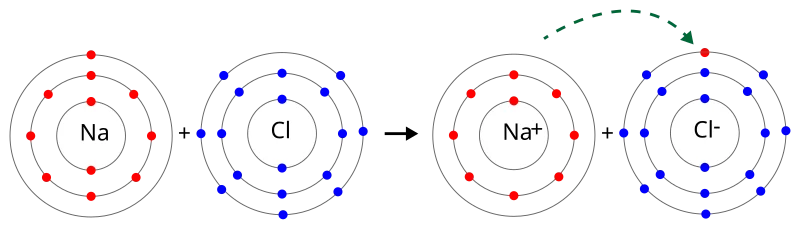
Electron transfer in NaCl formation. Sodium is the reducing agent (it loses an electron and is oxidized from 0 to +1), while chlorine is the oxidizing agent (it gains an electron and is reduced from 0 to −1). Remember: the reducing agent is oxidized, and the oxidizing agent is reduced. Credit: Wikimedia Commons, CC BY-SA 4.0
Conjugate Redox Pairs
Just as acids and bases form conjugate pairs, oxidizing and reducing agents form conjugate redox pairs. When a reducing agent loses electrons, it becomes an oxidizing agent (and vice versa).
Reducing agent
Loses electrons —>
Oxidizing agent
Zn
—> Zn2+ + 2e-
Zn2+
Fe
—> Fe2+ + 2e-
Fe2+
Na
—> Na+ + e-
Na+
A strong reducing agent (like Na) has a weak conjugate oxidizing agent (Na+ has little desire to regain its electron). A strong oxidizing agent (like F2) has a weak conjugate reducing agent (F- has little desire to give up its extra electron).
This mirrors the acid-base conjugate relationship: strong acid = weak conjugate base.
In the reaction 2Fe3+(aq) + Sn2+(aq) --> 2Fe2+(aq) + Sn4+(aq), identify the oxidizing agent and the reducing agent.
Click to reveal answer
Fe3+ is the oxidizing agent (it is reduced from +3 to +2, gaining electrons). Sn2+ is the reducing agent (it is oxidized from +2 to +4, losing electrons). Each Fe3+ gains one electron; Sn2+ loses two electrons total, which is why we need 2 Fe3+ ions.
Why is lithium metal one of the strongest reducing agents in chemistry?
Click to reveal answer
Lithium has an extremely low ionization energy and the most negative standard reduction potential (-3.04 V). It gives up its single valence electron more readily than any other metal. Once it loses that electron, Li+ has a noble gas configuration (like helium) and is very stable, so there is a strong thermodynamic driving force for lithium to be oxidized. This makes it the most powerful reducing agent on the standard reduction potential table.