Attitudes, Persuasion, and Cognitive Dissonance
An attitude is a learned tendency to evaluate a person, object, or idea in a certain way. Attitudes drive behavior sometimes. Behavior changes attitudes sometimes. This section untangles the three-way tangle between attitude, belief, and action, and covers the most-tested persuasion models.
The ABC Model of Attitude
Every attitude has three components:
- Affective - the feelings or emotions associated with the object. “I’m scared of spiders.”
- Behavioral - the tendency to act toward the object. “I run away whenever I see a spider.”
- Cognitive - the beliefs about the object. “Spiders are dangerous.”
A coherent attitude has all three aligned. Mismatch between the three creates psychological tension - the setup for cognitive dissonance.
Attitudes → Behavior
Theory of Planned Behavior (Ajzen)
Behavior is predicted by behavioral intention, which depends on three factors:
- Attitude toward the behavior. Do you like doing it?
- Subjective norms. Do others (family, peers) approve?
- Perceived behavioral control. Do you think you can do it?
All three must align for attitude to reliably predict behavior. A student with positive attitude toward studying might still not study if their peers think it’s uncool (subjective norm) or if they have too little time (perceived control).
Attitude-to-Behavior Process Model
An event triggers the attitude, which combines with background knowledge to drive behavior. Works best when the attitude is activated at the moment of decision and relevant to the choice.
Prototype Willingness Model
Behavior is a function of past behavior, attitudes, subjective norms, intentions, willingness, and models/prototypes (mental images of people who perform the behavior). Popular for health-risk behaviors in adolescents.
Behavior → Attitude
Attitudes don’t only drive behavior; behaviors reshape attitudes. Two classic techniques exploit this:
Foot-in-the-Door
Get someone to agree to a small request first. Later they’re much more likely to agree to a large request. The small “yes” subtly shifts their self-image (“I’m the kind of person who helps with surveys”). Commitments escalate.
Door-in-the-Face
Ask for something outrageously large, get refused, then ask for what you really wanted. The contrast makes the second request seem reasonable. Also taps into reciprocity (they seem to be compromising, so you feel social pressure to as well).
Role Playing (Zimbardo Prison Study)
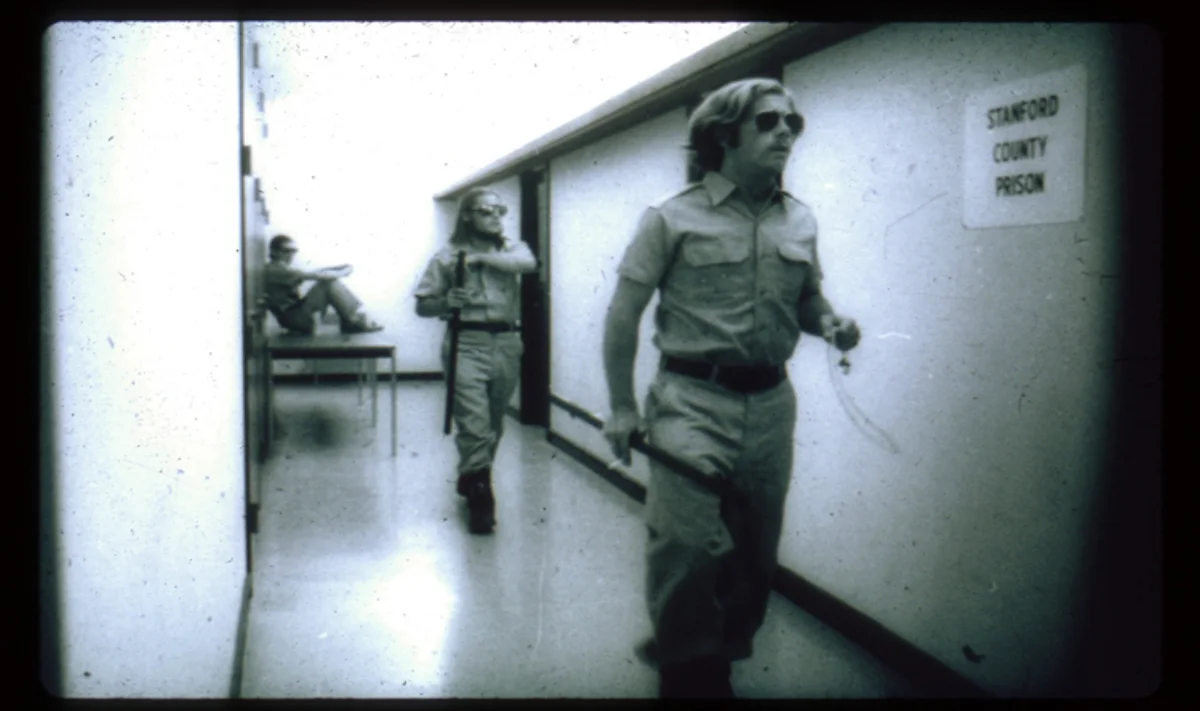
Adopting a new role changes your attitudes over time. Zimbardo’s Stanford Prison Experiment is the extreme case: college students randomly assigned to “guard” roles began behaving cruelly within days. We’ll return to this in Chapter 9.
Public Declaration and Justification of Effort
Publicly committing to a behavior (joining AA, announcing a diet) makes you more likely to follow through. Investing effort in a goal (grueling medical-school application) makes you value the outcome more - effort justification, a key consequence of cognitive dissonance.
Cognitive Dissonance Theory (Festinger)
Leon Festinger proposed that when we hold two conflicting cognitions (beliefs, attitudes, behaviors), we experience psychological discomfort and are motivated to reduce it.
Example. Cognition 1: “I smoke.” Cognition 2: “Smoking causes cancer.” The dissonance is uncomfortable. Four ways to reduce it:
- Change behavior. Quit smoking.
- Change cognition. “I’m not smoking that much.”
- Add new cognitions. “My grandmother smoked and lived to 90.”
- Reduce importance of the dissonance. “Everyone dies of something.”
Dissonance reduction is usually unconscious. Most smokers don’t quit - they rationalize. The same mechanism explains why you suddenly decide the expensive concert ticket was totally worth it right after buying it (post-purchase rationalization), and why cult members double down on their beliefs when predictions fail (Festinger’s original fieldwork on a doomsday cult).
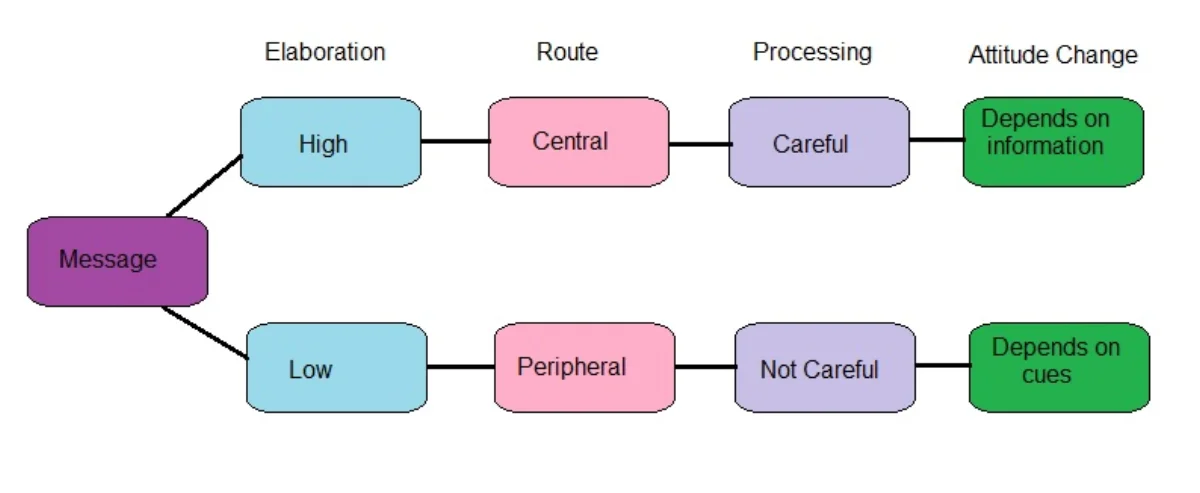
The Elaboration Likelihood Model of Persuasion (Petty and Cacioppo)
Persuasive messages influence us through two routes depending on how motivated and able we are to think about the message.
Central Route
Used when the audience is interested, motivated, and able to carefully evaluate the argument. Deep processing. Persuasion depends on the quality of the argument itself. Lasting attitude change results.
Peripheral Route
Used when the audience is unmotivated or distracted. Shallow processing. Persuasion depends on superficial cues - speaker attractiveness, number of arguments (not quality), confidence, expert badges. Temporary attitude change; audiences drift back when cues fade.
The model has three stages:
- Pre-processing filter. Target characteristics (mood, interest, motivation, intelligence) determine whether central or peripheral processing will occur.
- Processing. Central → deep. Peripheral → shallow.
- Attitude change. Central → lasting. Peripheral → temporary.